
How To Translate English to Chinese (Traditional)
Translating English to Chinese (Traditional) is super simple!
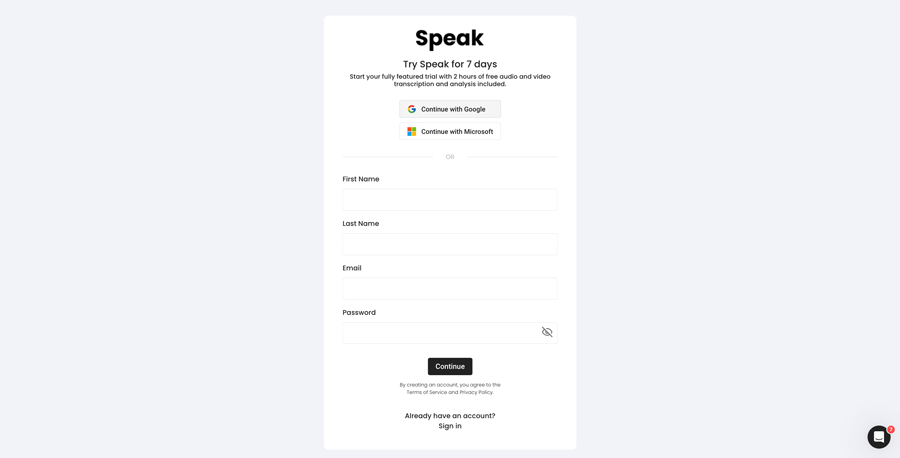
Étape 1 : S'inscrire à Speak
S'inscrire à Speak en utilisant ce lien.
Once you register, you can instantly begin translating your English to Chinese (Traditional) file(s).
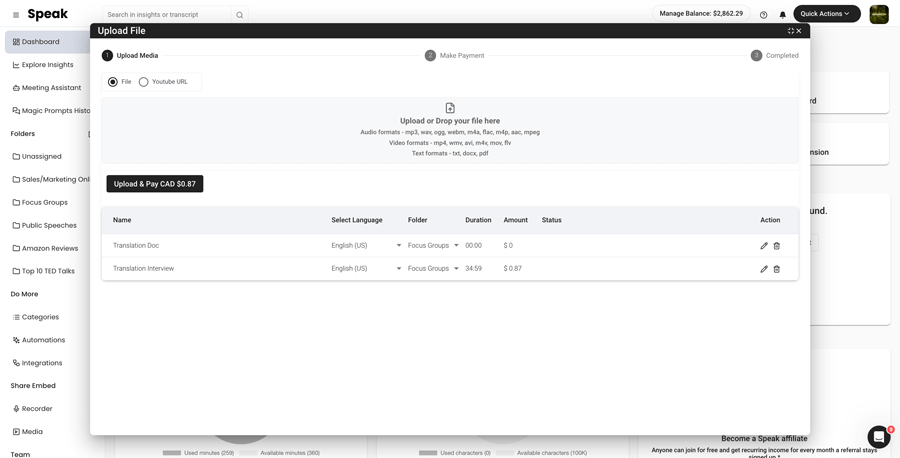
Étape 2 : Téléchargez votre (vos) fichier(s) en anglais
Dès que vous vous connectez, vous êtes redirigé vers le tableau de bord.
Une fois sur place, vous pouvez sélectionner l'action rapide "Nouveau téléchargement".
Dans Speak, vous pouvez télécharger, transcrire et traduire des fichiers audio, vidéo et texte en une seule fois ! Si vous avez une vidéo, vous pouvez utiliser notre Convertisseur vidéo-texte AI pour convertir la vidéo en texte ; si vous avez de l'audio, vous pouvez utiliser notre Convertisseur audio/texte AI pour convertir de l'audio en texte. Vous pouvez également transcrire des vidéos YouTube et utiliser l'IA pour analyser le texte.
Formats audio et vidéo pris en charge
- Convertir MP4 en texte
- Convertir M4A en texte
- Convertir un fichier MP3 en texte
- Convertir OGG en texte
- Convertir MPEG en texte
- Convertir WEBM en texte
- Convertir MOV en texte
- Convertir M4P en texte
- Convertir WMV en texte
- Convertir WAV en texte
- Convertir M4V en texte
- Audio Video to Text
- Convertir AVI en texte
- Convertir une vidéo en article
Langues de transcription prises en charge
- Comment transcrire l'afrikaans
- Comment transcrire l'arabe égyptien
- Comment transcrire l'arabe en Irak
- Comment transcrire l'arabe d'Israël
- Comment transcrire l'arabe jordanien
- Comment transcrire l'arabe au Koweït
- Comment transcrire l'arabe au Liban
- Comment transcrire l'arabe moderne standard Bahreïn
- Comment transcrire l'arabe moderne standard
- Comment transcrire l'arabe Oman
- Comment transcrire l'arabe Autorité palestinienne
- Comment transcrire l'arabe du Qatar
- Comment transcrire l'arabe en Arabie Saoudite
- Comment transcrire l'arabe République arabe syrienne
- Comment transcrire l'arabe E.A.U.
- Comment transcrire l'arménien
- Comment transcrire le bulgare
- Comment transcrire le catalan
- Comment transcrire le chinois cantonais traditionnel
- Comment transcrire le chinois simplifié
- Comment transcrire le croate
- Comment transcrire le tchèque
- Comment transcrire le danois
- Comment transcrire le néerlandais
- Comment transcrire l'anglais en Australie
- Comment transcrire l'anglais britannique
- Comment transcrire l'anglais indien
- Comment transcrire l'anglais irlandais
- Comment transcrire l'anglais en Nouvelle-Zélande
- Comment transcrire l'anglais écossais
- Comment transcrire l'anglais en Afrique du Sud
- Comment transcrire l'anglais Royaume-Uni
- Comment transcrire l'anglais États-Unis
- Comment transcrire l'estonien
- Comment transcrire le farsi
- Comment transcrire le finnois
- Comment transcrire le français au Canada
- Comment transcrire le suisse allemand
- Comment transcrire l'allemand
- Comment transcrire le grec
- Comment transcrire le gujarati
- Comment transcrire l'hébreu
- Comment transcrire l'hindi
- Comment transcrire le hongrois
- Comment transcrire l'islandais
- Comment transcrire l'indonésien
- Comment transcrire des entretiens
- Comment transcrire l'irlandais
- Comment transcrire l'italien
- Comment transcrire le japonais
- Comment transcrire en Kannada
- Comment transcrire le coréen
- Comment transcrire le letton
- Comment transcrire le lituanien
- Comment transcrire le malais
- Comment transcrire le malayalam
- Comment transcrire le norvégien
- Comment transcrire le persan
- Comment transcrire le polonais
- Comment transcrire le portugais brésilien
- Comment transcrire le portugais Portugal
- Comment transcrire le portugais
- Comment transcrire le roumain
- Comment transcrire le russe
- Comment transcrire le slovaque
- Comment transcrire le slovène
- Comment transcrire l'espagnol au Mexique
- Comment transcrire le suédois
- Comment transcrire le tamoul
- Comment transcrire le télougou
- Comment transcrire le thaïlandais
- Comment transcrire le turc
- Comment transcrire l'ukrainien
- Comment transcrire le vietnamien
- Transcrire le danois
- Transcrire l'anglais
- Transcrire le français
- Transcrire l'allemand
- Transcrire le portugais
- Transcrire l'espagnol
Nous disposons également d'un Assistant de réunion AI et Notetaker AI pour capturer automatiquement les réunions ainsi qu'un enregistreur vocal, enregistreur audio et vidéo intégrableet enregistreur d'écran.
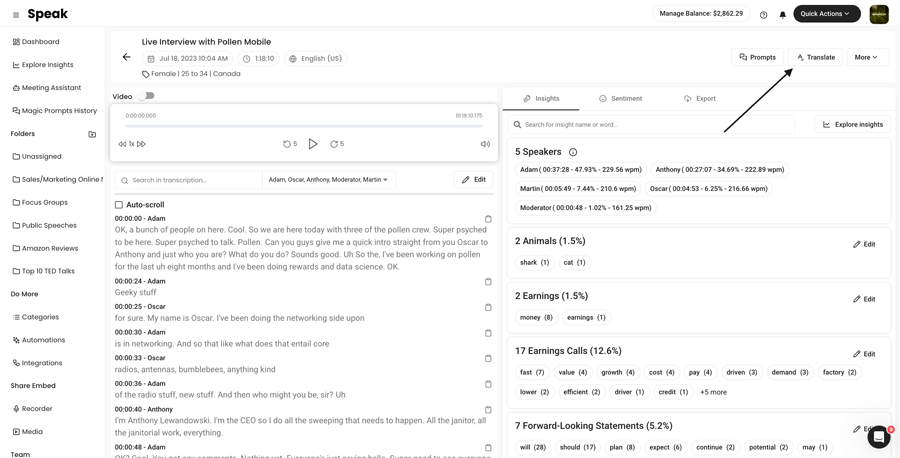
Step 3: Translate Your English file(s) to Chinese (Traditional)
Une fois le fichier téléchargé, il vous suffit d'accéder à votre fichier et de sélectionner "Traduire".
S'il s'agit d'un fichier audio et vidéo, Speak vous demandera si vous souhaitez conserver les noms des locuteurs et les horodatages dans la traduction.
Vous souhaitez traduire plusieurs fichiers à la fois ? Pas de problème !
You can view the files you want to automatically translate from English to Chinese (Traditional) from the folder level and instantly translate as many files as you need with our artificial intelligence translation in just a few clicks.
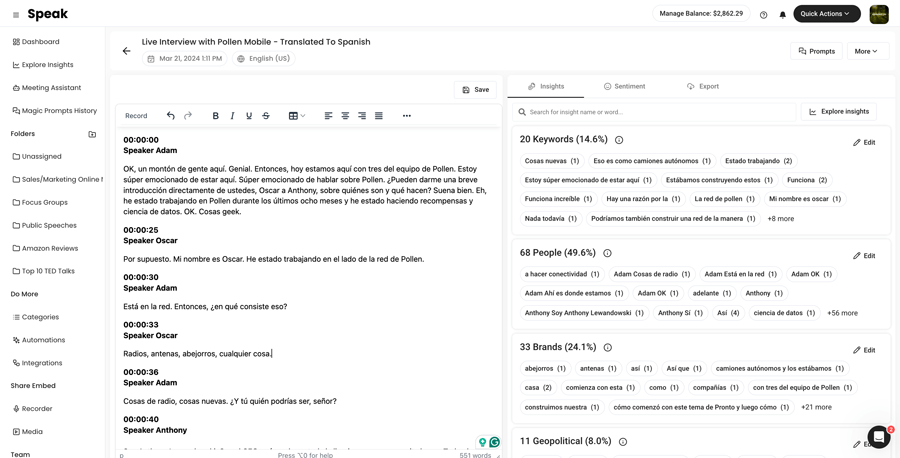
Step 4: That’s It! View, Analyze, Modify & Export Your New Chinese (Traditional) file(s)
Une fois la traduction effectuée, vous serez alerté et vous verrez un nouveau document dans le même dossier que le fichier original.
Le fichier portera le même nom, mais un tiret indiquera qu'il s'agit de la version traduite.
Besoin d'aide pour votre traduction en anglais ?
Nous sommes toujours là et heureux de vous aider à Speak !
Il vous suffit de nous envoyer un message sur le chat en direct dans le coin inférieur droit et nous nous assurerons que vous êtes prêt à réussir.
Vous souhaitez traduire l'anglais ou d'autres langues vers d'autres langues ? Consultez notre liste complète de traductions prises en charge langues ici.
Automatic, accurate, instant AI translation from English to Chinese (Traditional) is here for you.
S'inscrire à Speak en utilisant ce lien and begin translating English to Chinese (Traditional) today.
Unlocking Global Opportunities: Translate English to Chinese (Traditional)
In today’s fast-paced, digital-first world, the ability to communicate across languages and cultures is more than just a nice-to-have; it’s a necessity. For businesses and researchers looking to make their mark on the global stage, translating content from English to Chinese (Traditional) is a key step in bridging communication gaps and unlocking a world of opportunities.
Why Translate English to Chinese (Traditional)?
Chinese (Traditional) is not just another language; it’s a gateway to engaging with one of the largest markets and most dynamic cultures in the world. By translating content, whether it’s audio, video, or text, from English to Chinese (Traditional), you’re opening doors to millions of potential customers, collaborators, and audiences.
The Value of Automatic Translation
Automatic translation, powered by AI and NLP (Natural Language Processing), has revolutionized how we approach language barriers. Companies like Speak AI are at the forefront of this transformation, providing seamless, accurate, and efficient translation services that save time, reduce costs, and enhance communication.
Benefits for Researchers and Businesses
Translating content automatically can significantly benefit researchers and businesses in several ways:
- Global Reach: Broaden your audience or research impact by making your work accessible to Traditional Chinese speakers.
- Rentable : Automatic translation is a cost-efficient alternative to manual translation, reducing the need for expensive language services.
- Time-Saving: AI-driven translation drastically cuts down the time required to translate documents, allowing you to focus on your core activities.
- Accuracy and Context: Advanced NLP algorithms ensure translations are not only accurate but also contextually relevant.
Exploring the Global Landscape: English and Chinese (Traditional)
Where Are These Languages Popular?
English and Chinese (Traditional) are among the most spoken languages worldwide. English serves as a lingua franca in many parts of the globe, while Traditional Chinese is predominantly used in Taiwan, Hong Kong, and Macau. Impressively, these regions are not only cultural and economic hubs but also pivotal in international relations and global trade networks.
Interesting Statistics and History
The history of Traditional Chinese dates back thousands of years, making it one of the oldest written languages still in use today. Despite the adoption of Simplified Chinese in mainland China, Traditional Chinese has maintained its significance, with over 20 million people using it as their primary language.
Delving Into Languages: English vs. Chinese (Traditional)
Faits amusants
English and Chinese (Traditional) are fascinating in their uniqueness. For instance, Chinese is a tonal language, meaning the tone in which a word is spoken can change its meaning entirely. English, on the other hand, places a heavy emphasis on syntax and word order.
Différences et similitudes
While English and Chinese (Traditional) may seem worlds apart, they share common goals in communication and expression. Both languages have rich vocabularies and deep literary traditions that reflect the cultures they originated from. However, their writing systems, grammar rules, and phonetics are majorly different, offering unique challenges and rewards to learners and translators alike.
Speak AI: Your Partner in Breaking Language Barriers
At Speak AI, we understand the importance of accurate and nuanced translation. Our software integrates NLP, large language models, data visualization, and Generative AI to deliver top-quality English to Chinese (Traditional) translation. Whether you’re looking to automatically translate meetings, research papers, or global campaigns, we offer what you need with a 4.9 rating on G2 and a trusted user base of over 150K.
AI Meeting Assistant: A Game-Changer for Global Communication
Our AI Meeting Assistant is an innovative tool that joins meetings on platforms like Microsoft Teams, Zoom, Google Meet, and Webex. It automatically transcribes and analyzes conversations, offering real-time translation and insights. This tool is an invaluable asset for researchers and businesses aiming to excel in a multi-lingual, multi-cultural world.
The Path Forward
Translating English to Chinese (Traditional) is not just about converting words; it’s about connecting worlds. With the right tools and technologies, like those offered by Speak AI, businesses and researchers can overcome language barriers, embrace cultural diversity, and thrive in the global marketplace.
Embrace the future of communication. Explore how Speak AI can transform your approach to language and unlock the full potential of your global endeavors.
FAQ
What locations are English and Chinese (Traditional) popular?
English is a global lingua franca, while Traditional Chinese is primarily used in Taiwan, Hong Kong, and Macau. Both languages play crucial roles in international business, education, and diplomacy.
What are some fun facts about English and Chinese (Traditional)?
English’s syntax and word order drastically impact its meaning, whereas Chinese’s tone can change a word’s meaning. Both languages have evolved richly over centuries, reflecting their cultures and histories.
What are the differences and similarities between English and Chinese (Traditional)?
While vastly different in grammar, phonetics, and writing system, both languages serve the fundamental purpose of communication and expression, showcasing the diversity and unity of human language.
Traduire l'anglais vers ces autres langues prises en charge :
- Traduire de l'anglais vers l'arabe (Egypte)
- Traduire de l'anglais vers l'arabe (Irak)
- Traduire de l'anglais vers l'arabe (Israël)
- Traduire de l'anglais vers l'arabe (Jordanie)
- Traduire de l'anglais vers l'arabe (Koweït)
- Traduire de l'anglais vers l'arabe (Liban)
- Traduire de l'anglais vers l'arabe (Oman)
- Traduire de l'anglais vers l'arabe (Autorité palestinienne)
- Traduire de l'anglais vers l'arabe (Qatar)
- Traduire de l'anglais vers l'arabe (Arabie Saoudite)
- Traduire de l'anglais vers l'arabe (République arabe syrienne)
- Traduire de l'anglais vers l'arabe (Émirats arabes unis)
- Traduire de l'anglais vers l'arabe moderne standard (Bahreïn)
- Traduire de l'anglais vers l'arménien
- Traduire de l'anglais au bulgare
- Traduire de l'anglais au catalan
- Traduire de l'anglais au chinois (cantonais, traditionnel)
- Traduire de l'anglais au chinois (simplifié)
- Traduire de l'anglais au chinois (traditionnel)
- Traduire de l'anglais vers le croate
- Traduire de l'anglais vers le tchèque
- Traduire de l'anglais au danois
- Traduire de l'anglais au néerlandais
- Traduire de l'anglais à l'anglais
- Traduire de l'anglais à l'anglais (Australie)Traduire de l'anglais à l'anglais (Inde)
- Traduire de l'anglais à l'anglais (Irlande)
- Traduire de l'anglais à l'anglais (Nouvelle-Zélande)
- Traduire de l'anglais à l'anglais (écossais)
- Traduire de l'anglais à l'anglais (Afrique du Sud)
- Traduire de l'anglais vers l'anglais (Royaume-Uni)
- Traduire de l'anglais à l'anglais (États-Unis)
- Traduire de l'anglais vers l'estonien
- Traduire de l'anglais au farsi
- Traduire de l'anglais au finnois
- Traduire de l'anglais au français
- Traduire de l'anglais au français (Canada)
- Traduire de l'anglais vers l'allemand
- Traduire de l'anglais vers l'allemand (suisse)
- Traduire de l'anglais au grec
- Traduire de l'anglais au gujarati
- Traduire de l'anglais vers l'hébreu
- Traduire de l'anglais vers l'hindi
- Traduire de l'anglais vers le hongrois
- Traduire de l'anglais vers l'islandais
- Traduire de l'anglais vers l'indonésien
- Traduire de l'anglais vers l'irlandais
- Traduire de l'anglais à l'italien
- Traduire de l'anglais au japonais
- Traduire de l'anglais au kannada
- Traduire de l'anglais au coréen
- Traduire de l'anglais au letton
- Traduire de l'anglais au lituanien
- Traduire de l'anglais vers le malais
- Traduire de l'anglais au malayalam
- Traduire de l'anglais au norvégien
- Traduire de l'anglais vers le persan
- Traduire de l'anglais vers le polonais
- Traduire de l'anglais au portugais
- Traduire de l'anglais au portugais (brésilien)
- Traduire de l'anglais au portugais (Portugal)
- Traduire de l'anglais vers le roumain
- Traduire de l'anglais vers le russe
- Traduire de l'anglais au slovaque
- Traduire de l'anglais vers le slovène
- Traduire de l'anglais vers l'espagnol
- Traduire de l'anglais vers l'espagnol (Mexique)
- Traduire de l'anglais au suédois
- Traduire de l'anglais au tamoul
- Traduire de l'anglais au télougou
- Traduire de l'anglais vers la Thaïlande
- Traduire de l'anglais au turc
- Traduire de l'anglais vers l'ukrainien
- Traduire de l'anglais au vietnamien
Traduire & Transcrire avec Speak AI
Speak AI prend en charge la transcription et l’analyse en plus de 100 langues. Téléchargez votre audio ou vidéo et obtenez une transcription alimentée par IA, une aide à la traduction et des analyses NLP instantanées.
 English
 Español
 Français
 Italiano
 العربية
 Português do Brasil
 Nederlands
 Deutsch
 עִבְרִית
 Русский
 日本語
 Polski
 Čeština
 Українська
 Slovenščina
 Svenska
 Ελληνικά
 Norsk bokmål
 简体中文
 Türkçe
 Català
 Magyar
 한국어
 Slovenčina
 Suomi