
How To Translate English to Chinese (Traditional)
Translating English to Chinese (Traditional) is super simple!
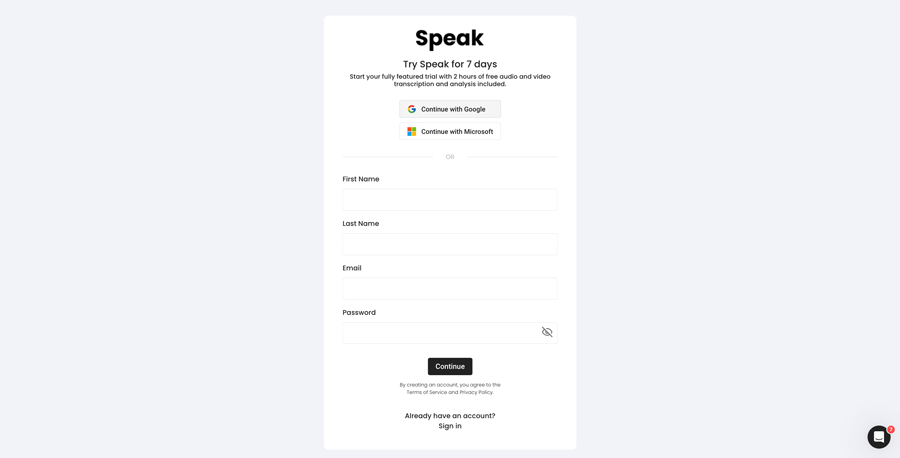
Schritt 1: Registrierung für Speak
Registrieren Sie sich für Speak mit dieser Link.
Once you register, you can instantly begin translating your English to Chinese (Traditional) file(s).
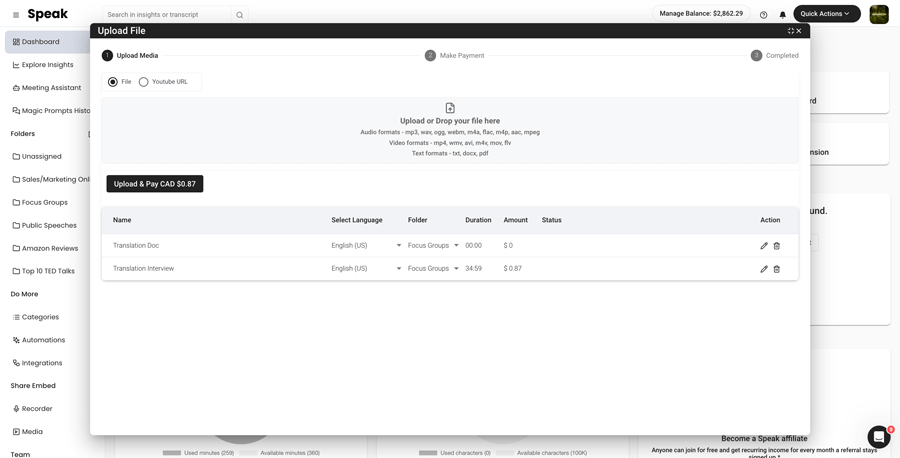
Schritt 2: Hochladen Ihrer englischen Datei(en)
Sobald Sie sich angemeldet haben, werden Sie zum Dashboard weitergeleitet.
Dort können Sie die Schnellaktion "Neuer Upload" auswählen.
Mit Speak können Sie Audio-, Video- und Textdateien gleichzeitig hochladen, transkribieren und übersetzen! Wenn Sie Videos haben, können Sie unsere AI Video-zu-Text-Konverter um Video in Text umzuwandeln; wenn Sie Audio haben, können Sie unser AI Audio-zu-Text-Konverter um Audio in Text umzuwandeln. Sie können auch YouTube-Videos umschreiben und KI zur Analyse von Text verwenden.
Unterstützte Audio- und Videoformate
- MP4 in Text umwandeln
- M4A in Text umwandeln
- MP3 in Text umwandeln
- OGG in Text umwandeln
- MPEG in Text umwandeln
- WEBM in Text umwandeln
- MOV in Text umwandeln
- M4P in Text umwandeln
- WMV in Text umwandeln
- WAV in Text umwandeln
- M4V in Text umwandeln
- Audio Video zu Text
- AVI in Text umwandeln
- Video in Artikel umwandeln
Unterstützte Transkriptionssprachen
- Wie man Afrikaans transkribiert
- Transkription Arabisch Ägypten
- Transkribieren von Arabisch Irak
- Transkription von Arabisch Israel
- Transkription von Arabisch Jordanien
- Transkribieren Arabisch Kuwait
- Transkription Arabisch Libanon
- Transkription von Arabisch Modern Standard Bahrain
- Wie man Arabisch Modern Standard transkribiert
- Transkribieren Arabisch Oman
- Transkribieren von Arabisch Palästinensische Autonomiebehörde
- Arabisch Katar transkribieren
- Transkribieren Arabisch Saudi-Arabien
- Transkribieren von Arabisch Arabische Republik Syrien
- Transkribieren von Arabisch U.A.E
- Wie man Armenisch transkribiert
- Wie man Bulgarisch transkribiert
- Wie man Katalanisch transkribiert
- Transkription von Chinesisch Kantonesisch Traditionell
- Transkription von Chinesisch (vereinfacht)
- Wie man Kroatisch transkribiert
- Wie man Tschechisch transkribiert
- Wie man Dänisch transkribiert
- Niederländisch transkribieren
- Transkribieren von Englisch Australien
- Wie transkribiert man Englisch Britisch
- Transkription von Englisch-Indisch
- Transkription von Englisch Irisch
- Transkribieren von Englisch in Neuseeland
- Wie transkribiert man Englisch-Schottisch?
- Transkribieren von Englisch Südafrikanisch
- Transkribieren von Englisch Vereinigtes Königreich
- Transkribieren Englisch Vereinigte Staaten
- Wie man Estnisch transkribiert
- Wie man Farsi transkribiert
- Wie man Finnisch transkribiert
- Transkription von Französisch Kanada
- Deutschschweizerisch transkribieren
- Wie man Deutsch transkribiert
- Wie man Griechisch transkribiert
- Wie man Gujarati transkribiert
- Wie man Hebräisch transkribiert
- Wie man Hindi transkribiert
- Wie man Ungarisch transkribiert
- Wie man Isländisch transkribiert
- Wie man Indonesisch transkribiert
- Wie man Interviews transkribiert
- Wie man Irisch transkribiert
- Wie man Italienisch transkribiert
- Wie man Japanisch transkribiert
- Wie man Kannada transkribiert
- Wie man Koreanisch transkribiert
- Wie man Lettisch transkribiert
- Wie man Litauisch transkribiert
- Wie man Malaiisch transkribiert
- Wie man Malayalam transkribiert
- Wie man Norwegisch transkribiert
- Wie man Persisch transkribiert
- Wie man Polnisch transkribiert
- Portugiesisch Brasilianisch transkribieren
- Wie man Portugiesisch transkribiert Portugal
- Wie man Portugiesisch transkribiert
- Wie man Rumänisch transkribiert
- Wie man Russisch transkribiert
- Wie man Slowakisch transkribiert
- Slowenisch transkribieren
- Transkription Spanisch Mexiko
- Wie man Schwedisch transkribiert
- Wie man Tamilisch transkribiert
- Wie man Telugu transkribiert
- Wie man Thai transkribiert
- Wie man Türkisch transkribiert
- Wie man Ukrainisch transkribiert
- Wie man Vietnamesisch transkribiert
- Transkribieren Dänisch
- Englisch transkribieren
- Französisch transkribieren
- Deutsch transkribieren
- Portugiesisch umschreiben
- Spanisch umschreiben
Wir haben auch eine AI Meeting Assistant und AI Notetaker zur automatischen Erfassung von Besprechungen sowie einer Sprachaufzeichnungsgerät, einbettbarer Audio- und Videorekorderund Bildschirmschreiber.
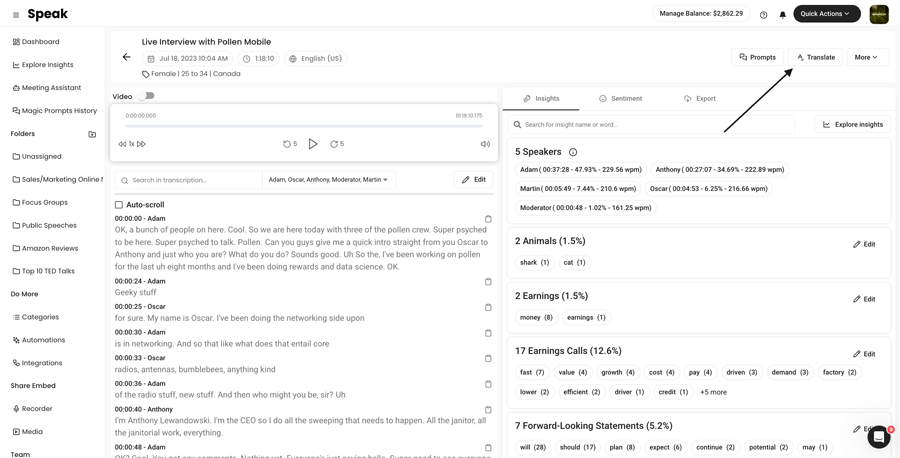
Step 3: Translate Your English file(s) to Chinese (Traditional)
Sobald die Datei hochgeladen ist, rufen Sie sie einfach auf und wählen "Übersetzen".
Wenn es sich um eine Audio- und Videodatei handelt, fragt Speak Sie, ob Sie die Namen der Sprecher und die Zeitstempel in der Übersetzung beibehalten möchten.
Sie möchten viele Dateien auf einmal übersetzen? Kein Problem!
You can view the files you want to automatically translate from English to Chinese (Traditional) from the folder level and instantly translate as many files as you need with our artificial intelligence translation in just a few clicks.
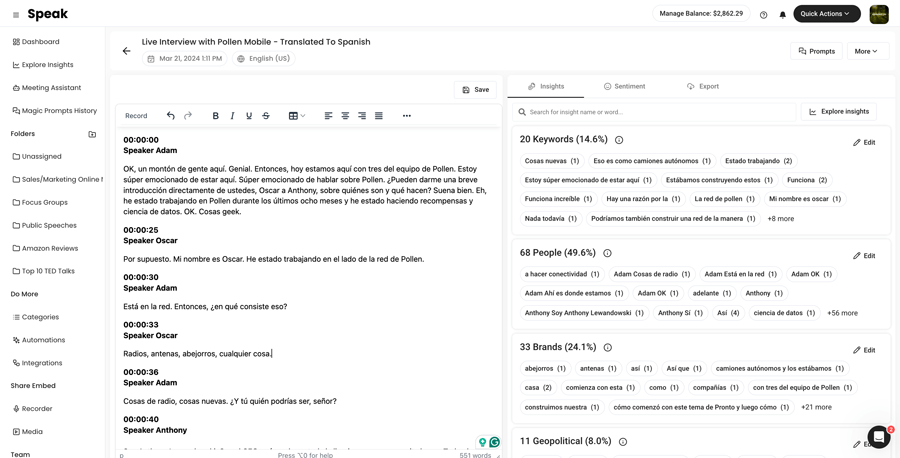
Step 4: That’s It! View, Analyze, Modify & Export Your New Chinese (Traditional) file(s)
Sobald die Übersetzung abgeschlossen ist, werden Sie benachrichtigt und sehen ein neues Dokument in demselben Ordner, in dem sich Ihre Originaldatei befindet.
Die Datei erhält den gleichen Namen, jedoch mit einem Bindestrich, der anzeigt, dass es sich um die übersetzte Version handelt.
Benötigen Sie Unterstützung bei Ihrer englischen Übersetzung?
Wir sind immer für Sie da und helfen Ihnen gerne bei Speak!
Senden Sie uns einfach eine Nachricht im Live-Chat unten rechts, und wir sorgen dafür, dass Sie erfolgreich sind.
Sind Sie daran interessiert, Englisch oder andere Sprachen in andere Sprachen zu übersetzen? Sehen Sie sich unsere gesamte Liste der unterstützten Übersetzungen an Sprachen hier.
Automatic, accurate, instant AI translation from English to Chinese (Traditional) is here for you.
Registrieren Sie sich für Speak mit dieser Link and begin translating English to Chinese (Traditional) today.
Unlocking Global Opportunities: Translate English to Chinese (Traditional)
In today’s fast-paced, digital-first world, the ability to communicate across languages and cultures is more than just a nice-to-have; it’s a necessity. For businesses and researchers looking to make their mark on the global stage, translating content from English to Chinese (Traditional) is a key step in bridging communication gaps and unlocking a world of opportunities.
Why Translate English to Chinese (Traditional)?
Chinese (Traditional) is not just another language; it’s a gateway to engaging with one of the largest markets and most dynamic cultures in the world. By translating content, whether it’s audio, video, or text, from English to Chinese (Traditional), you’re opening doors to millions of potential customers, collaborators, and audiences.
The Value of Automatic Translation
Automatic translation, powered by AI and NLP (Natural Language Processing), has revolutionized how we approach language barriers. Companies like Speak AI are at the forefront of this transformation, providing seamless, accurate, and efficient translation services that save time, reduce costs, and enhance communication.
Benefits for Researchers and Businesses
Translating content automatically can significantly benefit researchers and businesses in several ways:
- Global Reach: Broaden your audience or research impact by making your work accessible to Traditional Chinese speakers.
- Kostengünstig: Automatic translation is a cost-efficient alternative to manual translation, reducing the need for expensive language services.
- Time-Saving: AI-driven translation drastically cuts down the time required to translate documents, allowing you to focus on your core activities.
- Accuracy and Context: Advanced NLP algorithms ensure translations are not only accurate but also contextually relevant.
Exploring the Global Landscape: English and Chinese (Traditional)
Where Are These Languages Popular?
English and Chinese (Traditional) are among the most spoken languages worldwide. English serves as a lingua franca in many parts of the globe, while Traditional Chinese is predominantly used in Taiwan, Hong Kong, and Macau. Impressively, these regions are not only cultural and economic hubs but also pivotal in international relations and global trade networks.
Interesting Statistics and History
The history of Traditional Chinese dates back thousands of years, making it one of the oldest written languages still in use today. Despite the adoption of Simplified Chinese in mainland China, Traditional Chinese has maintained its significance, with over 20 million people using it as their primary language.
Delving Into Languages: English vs. Chinese (Traditional)
Wissenswertes
English and Chinese (Traditional) are fascinating in their uniqueness. For instance, Chinese is a tonal language, meaning the tone in which a word is spoken can change its meaning entirely. English, on the other hand, places a heavy emphasis on syntax and word order.
Unterschiede und Gemeinsamkeiten
While English and Chinese (Traditional) may seem worlds apart, they share common goals in communication and expression. Both languages have rich vocabularies and deep literary traditions that reflect the cultures they originated from. However, their writing systems, grammar rules, and phonetics are majorly different, offering unique challenges and rewards to learners and translators alike.
Speak AI: Your Partner in Breaking Language Barriers
At Speak AI, we understand the importance of accurate and nuanced translation. Our software integrates NLP, large language models, data visualization, and Generative AI to deliver top-quality English to Chinese (Traditional) translation. Whether you’re looking to automatically translate meetings, research papers, or global campaigns, we offer what you need with a 4.9 rating on G2 and a trusted user base of over 150K.
AI Meeting Assistant: A Game-Changer for Global Communication
Our AI Meeting Assistant is an innovative tool that joins meetings on platforms like Microsoft Teams, Zoom, Google Meet, and Webex. It automatically transcribes and analyzes conversations, offering real-time translation and insights. This tool is an invaluable asset for researchers and businesses aiming to excel in a multi-lingual, multi-cultural world.
The Path Forward
Translating English to Chinese (Traditional) is not just about converting words; it’s about connecting worlds. With the right tools and technologies, like those offered by Speak AI, businesses and researchers can overcome language barriers, embrace cultural diversity, and thrive in the global marketplace.
Embrace the future of communication. Explore how Speak AI can transform your approach to language and unlock the full potential of your global endeavors.
FAQ
What locations are English and Chinese (Traditional) popular?
English is a global lingua franca, while Traditional Chinese is primarily used in Taiwan, Hong Kong, and Macau. Both languages play crucial roles in international business, education, and diplomacy.
What are some fun facts about English and Chinese (Traditional)?
English’s syntax and word order drastically impact its meaning, whereas Chinese’s tone can change a word’s meaning. Both languages have evolved richly over centuries, reflecting their cultures and histories.
What are the differences and similarities between English and Chinese (Traditional)?
While vastly different in grammar, phonetics, and writing system, both languages serve the fundamental purpose of communication and expression, showcasing the diversity and unity of human language.
Übersetzen Sie Englisch in diese anderen unterstützten Sprachen:
- Übersetzen Englisch-Arabisch (Ägypten)
- Übersetzen Englisch-Arabisch (Irak)
- Übersetzen Englisch-nach-Arabisch (Israel)
- Übersetzen Englisch-Arabisch (Jordanien)
- Übersetzen Englisch-Arabisch (Kuwait)
- Übersetzen Englisch-Arabisch (Libanon)
- Übersetzen Englisch-Arabisch (Oman)
- Übersetzen Englisch-Arabisch (Palästinensische Behörde)
- Übersetzen Englisch-Arabisch (Katar)
- Übersetzen Englisch-Arabisch (Saudi-Arabien)
- Übersetzen Englisch-Arabisch (Arabische Republik Syrien)
- Übersetzen Englisch-Arabisch (Vereinigte Arabische Emirate)
- Übersetzen Englisch-Arabisch Modern Standard (Bahrain)
- Übersetzen Englisch-Armenisch
- Übersetzen Englisch-Bulgarisch
- Übersetzen Englisch-Katalanisch
- Übersetzen Englisch-Chinesisch (Kantonesisch, Traditionell)
- Übersetzen Englisch-Chinesisch (Vereinfacht)
- Übersetzen Englisch-Chinesisch (Traditionell)
- Übersetzen Englisch-Kroatisch
- Übersetzen Englisch-Tschechisch
- Übersetzen Englisch-Dänisch
- Übersetzen Englisch-Niederländisch
- Übersetzen Englisch-Englisch
- Übersetzen Englisch-Englisch (Australien)Übersetzen Englisch-Englisch (Indien)
- Übersetzen Englisch-Englisch (Irland)
- Übersetzen Englisch-Englisch (Neuseeland)
- Übersetzen Englisch-Englisch (Schottisch)
- Übersetzen Englisch-Englisch (Südafrikanisch)
- Übersetzen Englisch-Englisch (Vereinigtes Königreich)
- Übersetzen Englisch-Englisch (Vereinigte Staaten)
- Übersetzen von Englisch in Estnisch
- Übersetzen von Englisch in Farsi
- Übersetzen Englisch-Finnisch
- Übersetzen Englisch-Französisch
- Übersetzen Englisch-Französisch (Kanada)
- Übersetzen Englisch-Deutsch
- Übersetzen Englisch-Deutsch (Schweiz)
- Übersetzen Englisch-Griechisch
- Übersetzen von Englisch in Gujarati
- Übersetzen von Englisch nach Hebräisch
- Übersetzen von Englisch in Hindi
- Übersetzen Englisch-Ungarisch
- Übersetzen von Englisch nach Isländisch
- Übersetzen Englisch-Indonesisch
- Übersetzen Englisch-Irisch
- Übersetzen Englisch-Italienisch
- Übersetzen Englisch-Japanisch
- Übersetzen von Englisch nach Kannada
- Übersetzen Englisch-Koreanisch
- Übersetzen von Englisch in Lettisch
- Übersetzen Englisch-Litauisch
- Übersetzen Englisch-Malaiisch
- Übersetzen Englisch-nach-Malayalam
- Übersetzen Englisch-Norwegisch
- Übersetzen von Englisch in Persisch
- Übersetzen Englisch-Polnisch
- Übersetzen von Englisch in Portugiesisch
- Übersetzen von Englisch in Portugiesisch (Brasilianisch)
- Übersetzen Englisch-Portugiesisch (Portugal)
- Übersetzen Englisch-Rumänisch
- Übersetzen Englisch-Russisch
- Übersetzen von Englisch in Slowakisch
- Übersetzen Englisch-nach-Slowenisch
- Übersetzen Englisch-Spanisch
- Übersetzen Englisch-Spanisch (Mexiko)
- Übersetzen Englisch-Schwedisch
- Übersetzen von Englisch in Tamilisch
- Übersetzen Englisch-zu-Telugu
- Übersetzen von Englisch in Thailändisch
- Übersetzen Englisch-Türkisch
- Übersetzen Englisch - Ukrainisch
- Übersetzen Englisch-Vietnamesisch
Übersetzen & Transkribieren mit Speak AI
Speak AI unterstützt Transkription und Analyse in über 100 Sprachen. Laden Sie Ihre Audio- oder Videodatei hoch und erhalten Sie sofortige KI-gestützte Transkription, Übersetzungshilfe und NLP-Analysen.
 English
 Español
 Français
 Italiano
 العربية
 Português do Brasil
 Nederlands
 Deutsch
 עִבְרִית
 Русский
 日本語
 Polski
 Čeština
 Українська
 Slovenščina
 Svenska
 Ελληνικά
 Norsk bokmål
 简体中文
 Türkçe
 Català
 Magyar
 한국어
 Slovenčina
 Suomi