
How To Translate English to Chinese (Traditional)
Translating English to Chinese (Traditional) is super simple!
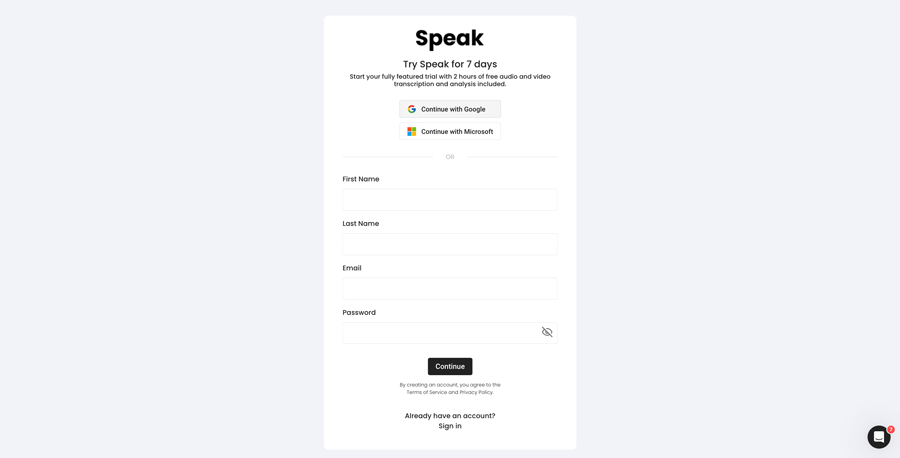
Paso 1: Registrarse en Speak
Inscríbase en Speak utilizando este enlace.
Once you register, you can instantly begin translating your English to Chinese (Traditional) file(s).
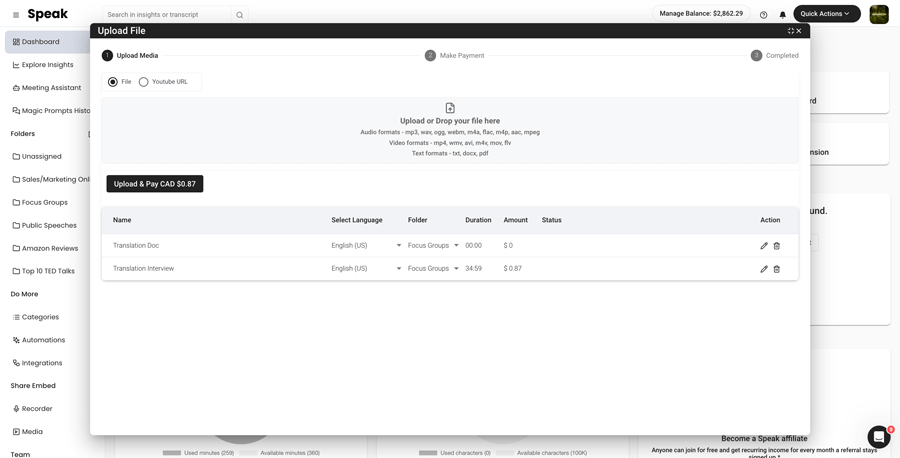
Paso 2: Cargue su(s) archivo(s) en inglés
En cuanto te conectes, se te redirigirá al panel de control.
Una vez allí, puede seleccionar la acción rápida "Nueva carga".
En Speak, puedes subir, transcribir y traducir archivos de audio, vídeo y texto a la vez. Si tienes vídeo, puedes utilizar nuestro Conversor AI de vídeo a texto para convertir vídeo a texto; si tiene audio, puede utilizar nuestro Conversor AI de audio a texto para convertir audio en texto. También puede transcribir vídeos de YouTube y utilizar la IA para analizar textos.
Formatos de audio y vídeo compatibles
- Convertir MP4 a texto
- Convertir M4A en texto
- Convertir MP3 a texto
- Convertir OGG en texto
- Convertir MPEG a texto
- Convertir WEBM a texto
- Convertir MOV a texto
- Convertir M4P a texto
- Convertir WMV a texto
- Convertir WAV en texto
- Convertir M4V a texto
- De audio y vídeo a texto
- Convertir AVI a texto
- Convertir vídeo en artículo
Idiomas de transcripción admitidos
- Cómo transcribir afrikaans
- Cómo transcribir el árabe egipcio
- Cómo transcribir el árabe iraquí
- Cómo transcribir el árabe israelí
- Cómo transcribir el árabe jordano
- Cómo transcribir árabe Kuwait
- Cómo transcribir el árabe libanés
- Cómo transcribir el árabe moderno estándar de Bahréin
- Cómo transcribir el árabe moderno estándar
- Cómo transcribir el árabe de Omán
- Cómo transcribir el árabe Autoridad Palestina
- Cómo transcribir el árabe Qatar
- Cómo transcribir árabe Arabia Saudí
- Cómo transcribir árabe República Árabe Siria
- Cómo transcribir árabe U.A.E
- Cómo transcribir armenio
- Cómo transcribir búlgaro
- Cómo transcribir catalán
- Cómo transcribir chino cantonés tradicional
- Cómo transcribir chino simplificado
- Cómo transcribir croata
- Cómo transcribir el checo
- Cómo transcribir danés
- Cómo transcribir neerlandés
- Cómo transcribir inglés Australia
- Cómo transcribir inglés británico
- Cómo transcribir inglés indio
- Cómo transcribir el inglés irlandés
- Cómo transcribir inglés Nueva Zelanda
- Cómo transcribir el escocés inglés
- Cómo transcribir inglés sudafricano
- Cómo transcribir inglés Reino Unido
- Cómo transcribir inglés Estados Unidos
- Cómo transcribir estonio
- Cómo transcribir el persa
- Cómo transcribir finés
- Cómo transcribir el francés de Canadá
- Cómo transcribir el suizo alemán
- Cómo transcribir alemán
- Cómo transcribir el griego
- Cómo transcribir el gujarati
- Cómo transcribir el hebreo
- Cómo transcribir el hindi
- Cómo transcribir el húngaro
- Cómo transcribir islandés
- Cómo transcribir indonesio
- Cómo transcribir entrevistas
- Cómo transcribir irlandés
- Cómo transcribir italiano
- Cómo transcribir japonés
- Cómo transcribir el canarés
- Cómo transcribir coreano
- Cómo transcribir letón
- Cómo transcribir lituano
- Cómo transcribir malayo
- Cómo transcribir malayalam
- Cómo transcribir noruego
- Cómo transcribir el persa
- Cómo transcribir el polaco
- Cómo transcribir portugués brasileño
- Cómo transcribir portugués Portugal
- Cómo transcribir portugués
- Cómo transcribir rumano
- Cómo transcribir el ruso
- Cómo transcribir eslovaco
- Cómo transcribir esloveno
- Cómo transcribir el español de México
- Cómo transcribir sueco
- Cómo transcribir tamil
- Cómo transcribir telugu
- Cómo transcribir tailandés
- Cómo transcribir el turco
- Cómo transcribir ucraniano
- Cómo transcribir vietnamita
- Transcribir danés
- Transcribir inglés
- Transcribir francés
- Transcribir alemán
- Transcribir portugués
- Transcribir español
También disponemos de un Asistente de reuniones AI y AI Notetaker para capturar automáticamente las reuniones, así como un grabadora de voz, grabador de audio y vídeo integrabley grabador de pantalla.
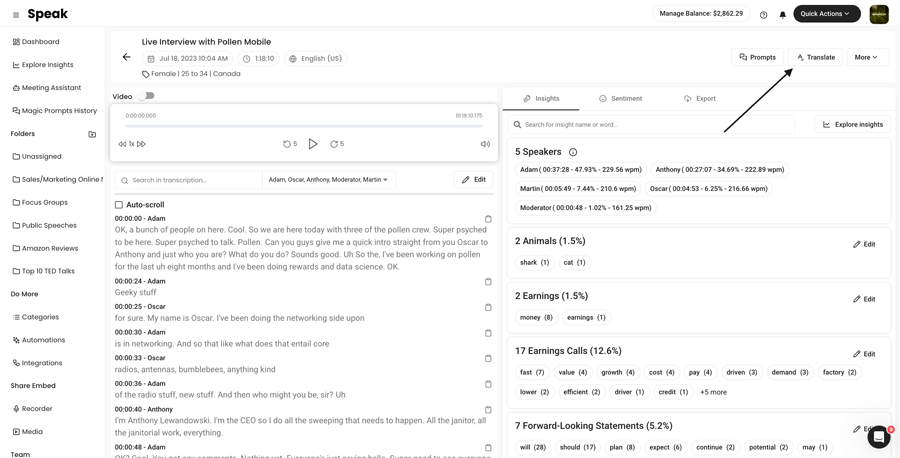
Step 3: Translate Your English file(s) to Chinese (Traditional)
Una vez cargado el archivo, sólo tiene que visitarlo y seleccionar "Traducir".
Si se trata de un archivo de audio y vídeo, Speak te preguntará si quieres mantener los nombres de los hablantes y las marcas de tiempo en la traducción.
¿Quieres traducir muchos archivos a la vez? No hay problema.
You can view the files you want to automatically translate from English to Chinese (Traditional) from the folder level and instantly translate as many files as you need with our artificial intelligence translation in just a few clicks.
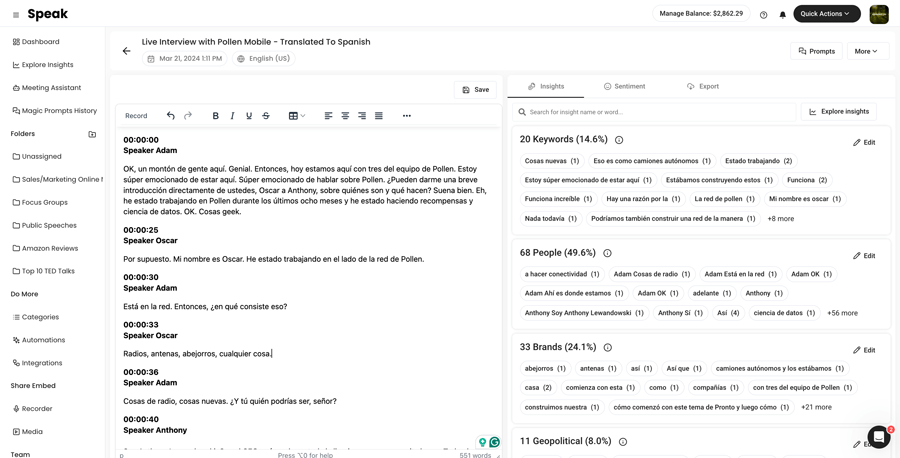
Step 4: That’s It! View, Analyze, Modify & Export Your New Chinese (Traditional) file(s)
Una vez realizada la traducción, recibirás una alerta y verás un nuevo documento en la misma carpeta en la que está tu archivo original.
El archivo se llamará igual, pero con un guión para indicar que se trata de la versión traducida.
¿Necesita ayuda con su traducción al inglés?
¡Estamos siempre aquí y encantados de ayudarle en Speak!
Envíanos un mensaje al chat en directo de la esquina inferior derecha y nos aseguraremos de que estés preparado para el éxito.
¿Le interesa traducir del inglés o de otros idiomas a otros idiomas? Consulte nuestra lista completa de traducciones compatibles idiomas aquí.
Automatic, accurate, instant AI translation from English to Chinese (Traditional) is here for you.
Inscríbase en Speak utilizando este enlace and begin translating English to Chinese (Traditional) today.
Unlocking Global Opportunities: Translate English to Chinese (Traditional)
In today’s fast-paced, digital-first world, the ability to communicate across languages and cultures is more than just a nice-to-have; it’s a necessity. For businesses and researchers looking to make their mark on the global stage, translating content from English to Chinese (Traditional) is a key step in bridging communication gaps and unlocking a world of opportunities.
Why Translate English to Chinese (Traditional)?
Chinese (Traditional) is not just another language; it’s a gateway to engaging with one of the largest markets and most dynamic cultures in the world. By translating content, whether it’s audio, video, or text, from English to Chinese (Traditional), you’re opening doors to millions of potential customers, collaborators, and audiences.
The Value of Automatic Translation
Automatic translation, powered by AI and NLP (Natural Language Processing), has revolutionized how we approach language barriers. Companies like Speak AI are at the forefront of this transformation, providing seamless, accurate, and efficient translation services that save time, reduce costs, and enhance communication.
Benefits for Researchers and Businesses
Translating content automatically can significantly benefit researchers and businesses in several ways:
- Global Reach: Broaden your audience or research impact by making your work accessible to Traditional Chinese speakers.
- Rentable: Automatic translation is a cost-efficient alternative to manual translation, reducing the need for expensive language services.
- Time-Saving: AI-driven translation drastically cuts down the time required to translate documents, allowing you to focus on your core activities.
- Accuracy and Context: Advanced NLP algorithms ensure translations are not only accurate but also contextually relevant.
Exploring the Global Landscape: English and Chinese (Traditional)
Where Are These Languages Popular?
English and Chinese (Traditional) are among the most spoken languages worldwide. English serves as a lingua franca in many parts of the globe, while Traditional Chinese is predominantly used in Taiwan, Hong Kong, and Macau. Impressively, these regions are not only cultural and economic hubs but also pivotal in international relations and global trade networks.
Interesting Statistics and History
The history of Traditional Chinese dates back thousands of years, making it one of the oldest written languages still in use today. Despite the adoption of Simplified Chinese in mainland China, Traditional Chinese has maintained its significance, with over 20 million people using it as their primary language.
Delving Into Languages: English vs. Chinese (Traditional)
Datos curiosos
English and Chinese (Traditional) are fascinating in their uniqueness. For instance, Chinese is a tonal language, meaning the tone in which a word is spoken can change its meaning entirely. English, on the other hand, places a heavy emphasis on syntax and word order.
Diferencias y similitudes
While English and Chinese (Traditional) may seem worlds apart, they share common goals in communication and expression. Both languages have rich vocabularies and deep literary traditions that reflect the cultures they originated from. However, their writing systems, grammar rules, and phonetics are majorly different, offering unique challenges and rewards to learners and translators alike.
Speak AI: Your Partner in Breaking Language Barriers
At Speak AI, we understand the importance of accurate and nuanced translation. Our software integrates NLP, large language models, data visualization, and Generative AI to deliver top-quality English to Chinese (Traditional) translation. Whether you’re looking to automatically translate meetings, research papers, or global campaigns, we offer what you need with a 4.9 rating on G2 and a trusted user base of over 150K.
AI Meeting Assistant: A Game-Changer for Global Communication
Our AI Meeting Assistant is an innovative tool that joins meetings on platforms like Microsoft Teams, Zoom, Google Meet, and Webex. It automatically transcribes and analyzes conversations, offering real-time translation and insights. This tool is an invaluable asset for researchers and businesses aiming to excel in a multi-lingual, multi-cultural world.
The Path Forward
Translating English to Chinese (Traditional) is not just about converting words; it’s about connecting worlds. With the right tools and technologies, like those offered by Speak AI, businesses and researchers can overcome language barriers, embrace cultural diversity, and thrive in the global marketplace.
Embrace the future of communication. Explore how Speak AI can transform your approach to language and unlock the full potential of your global endeavors.
PREGUNTAS FRECUENTES
What locations are English and Chinese (Traditional) popular?
English is a global lingua franca, while Traditional Chinese is primarily used in Taiwan, Hong Kong, and Macau. Both languages play crucial roles in international business, education, and diplomacy.
What are some fun facts about English and Chinese (Traditional)?
English’s syntax and word order drastically impact its meaning, whereas Chinese’s tone can change a word’s meaning. Both languages have evolved richly over centuries, reflecting their cultures and histories.
What are the differences and similarities between English and Chinese (Traditional)?
While vastly different in grammar, phonetics, and writing system, both languages serve the fundamental purpose of communication and expression, showcasing the diversity and unity of human language.
Traduce inglés a estos otros idiomas compatibles:
- Traducir Inglés-Árabe (Egipto)
- Traducir Inglés-Árabe (Irak)
- Traducir Inglés-Árabe (Israel)
- Traducir Inglés-Árabe (Jordania)
- Traducir Inglés-Árabe (Kuwait)
- Traducir Inglés-Árabe (Líbano)
- Traducir Inglés-Árabe (Omán)
- Traducir Inglés-Árabe (Autoridad Palestina)
- Traducir Inglés-Árabe (Qatar)
- Traducir Inglés-Árabe (Arabia Saudí)
- Traducir Inglés-Árabe (República Árabe Siria)
- Traducir Inglés-Árabe (Emiratos Árabes Unidos)
- Traducir Inglés-Árabe Estándar Moderno (Bahréin)
- Traducir inglés a armenio
- Traducir inglés a búlgaro
- Traducir del inglés al catalán
- Traducir inglés a chino (cantonés, tradicional)
- Traducir inglés a chino (simplificado)
- Traducir inglés a chino (tradicional)
- Traducir inglés a croata
- Traducir inglés a checo
- Traducir inglés a danés
- Traducir inglés-neerlandés
- Traducir inglés a inglés
- Traducir Inglés-Español (Australia)Traducir Inglés-Español (India)
- Traducir Inglés-Español (Irlanda)
- Traducir Inglés-Español (Nueva Zelanda)
- Traducir Inglés-Español (Escocés)
- Traducir Inglés-Español (Sudáfrica)
- Traducir Inglés-Español (Reino Unido)
- Traducir Inglés-Español (Estados Unidos)
- Traducir inglés a estonio
- Traducir inglés a farsi
- Traducir inglés-finés
- Traducir inglés-francés
- Traducir Inglés-Francés (Canadá)
- Traducir del inglés al alemán
- Traducir Inglés-Alemán (Suizo)
- Traducir inglés al griego
- Traducir inglés a guyaratí
- Traducir del inglés al hebreo
- Traducir inglés a hindi
- Traducir del inglés al húngaro
- Traducir inglés-islandés
- Traducir inglés a indonesio
- Traducir inglés-irlandés
- Traducir del inglés al italiano
- Traducir del inglés al japonés
- Traducir del inglés al canarés
- Traducir del inglés al coreano
- Traducir inglés a letón
- Traducir inglés a lituano
- Traducir inglés a malayo
- Traducir Inglés-Malayo
- Traducir inglés a noruego
- Traducir del inglés al persa
- Traducir inglés a polaco
- Traducir inglés-portugués
- Traducir Inglés-Portugués (Brasileño)
- Traducir Inglés-Portugués (Portugal)
- Traducir inglés a rumano
- Traducir inglés a ruso
- Traducir inglés-eslovaco
- Traducir inglés-esloveno
- Traducir inglés-español
- Traducir Inglés-Español (México)
- Traducir inglés a sueco
- Traducir inglés a tamil
- Traducir inglés a telugu
- Traducir inglés-tailandés
- Traducir inglés-turco
- Traducir inglés a ucraniano
- Traducir del inglés al vietnamita
Traducir & Transcribir con Speak AI
Speak AI admite transcripción y análisis en más de 100 idiomas. Carga tu audio o vídeo y obtén transcripción impulsada por IA al instante, asistencia de traducción y análisis de NLP.
 English
 Español
 Français
 Italiano
 العربية
 Português do Brasil
 Nederlands
 Deutsch
 עִבְרִית
 Русский
 日本語
 Polski
 Čeština
 Українська
 Slovenščina
 Svenska
 Ελληνικά
 Norsk bokmål
 简体中文
 Türkçe
 Català
 Magyar
 한국어
 Slovenčina
 Suomi