
How To Translate English to Chinese (Traditional)
Translating English to Chinese (Traditional) is super simple!
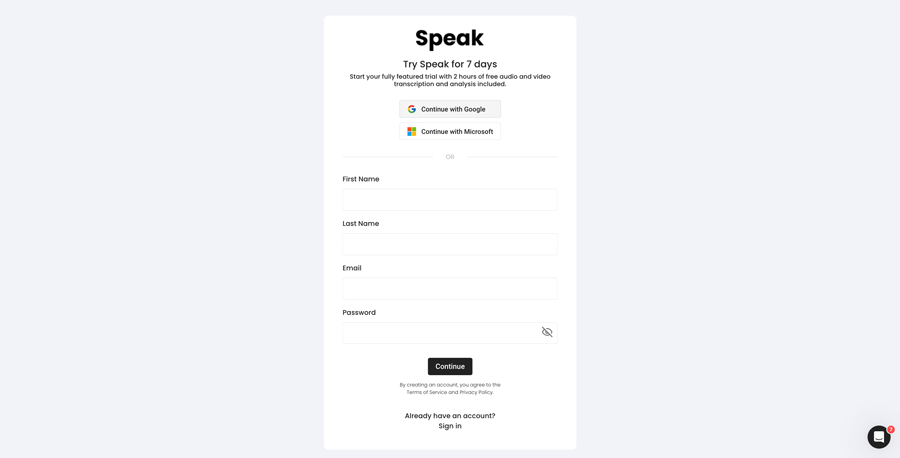
Step 1: Register for Speak
Register for Speak using bu bağlantı.
Once you register, you can instantly begin translating your English to Chinese (Traditional) file(s).
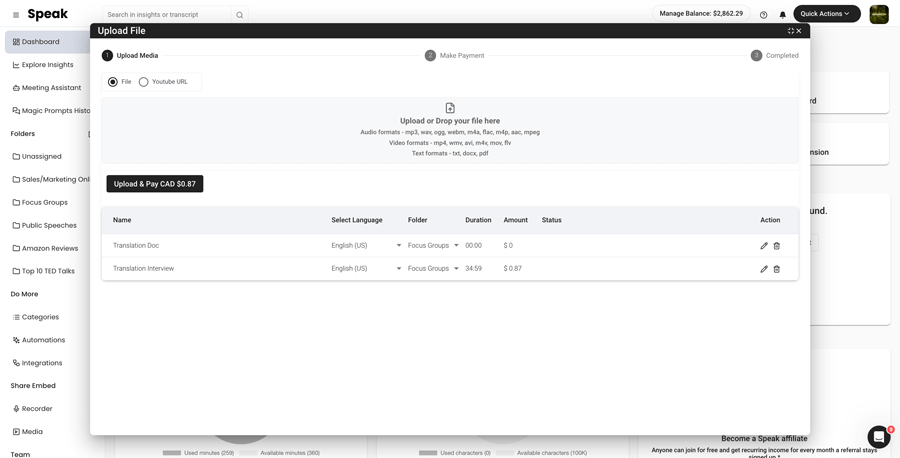
Step 2: Upload Your English file(s)
As soon as you log in, you will be redirected to the dashboard.
Once there, you can select the Quick Action “New Upload”.
Speak'te ses, video ve metin dosyalarını tek seferde sorunsuz bir şekilde yükleyebilir, yazıya dökebilir ve çevirebilirsiniz! Eğer videonuz varsa, bizim AI video-metin dönüştürücü videoyu metne dönüştürmek için; sesiniz varsa, bizim AI ses-metin dönüştürücü sesi metne dönüştürmek için. Ayrıca şunları da yapabilirsiniz YouTube videolarını yazıya dökme ve metni analiz etmek için yapay zeka kullanın.
Desteklenen Ses ve Video Formatları
- MP4'ü Metne Dönüştürme
- M4A'yı Metne Dönüştürme
- MP3'ü Metne Dönüştürme
- OGG'yi Metne Dönüştürme
- MPEG'i Metne Dönüştürme
- WEBM'i Metne Dönüştürme
- MOV'u Metne Dönüştürme
- M4P'yi Metne Dönüştürme
- WMV'yi Metne Dönüştürme
- WAV'ı Metne Dönüştürme
- M4V'yi Metne Dönüştürme
- Sesten Metne Video
- AVI'yi Metne Dönüştürme
- Videoyu Makaleye Dönüştür
Supported Transcription Languages
- How to Transcribe Afrikaans
- How to Transcribe Arabic Egypt
- How to Transcribe Arabic Iraq
- How to Transcribe Arabic Israel
- How to Transcribe Arabic Jordan
- How to Transcribe Arabic Kuwait
- How to Transcribe Arabic Lebanon
- How to Transcribe Arabic Modern Standard Bahrain
- How to Transcribe Arabic Modern Standard
- How to Transcribe Arabic Oman
- How to Transcribe Arabic Palestinian Authority
- How to Transcribe Arabic Qatar
- How to Transcribe Arabic Saudi Arabia
- How to Transcribe Arabic Syrian Arab Republic
- How to Transcribe Arabic U.A.E
- Ermenice Transkripsiyon Nasıl Yapılır
- How to Transcribe Bulgarian
- Katalanca Transkripsiyon Nasıl Yapılır
- How to Transcribe Chinese Cantonese Traditional
- How to Transcribe Chinese Simplified
- How to Transcribe Croatian
- How to Transcribe Czech
- How to Transcribe Danish
- How to Transcribe Dutch
- How to Transcribe English Australia
- How to Transcribe English British
- How to Transcribe English Indian
- How to Transcribe English Irish
- How to Transcribe English New Zealand
- How to Transcribe English Scottish
- How to Transcribe English South African
- How to Transcribe English United Kingdom
- How to Transcribe English United States
- How to Transcribe Estonian
- How to Transcribe Farsi
- How to Transcribe Finnish
- How to Transcribe French Canada
- How to Transcribe German Swiss
- How to Transcribe German
- How to Transcribe Greek
- How to Transcribe Gujarati
- How to Transcribe Hebrew
- How to Transcribe Hindi
- How to Transcribe Hungarian
- How to Transcribe Icelandic
- How to Transcribe Indonesian
- How to Transcribe Interviews
- How to Transcribe Irish
- How to Transcribe Italian
- How to Transcribe Japanese
- How to Transcribe Kannada
- How to Transcribe Korean
- How to Transcribe Latvian
- How to Transcribe Lithuanian
- How to Transcribe Malay
- How to Transcribe Malayalam
- Norveççe Transkripsiyon Nasıl Yapılır
- How to Transcribe Persian
- How to Transcribe Polish
- How to Transcribe Portuguese Brazilian
- How to Transcribe Portuguese Portugal
- How to Transcribe Portuguese
- How to Transcribe Romanian
- How to Transcribe Russian
- How to Transcribe Slovak
- How to Transcribe Slovenian
- How to Transcribe Spanish Mexico
- How to Transcribe Swedish
- How to Transcribe Tamil
- How to Transcribe Telugu
- How to Transcribe Thai
- How to Transcribe Turkish
- How to Transcribe Ukrainian
- How to Transcribe Vietnamese
- Danca transkripsiyon
- İngilizce'yi yazıya dök
- Fransızca transkripsiyon
- Almanca transkripsiyon
- Transcribe Portuguese
- İspanyolca transkripsiyon
Bizim de bir Yapay Zeka Toplantı Asistanı ve AI Notetaker toplantıları otomatik olarak yakalamanın yanı sıra ses kaydedici, gömülebilir ses ve video kaydedicive ekran kaydedici.
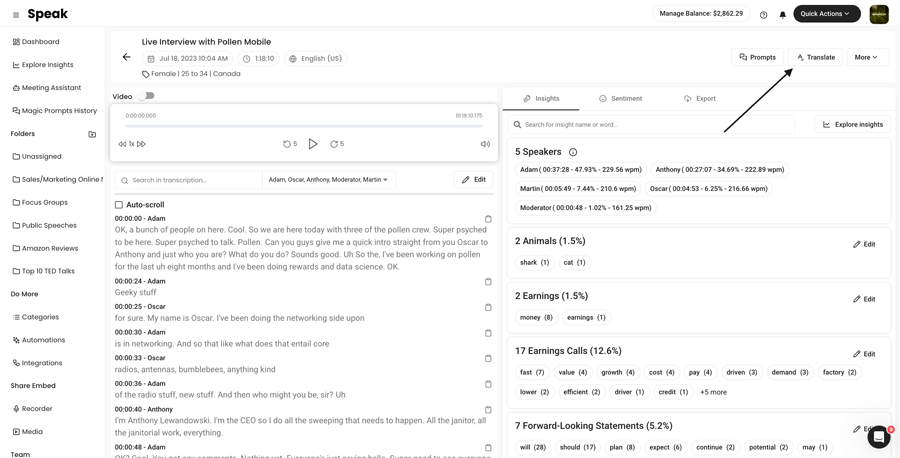
Step 3: Translate Your English file(s) to Chinese (Traditional)
Dosya yüklendikten sonra, dosyanıza ziyaret edin ve “Çevir” seçeneğini tıklayın.
Ses ve video dosyası ise, Speak çeviride konuşmacı adlarını ve zaman damgalarını tutmak isteyip istemediğinizi soracaktır.
Want to translate many files at once? No problem!
You can view the files you want to automatically translate from English to Chinese (Traditional) from the folder level and instantly translate as many files as you need with our artificial intelligence translation in just a few clicks.
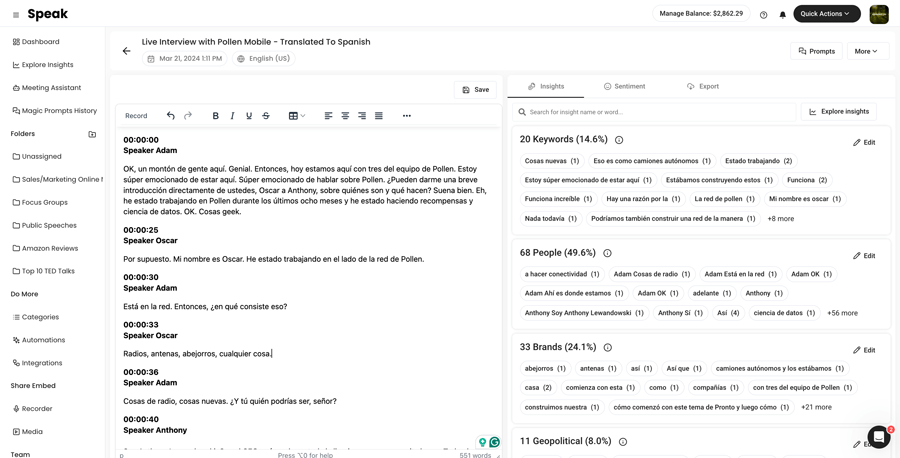
Step 4: That’s It! View, Analyze, Modify & Export Your New Chinese (Traditional) file(s)
Çeviri tamamlandığında, size bildirilecek ve orijinal dosyanızın bulunduğu klasörde yeni bir belge göreceksiniz.
Dosya aynı adla ancak çevrilmiş sürüm olduğunu gösteren tire ile adlandırılacaktır.
Need support with your English translation?
We are always here and happy to help at Speak!
Canlı sohbetten sağ alt köşedeki bize bir mesaj gönderin ve başarıya ulaşmanız için gerekeni yapacağız.
Interested in translating English or other languages to different languages? View our entire list of supported translation languages here.
Automatic, accurate, instant AI translation from English to Chinese (Traditional) is here for you.
Register for Speak using bu bağlantı and begin translating English to Chinese (Traditional) today.
Unlocking Global Opportunities: Translate English to Chinese (Traditional)
In today’s fast-paced, digital-first world, the ability to communicate across languages and cultures is more than just a nice-to-have; it’s a necessity. For businesses and researchers looking to make their mark on the global stage, translating content from English to Chinese (Traditional) is a key step in bridging communication gaps and unlocking a world of opportunities.
Why Translate English to Chinese (Traditional)?
Chinese (Traditional) is not just another language; it’s a gateway to engaging with one of the largest markets and most dynamic cultures in the world. By translating content, whether it’s audio, video, or text, from English to Chinese (Traditional), you’re opening doors to millions of potential customers, collaborators, and audiences.
The Value of Automatic Translation
Automatic translation, powered by AI and NLP (Natural Language Processing), has revolutionized how we approach language barriers. Companies like Speak AI are at the forefront of this transformation, providing seamless, accurate, and efficient translation services that save time, reduce costs, and enhance communication.
Benefits for Researchers and Businesses
Translating content automatically can significantly benefit researchers and businesses in several ways:
- Global Reach: Broaden your audience or research impact by making your work accessible to Traditional Chinese speakers.
- Maliyet Etkin: Automatic translation is a cost-efficient alternative to manual translation, reducing the need for expensive language services.
- Time-Saving: AI-driven translation drastically cuts down the time required to translate documents, allowing you to focus on your core activities.
- Accuracy and Context: Advanced NLP algorithms ensure translations are not only accurate but also contextually relevant.
Exploring the Global Landscape: English and Chinese (Traditional)
Where Are These Languages Popular?
English and Chinese (Traditional) are among the most spoken languages worldwide. English serves as a lingua franca in many parts of the globe, while Traditional Chinese is predominantly used in Taiwan, Hong Kong, and Macau. Impressively, these regions are not only cultural and economic hubs but also pivotal in international relations and global trade networks.
Interesting Statistics and History
The history of Traditional Chinese dates back thousands of years, making it one of the oldest written languages still in use today. Despite the adoption of Simplified Chinese in mainland China, Traditional Chinese has maintained its significance, with over 20 million people using it as their primary language.
Delving Into Languages: English vs. Chinese (Traditional)
Fun Facts
English and Chinese (Traditional) are fascinating in their uniqueness. For instance, Chinese is a tonal language, meaning the tone in which a word is spoken can change its meaning entirely. English, on the other hand, places a heavy emphasis on syntax and word order.
Differences and Similarities
While English and Chinese (Traditional) may seem worlds apart, they share common goals in communication and expression. Both languages have rich vocabularies and deep literary traditions that reflect the cultures they originated from. However, their writing systems, grammar rules, and phonetics are majorly different, offering unique challenges and rewards to learners and translators alike.
Speak AI: Your Partner in Breaking Language Barriers
At Speak AI, we understand the importance of accurate and nuanced translation. Our software integrates NLP, large language models, data visualization, and Generative AI to deliver top-quality English to Chinese (Traditional) translation. Whether you’re looking to automatically translate meetings, research papers, or global campaigns, we offer what you need with a 4.9 rating on G2 and a trusted user base of over 150K.
AI Meeting Assistant: A Game-Changer for Global Communication
Our AI Meeting Assistant is an innovative tool that joins meetings on platforms like Microsoft Teams, Zoom, Google Meet, and Webex. It automatically transcribes and analyzes conversations, offering real-time translation and insights. This tool is an invaluable asset for researchers and businesses aiming to excel in a multi-lingual, multi-cultural world.
The Path Forward
Translating English to Chinese (Traditional) is not just about converting words; it’s about connecting worlds. With the right tools and technologies, like those offered by Speak AI, businesses and researchers can overcome language barriers, embrace cultural diversity, and thrive in the global marketplace.
Embrace the future of communication. Explore how Speak AI can transform your approach to language and unlock the full potential of your global endeavors.
SSS
What locations are English and Chinese (Traditional) popular?
English is a global lingua franca, while Traditional Chinese is primarily used in Taiwan, Hong Kong, and Macau. Both languages play crucial roles in international business, education, and diplomacy.
What are some fun facts about English and Chinese (Traditional)?
English’s syntax and word order drastically impact its meaning, whereas Chinese’s tone can change a word’s meaning. Both languages have evolved richly over centuries, reflecting their cultures and histories.
What are the differences and similarities between English and Chinese (Traditional)?
While vastly different in grammar, phonetics, and writing system, both languages serve the fundamental purpose of communication and expression, showcasing the diversity and unity of human language.
Translate English To These Other Supported Languages:
- Translate English-to-Arabic (Egypt)
- Translate English-to-Arabic (Iraq)
- Translate English-to-Arabic (Israel)
- Translate English-to-Arabic (Jordan)
- Translate English-to-Arabic (Kuwait)
- Translate English-to-Arabic (Lebanon)
- Translate English-to-Arabic (Oman)
- Translate English-to-Arabic (Palestinian Authority)
- Translate English-to-Arabic (Qatar)
- Translate English-to-Arabic (Saudi Arabia)
- Translate English-to-Arabic (Syrian Arab Republic)
- Translate English-to-Arabic (United Arab Emirates)
- Translate English-to-Arabic Modern Standard (Bahrain)
- Translate English-to-Armenian
- Translate English-to-Bulgarian
- Translate English-to-Catalan
- Translate English-to-Chinese (Cantonese, Traditional)
- Translate English-to-Chinese (Simplified)
- Translate English-to-Chinese (Traditional)
- Translate English-to-Croatian
- Translate English-to-Czech
- Translate English-to-Danish
- Translate English-to-Dutch
- Translate English-to-English
- Translate English-to-English (Australia)Translate English-to-English (India)
- Translate English-to-English (Ireland)
- Translate English-to-English (New Zealand)
- Translate English-to-English (Scottish)
- Translate English-to-English (South African)
- Translate English-to-English (United Kingdom)
- Translate English-to-English (United States)
- Translate English-to-Estonian
- Translate English-to-Farsi
- Translate English-to-Finnish
- Translate English-to-French
- Translate English-to-French (Canada)
- Translate English-to-German
- Translate English-to-German (Swiss)
- Translate English-to-Greek
- Translate English-to-Gujarati
- Translate English-to-Hebrew
- Translate English-to-Hindi
- Translate English-to-Hungarian
- Translate English-to-Icelandic
- Translate English-to-Indonesian
- Translate English-to-Irish
- Translate English-to-Italian
- Translate English-to-Japanese
- Translate English-to-Kannada
- Translate English-to-Korean
- Translate English-to-Latvian
- Translate English-to-Lithuanian
- Translate English-to-Malay
- Translate English-to-Malayalam
- Translate English-to-Norwegian
- Translate English-to-Persian
- Translate English-to-Polish
- Translate English-to-Portuguese
- Translate English-to-Portuguese (Brazilian)
- Translate English-to-Portuguese (Portugal)
- Translate English-to-Romanian
- Translate English-to-Russian
- Translate English-to-Slovak
- Translate English-to-Slovenian
- Translate English-to-Spanish
- Translate English-to-Spanish (Mexico)
- Translate English-to-Swedish
- Translate English-to-Tamil
- Translate English-to-Telugu
- Translate English-to-Thai
- Translate English-to-Turkish
- Translate English-to-Ukrainian
- Translate English-to-Vietnamese
Translate & Transcribe with Speak AI
Speak AI supports transcription and analysis in 100+ languages. Upload your audio or video and get instant AI-powered transcription, translation assistance, and NLP analytics.
 English
 Español
 Français
 Italiano
 العربية
 Português do Brasil
 Nederlands
 Deutsch
 עִבְרִית
 Русский
 日本語
 Polski
 Čeština
 Українська
 Slovenščina
 Svenska
 Ελληνικά
 Norsk bokmål
 简体中文
 Türkçe
 Català
 Magyar
 한국어
 Slovenčina
 Suomi