
How To Translate English to Chinese (Traditional)
Translating English to Chinese (Traditional) is super simple!
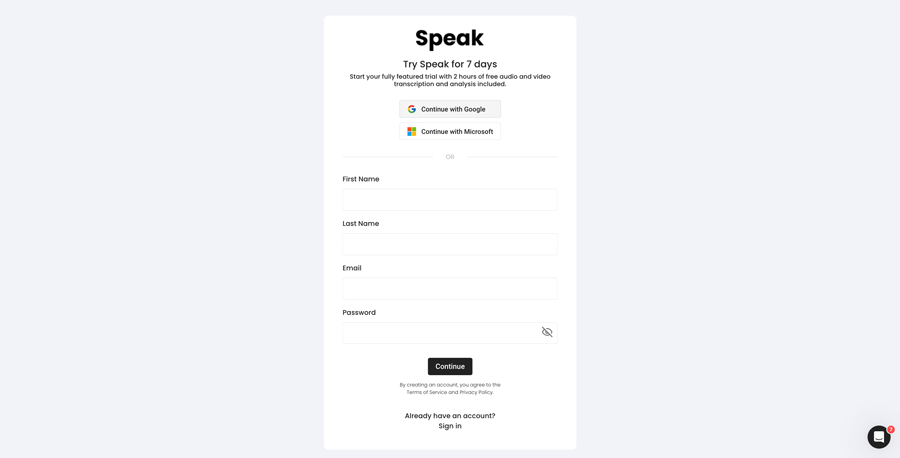
Etapa 1: Registre-se no Speak
Registre-se para o Speak usando este link.
Once you register, you can instantly begin translating your English to Chinese (Traditional) file(s).
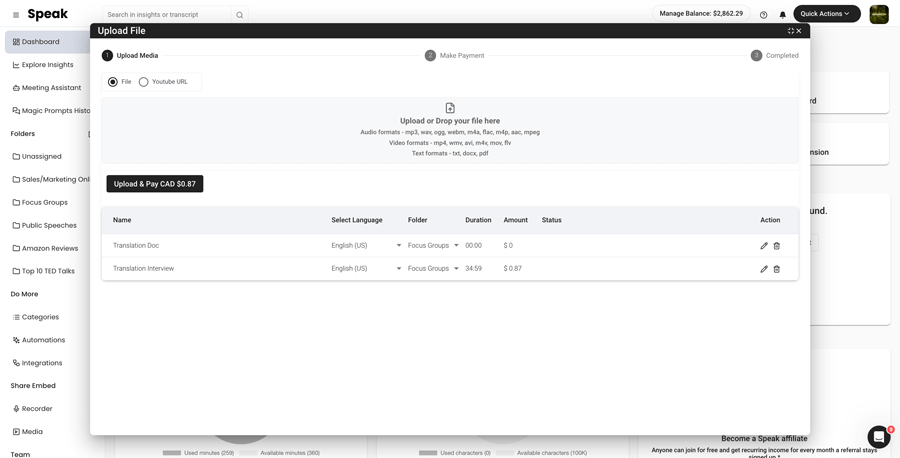
Etapa 2: Faça o upload de seu(s) arquivo(s) em inglês
Assim que fizer login, você será redirecionado para o painel de controle.
Uma vez lá, você pode selecionar a ação rápida "New Upload".
No Speak, você pode carregar, transcrever e traduzir arquivos de áudio, vídeo e texto de uma só vez! Se você tiver um vídeo, poderá usar nosso Conversor de vídeo para texto com IA para converter vídeo em texto; se você tiver áudio, poderá usar nosso Conversor de áudio para texto AI para converter áudio em texto. Você também pode transcrever vídeos do YouTube e usar IA para analisar textos.
Formatos de áudio e vídeo compatíveis
- Converter MP4 em texto
- Converter M4A em texto
- Converter MP3 em texto
- Converter OGG em texto
- Converter MPEG em texto
- Converter WEBM em texto
- Converter MOV em texto
- Converter M4P em texto
- Converter WMV em texto
- Converter WAV em texto
- Converter M4V em texto
- Áudio e vídeo para texto
- Converter AVI em texto
- Converter vídeo em artigo
Idiomas de transcrição suportados
- Como transcrever em africâner
- Como transcrever o Egito árabe
- Como transcrever Arabic Iraq
- Como transcrever Arabic Israel
- Como transcrever Arabic Jordan
- Como transcrever Arabic Kuwait
- Como transcrever Arabic Lebanon
- Como transcrever o padrão moderno do árabe no Bahrein
- Como transcrever o padrão moderno do árabe
- Como transcrever Arabic Oman
- Como transcrever o árabe Autoridade Palestina
- Como transcrever Arabic Qatar
- Como transcrever o árabe da Arábia Saudita
- Como transcrever árabe República Árabe da Síria
- Como transcrever o árabe U.A.E
- Como transcrever armênio
- Como transcrever em búlgaro
- Como transcrever o catalão
- Como transcrever o chinês cantonês tradicional
- Como transcrever chinês simplificado
- Como transcrever em croata
- Como transcrever o tcheco
- Como transcrever o dinamarquês
- Como transcrever em holandês
- Como transcrever o inglês da Austrália
- Como transcrever o inglês britânico
- Como transcrever o inglês indiano
- Como transcrever o inglês irlandês
- Como transcrever o inglês da Nova Zelândia
- Como transcrever o inglês escocês
- Como transcrever inglês sul-africano
- Como transcrever inglês do Reino Unido
- Como transcrever inglês dos Estados Unidos
- Como transcrever em estoniano
- Como transcrever Farsi
- Como transcrever em finlandês
- Como transcrever o Canadá francês
- Como transcrever o suíço alemão
- Como transcrever em alemão
- Como transcrever grego
- Como transcrever Gujarati
- Como transcrever hebraico
- Como transcrever em hindi
- Como transcrever o húngaro
- Como transcrever o islandês
- Como transcrever em indonésio
- Como transcrever entrevistas
- Como transcrever irlandês
- Como transcrever italiano
- Como transcrever em japonês
- Como transcrever Kannada
- Como transcrever coreano
- Como transcrever o letão
- Como transcrever em lituano
- Como transcrever o malaio
- Como transcrever Malayalam
- Como transcrever o norueguês
- Como transcrever persa
- Como transcrever polonês
- Como transcrever o português brasileiro
- Como transcrever o português de Portugal
- Como transcrever em português
- Como transcrever em romeno
- Como transcrever russo
- Como transcrever o eslovaco
- Como transcrever em esloveno
- Como transcrever o espanhol do México
- Como transcrever sueco
- Como transcrever o Tamil
- Como transcrever Telugu
- Como transcrever em tailandês
- Como transcrever em turco
- Como transcrever Ukrainian
- Como transcrever em vietnamita
- Transcrever dinamarquês
- Transcrever em inglês
- Transcrever francês
- Transcrever em alemão
- Transcrever português
- Transcrição de espanhol
Também temos um Assistente de reunião com IA e Anotador de IA para capturar reuniões automaticamente, bem como um gravador de voz, gravador de áudio e vídeo incorporávele gravador de tela.
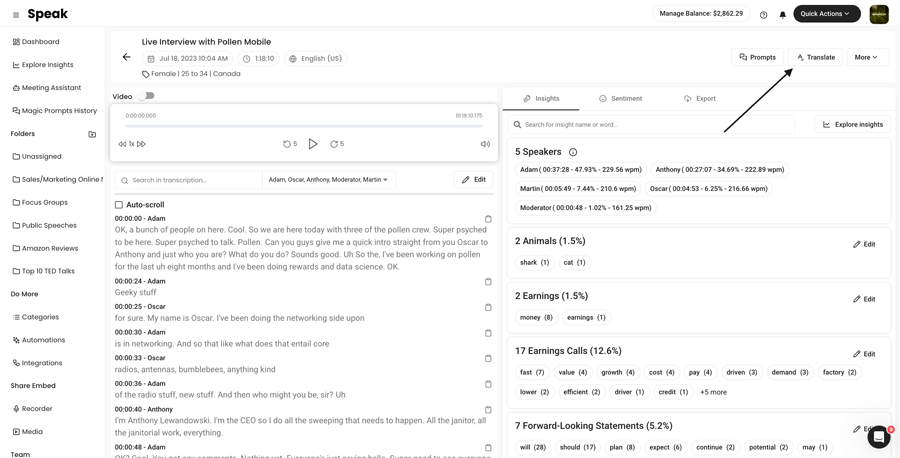
Step 3: Translate Your English file(s) to Chinese (Traditional)
Depois que o arquivo for carregado, basta acessar o arquivo e selecionar "Translate" (Traduzir).
Se for um arquivo de áudio e vídeo, o Speak perguntará se você deseja manter os nomes dos locutores e as marcas de tempo na tradução.
Deseja traduzir muitos arquivos de uma só vez? Não tem problema!
You can view the files you want to automatically translate from English to Chinese (Traditional) from the folder level and instantly translate as many files as you need with our artificial intelligence translation in just a few clicks.
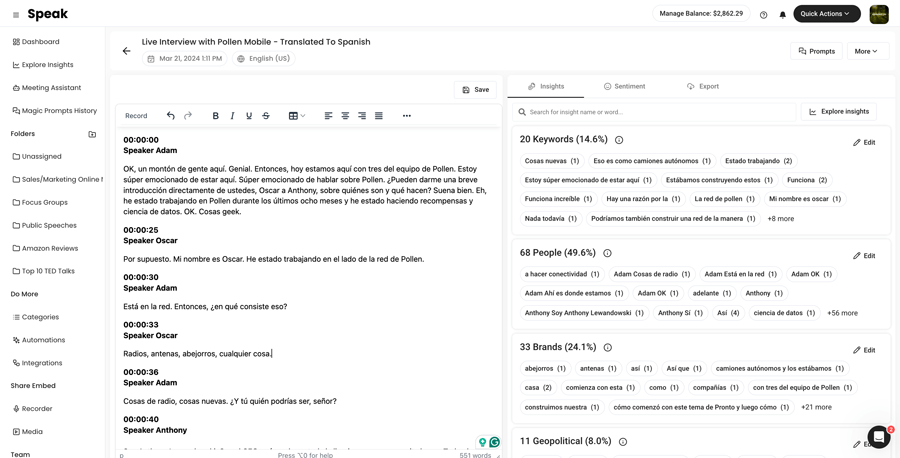
Step 4: That’s It! View, Analyze, Modify & Export Your New Chinese (Traditional) file(s)
Quando a tradução for concluída, você será alertado e verá um novo documento na mesma pasta em que está o arquivo original.
O arquivo terá o mesmo nome, mas com um traço indicando que é a versão traduzida.
Precisa de suporte com sua tradução para o inglês?
Estamos sempre aqui e felizes em ajudar no Speak!
Basta nos enviar uma mensagem no bate-papo ao vivo no canto inferior direito e garantiremos que você esteja preparado para o sucesso.
Interessado em traduzir inglês ou outros idiomas para outros idiomas? Veja nossa lista completa de traduções compatíveis idiomas aqui.
Automatic, accurate, instant AI translation from English to Chinese (Traditional) is here for you.
Registre-se para o Speak usando este link and begin translating English to Chinese (Traditional) today.
Unlocking Global Opportunities: Translate English to Chinese (Traditional)
In today’s fast-paced, digital-first world, the ability to communicate across languages and cultures is more than just a nice-to-have; it’s a necessity. For businesses and researchers looking to make their mark on the global stage, translating content from English to Chinese (Traditional) is a key step in bridging communication gaps and unlocking a world of opportunities.
Why Translate English to Chinese (Traditional)?
Chinese (Traditional) is not just another language; it’s a gateway to engaging with one of the largest markets and most dynamic cultures in the world. By translating content, whether it’s audio, video, or text, from English to Chinese (Traditional), you’re opening doors to millions of potential customers, collaborators, and audiences.
The Value of Automatic Translation
Automatic translation, powered by AI and NLP (Natural Language Processing), has revolutionized how we approach language barriers. Companies like Speak AI are at the forefront of this transformation, providing seamless, accurate, and efficient translation services that save time, reduce costs, and enhance communication.
Benefits for Researchers and Businesses
Translating content automatically can significantly benefit researchers and businesses in several ways:
- Global Reach: Broaden your audience or research impact by making your work accessible to Traditional Chinese speakers.
- Custo-benefício: Automatic translation is a cost-efficient alternative to manual translation, reducing the need for expensive language services.
- Time-Saving: AI-driven translation drastically cuts down the time required to translate documents, allowing you to focus on your core activities.
- Accuracy and Context: Advanced NLP algorithms ensure translations are not only accurate but also contextually relevant.
Exploring the Global Landscape: English and Chinese (Traditional)
Where Are These Languages Popular?
English and Chinese (Traditional) are among the most spoken languages worldwide. English serves as a lingua franca in many parts of the globe, while Traditional Chinese is predominantly used in Taiwan, Hong Kong, and Macau. Impressively, these regions are not only cultural and economic hubs but also pivotal in international relations and global trade networks.
Interesting Statistics and History
The history of Traditional Chinese dates back thousands of years, making it one of the oldest written languages still in use today. Despite the adoption of Simplified Chinese in mainland China, Traditional Chinese has maintained its significance, with over 20 million people using it as their primary language.
Delving Into Languages: English vs. Chinese (Traditional)
Fatos divertidos
English and Chinese (Traditional) are fascinating in their uniqueness. For instance, Chinese is a tonal language, meaning the tone in which a word is spoken can change its meaning entirely. English, on the other hand, places a heavy emphasis on syntax and word order.
Diferenças e semelhanças
While English and Chinese (Traditional) may seem worlds apart, they share common goals in communication and expression. Both languages have rich vocabularies and deep literary traditions that reflect the cultures they originated from. However, their writing systems, grammar rules, and phonetics are majorly different, offering unique challenges and rewards to learners and translators alike.
Speak AI: Your Partner in Breaking Language Barriers
At Speak AI, we understand the importance of accurate and nuanced translation. Our software integrates NLP, large language models, data visualization, and Generative AI to deliver top-quality English to Chinese (Traditional) translation. Whether you’re looking to automatically translate meetings, research papers, or global campaigns, we offer what you need with a 4.9 rating on G2 and a trusted user base of over 150K.
AI Meeting Assistant: A Game-Changer for Global Communication
Our AI Meeting Assistant is an innovative tool that joins meetings on platforms like Microsoft Teams, Zoom, Google Meet, and Webex. It automatically transcribes and analyzes conversations, offering real-time translation and insights. This tool is an invaluable asset for researchers and businesses aiming to excel in a multi-lingual, multi-cultural world.
The Path Forward
Translating English to Chinese (Traditional) is not just about converting words; it’s about connecting worlds. With the right tools and technologies, like those offered by Speak AI, businesses and researchers can overcome language barriers, embrace cultural diversity, and thrive in the global marketplace.
Embrace the future of communication. Explore how Speak AI can transform your approach to language and unlock the full potential of your global endeavors.
PERGUNTAS FREQUENTES
What locations are English and Chinese (Traditional) popular?
English is a global lingua franca, while Traditional Chinese is primarily used in Taiwan, Hong Kong, and Macau. Both languages play crucial roles in international business, education, and diplomacy.
What are some fun facts about English and Chinese (Traditional)?
English’s syntax and word order drastically impact its meaning, whereas Chinese’s tone can change a word’s meaning. Both languages have evolved richly over centuries, reflecting their cultures and histories.
What are the differences and similarities between English and Chinese (Traditional)?
While vastly different in grammar, phonetics, and writing system, both languages serve the fundamental purpose of communication and expression, showcasing the diversity and unity of human language.
Traduzir o inglês para esses outros idiomas suportados:
- Traduzir do inglês para o árabe (Egito)
- Traduzir do inglês para o árabe (Iraque)
- Traduzir do inglês para o árabe (Israel)
- Traduzir do inglês para o árabe (Jordânia)
- Tradução de inglês para árabe (Kuwait)
- Traduzir do inglês para o árabe (Líbano)
- Traduzir inglês para árabe (Omã)
- Traduzir inglês para árabe (Autoridade Palestina)
- Traduzir do inglês para o árabe (Qatar)
- Tradução de inglês para árabe (Arábia Saudita)
- Traduzir inglês para árabe (República Árabe da Síria)
- Traduzir inglês para árabe (Emirados Árabes Unidos)
- Tradução de inglês para árabe padrão moderno (Bahrein)
- Traduzir de inglês para armênio
- Traduzir de inglês para búlgaro
- Traduzir inglês para catalão
- Tradução de inglês para chinês (cantonês, tradicional)
- Traduzir inglês para chinês (simplificado)
- Traduzir inglês para chinês (tradicional)
- Traduzir inglês para croata
- Traduzir do inglês para o tcheco
- Traduzir do inglês para o dinamarquês
- Traduzir do inglês para o holandês
- Traduzir de inglês para inglês
- Traduzir de inglês para inglês (Austrália)Traduzir de inglês para inglês (Índia)
- Traduzir de inglês para inglês (Irlanda)
- Traduzir de inglês para inglês (Nova Zelândia)
- Traduzir de inglês para inglês (escocês)
- Traduzir de inglês para inglês (sul-africano)
- Traduzir de inglês para inglês (Reino Unido)
- Traduzir de inglês para inglês (Estados Unidos)
- Traduzir de inglês para estoniano
- Traduzir de inglês para farsi
- Traduzir do inglês para o finlandês
- Traduzir do inglês para o francês
- Traduzir de inglês para francês (Canadá)
- Traduzir do inglês para o alemão
- Traduzir do inglês para o alemão (suíço)
- Traduzir do inglês para o grego
- Traduzir de inglês para gujarati
- Traduzir de inglês para hebraico
- Traduzir de inglês para hindi
- Traduzir do inglês para o húngaro
- Traduzir do inglês para o islandês
- Traduzir de inglês para indonésio
- Traduzir do inglês para o irlandês
- Traduzir de inglês para italiano
- Traduzir do inglês para o japonês
- Traduzir inglês para kannada
- Traduzir do inglês para o coreano
- Traduzir de inglês para letão
- Traduzir de inglês para lituano
- Traduzir de inglês para malaio
- Traduzir Inglês para Malayalam
- Traduzir de inglês para norueguês
- Traduzir de inglês para persa
- Traduzir de inglês para polonês
- Traduzir do inglês para o português
- Traduzir de inglês para português (brasileiro)
- Traduzir de inglês para português (Portugal)
- Traduzir de inglês para romeno
- Traduzir do inglês para o russo
- Traduzir de inglês para eslovaco
- Traduzir de inglês para esloveno
- Traduzir do inglês para o espanhol
- Traduzir de inglês para espanhol (México)
- Traduzir do inglês para o sueco
- Traduzir inglês para tâmil
- Traduzir de inglês para telugu
- Traduzir do inglês para o tailandês
- Traduzir do inglês para o turco
- Traduzir de inglês para ucraniano
- Traduzir de inglês para vietnamita
Traduzir & Transcrever com Speak AI
O Speak AI suporta transcrição e análise em mais de 100 idiomas. Carregue seu áudio ou vídeo e obtenha transcrição alimentada por IA instantânea, assistência de tradução e análise de NLP.
 English
 Español
 Français
 Italiano
 العربية
 Português do Brasil
 Nederlands
 Deutsch
 עִבְרִית
 Русский
 日本語
 Polski
 Čeština
 Українська
 Slovenščina
 Svenska
 Ελληνικά
 Norsk bokmål
 简体中文
 Türkçe
 Català
 Magyar
 한국어
 Slovenčina
 Suomi