
How To Translate English to Chinese (Traditional)
Translating English to Chinese (Traditional) is super simple!
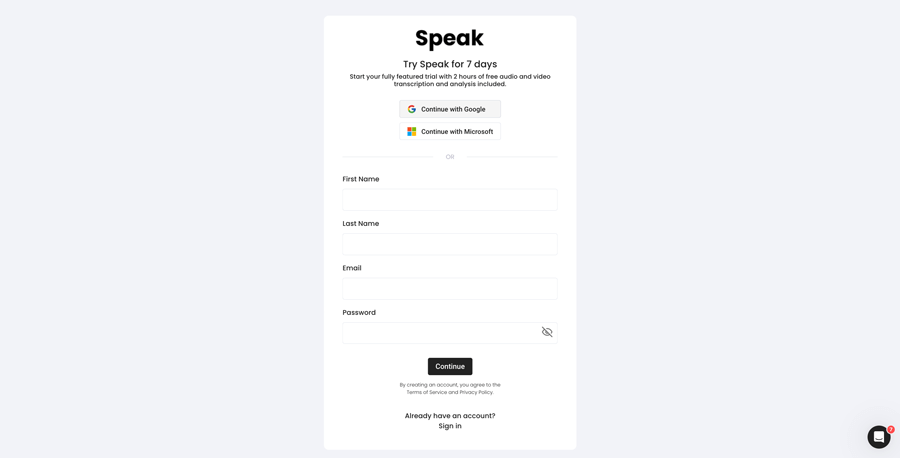
Trinn 1: Registrer deg for Speak
Register for Speak using denne lenken.
Once you register, you can instantly begin translating your English to Chinese (Traditional) file(s).
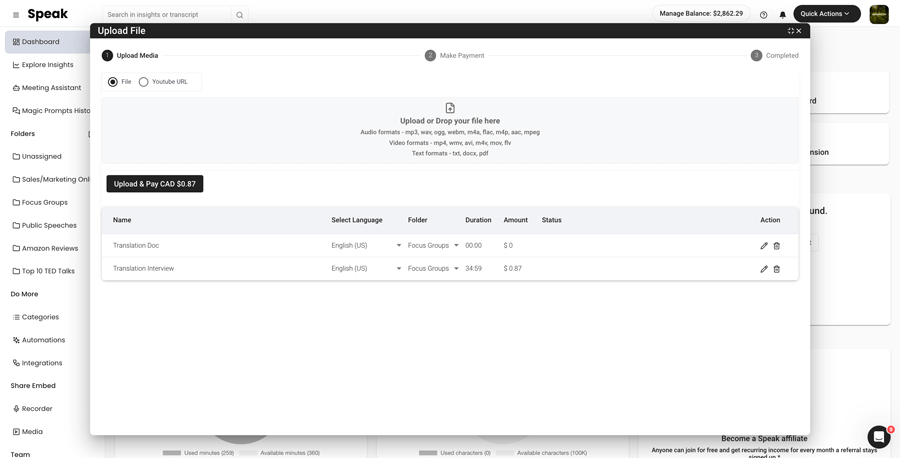
Trinn 2: Last opp engelsk fil(er)
Så snart du logger inn, blir du omdirigert til dashbordet.
Der kan du velge Quick Action “New Upload”.
I Speak kan du sømløst laste opp, transkribere og oversette lyd-, video- og tekstfiler på én gang! Hvis du har video, kan du bruke vår AI video-til-tekst-omformer for å konvertere video til tekst; hvis du har lyd, kan du bruke vår AI-lyd-til-tekst-omformer for å konvertere lyd til tekst. Du kan også transkribere YouTube-videoer og bruke kunstig intelligens til å analysere tekst.
Støttede lyd- og videoformater
- Konverter MP4 til tekst
- Konverter M4A til tekst
- Konverter MP3 til tekst
- Konvertere OGG til tekst
- Konverter MPEG til tekst
- Konverter WEBM til tekst
- Konverter MOV til tekst
- Konvertere M4P til tekst
- Konverter WMV til tekst
- Konverter WAV til tekst
- Konverter M4V til tekst
- Lyd Video til tekst
- Konverter AVI til tekst
- Konverter video til artikkel
Støttede transkripsjonsspråk
- Hvordan transkribere afrikaans
- Slik transkriberer du arabisk Egypt
- Slik transkriberer du arabisk irak
- Slik transkriberer du arabisk israelisk
- Slik transkriberer du arabisk jordansk
- Slik transkriberer du arabisk kuwaitisk
- Hvordan transkribere arabisk Libanon
- Hvordan transkribere arabisk moderne standardbahrain
- Slik transkriberer du arabisk moderne standardspråk
- Slik transkriberer du arabisk oman
- Hvordan transkribere arabisk palestinsk myndighet
- Slik transkriberer du arabisk Qatar
- Hvordan transkribere arabisk Saudi-Arabia
- Slik transkriberer du arabisk syrisk arabisk republik
- Slik transkriberer du arabisk U.A.E
- Hvordan transkribere armensk
- Hvordan transkribere bulgarsk
- Hvordan transkribere katalansk
- Slik transkriberer du kinesisk kantonesisk tradisjonell
- Slik transkriberer du kinesisk forenklet
- Hvordan transkribere kroatisk
- Slik transkriberer du tsjekkisk
- Slik transkriberer du dansk
- Slik transkriberer du nederlandsk
- Hvordan transkribere engelsk Australia
- Hvordan transkribere engelsk britisk
- Hvordan transkribere engelsk India
- Slik transkriberer du engelsk irsk
- Hvordan transkribere engelsk New Zealand
- Hvordan transkribere engelsk skotsk
- Slik transkriberer du engelsk fra Sør-Afrika
- Slik transkriberer du engelsk Storbritannia
- Slik transkriberer du engelsk fra USA
- Hvordan transkribere estisk
- How to Transcribe Farsi
- Hvordan transkribere finsk
- Slik transkriberer du fransk kanadisk
- Slik transkriberer du tysk Sveits
- Slik transkriberer du tysk
- Slik transkriberer du gresk
- Hvordan transkribere gujarati
- How to Transcribe Hebrew
- How to Transcribe Hindi
- Hvordan transkribere ungarsk
- Hvordan transkribere islandsk
- Hvordan transkribere indonesisk
- Hvordan transkribere intervjuer
- Slik transkriberer du irsk
- Hvordan transkribere italiensk
- Hvordan transkribere japansk
- Hvordan transkribere kannada
- Slik transkriberer du koreansk
- Hvordan transkribere latvisk
- Hvordan transkribere litauisk
- Slik transkriberer du malayisk
- Hvordan transkribere malayalam
- Hvordan transkribere norsk
- Hvordan transkribere persisk
- Slik transkriberer du polsk
- Hvordan transkribere portugisisk brasiliansk
- Hvordan transkribere portugisisk Portugal
- Hvordan transkribere portugisisk
- Hvordan transkribere rumensk
- Hvordan transkribere russisk
- Slik transkriberer du slovakisk
- Hvordan transkribere slovenisk
- Hvordan transkribere spansk Mexico
- Hvordan transkribere svensk
- Slik transkriberer du tamil
- Slik transkriberer du Telugu
- Hvordan transkribere thai
- Hvordan transkribere tyrkisk
- Hvordan transkribere ukrainsk
- Hvordan transkribere vietnamesisk
- Transkribere dansk
- Transkribere engelsk
- Transkribere fransk
- Transkribere tysk
- Transkriber portugisisk
- Transkribere spansk
Vi har også en AI-møteassistent og AI Notetaker for automatisk registrering av møter samt en stemmeopptaker, innebygd lyd- og videoopptaker, og skjermopptaker.
Fortsett å lese hele veiledningen (klikk for å utvide)
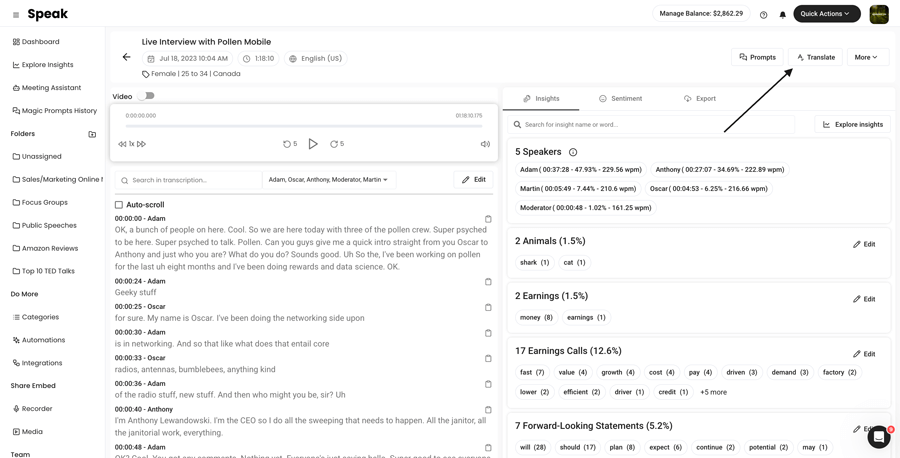
Step 3: Translate Your English file(s) to Chinese (Traditional)
Når filen er lastet opp, besøk ganske enkelt filen og velg “Oversett”.
Hvis det er en lyd- og videofil, vil Speak spørre deg om du vil beholde talernavn og tidsstempler i oversettelsen.
Vil du oversette mange filer samtidig? Ingen problem!
You can view the files you want to automatically translate from English to Chinese (Traditional) from the folder level and instantly translate as many files as you need with our artificial intelligence translation in just a few clicks.
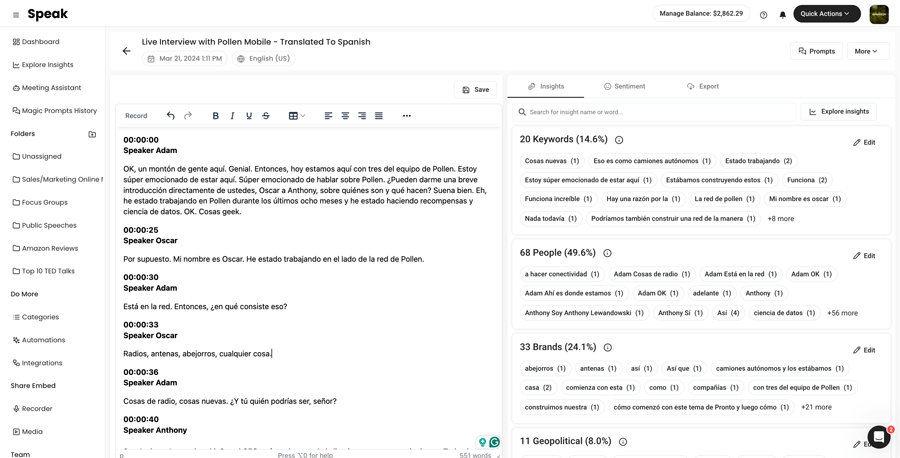
Step 4: That’s It! View, Analyze, Modify & Export Your New Chinese (Traditional) file(s)
Når oversettelsen er ferdig, blir du varslet og du vil se et nytt dokument i samme mappe som den opprinnelige filen din.
The file will be named the same but with a dash indicating that it is the translated version.
Trenger du hjelp med din engelske oversettelse?
Vi er alltid her og gjerne hjelper til hos Speak!
Send oss en melding på direktechat i nedre høyre hjørne, så sørger vi for at du er klar til suksess.
Interested in translating English or other languages to different languages? View our entire list of supported translation languages here.
Automatic, accurate, instant AI translation from English to Chinese (Traditional) is here for you.
Register for Speak using denne lenken and begin translating English to Chinese (Traditional) today.
Unlocking Global Opportunities: Translate English to Chinese (Traditional)
In today’s fast-paced, digital-first world, the ability to communicate across languages and cultures is more than just a nice-to-have; it’s a necessity. For businesses and researchers looking to make their mark on the global stage, translating content from English to Chinese (Traditional) is a key step in bridging communication gaps and unlocking a world of opportunities.
Why Translate English to Chinese (Traditional)?
Chinese (Traditional) is not just another language; it’s a gateway to engaging with one of the largest markets and most dynamic cultures in the world. By translating content, whether it’s audio, video, or text, from English to Chinese (Traditional), you’re opening doors to millions of potential customers, collaborators, and audiences.
The Value of Automatic Translation
Automatic translation, powered by AI and NLP (Natural Language Processing), has revolutionized how we approach language barriers. Companies like Speak AI are at the forefront of this transformation, providing seamless, accurate, and efficient translation services that save time, reduce costs, and enhance communication.
Benefits for Researchers and Businesses
Translating content automatically can significantly benefit researchers and businesses in several ways:
- Global Reach: Broaden your audience or research impact by making your work accessible to Traditional Chinese speakers.
- Kostnadseffektiv: Automatic translation is a cost-efficient alternative to manual translation, reducing the need for expensive language services.
- Time-Saving: AI-driven translation drastically cuts down the time required to translate documents, allowing you to focus on your core activities.
- Accuracy and Context: Advanced NLP algorithms ensure translations are not only accurate but also contextually relevant.
Exploring the Global Landscape: English and Chinese (Traditional)
Where Are These Languages Popular?
English and Chinese (Traditional) are among the most spoken languages worldwide. English serves as a lingua franca in many parts of the globe, while Traditional Chinese is predominantly used in Taiwan, Hong Kong, and Macau. Impressively, these regions are not only cultural and economic hubs but also pivotal in international relations and global trade networks.
Interesting Statistics and History
The history of Traditional Chinese dates back thousands of years, making it one of the oldest written languages still in use today. Despite the adoption of Simplified Chinese in mainland China, Traditional Chinese has maintained its significance, with over 20 million people using it as their primary language.
Delving Into Languages: English vs. Chinese (Traditional)
Fun Facts
English and Chinese (Traditional) are fascinating in their uniqueness. For instance, Chinese is a tonal language, meaning the tone in which a word is spoken can change its meaning entirely. English, on the other hand, places a heavy emphasis on syntax and word order.
Forskjeller og likheter
While English and Chinese (Traditional) may seem worlds apart, they share common goals in communication and expression. Both languages have rich vocabularies and deep literary traditions that reflect the cultures they originated from. However, their writing systems, grammar rules, and phonetics are majorly different, offering unique challenges and rewards to learners and translators alike.
Speak AI: Your Partner in Breaking Language Barriers
At Speak AI, we understand the importance of accurate and nuanced translation. Our software integrates NLP, large language models, data visualization, and Generative AI to deliver top-quality English to Chinese (Traditional) translation. Whether you’re looking to automatically translate meetings, research papers, or global campaigns, we offer what you need with a 4.9 rating on G2 and a trusted user base of over 150K.
AI Meeting Assistant: A Game-Changer for Global Communication
Our AI Meeting Assistant is an innovative tool that joins meetings on platforms like Microsoft Teams, Zoom, Google Meet, and Webex. It automatically transcribes and analyzes conversations, offering real-time translation and insights. This tool is an invaluable asset for researchers and businesses aiming to excel in a multi-lingual, multi-cultural world.
The Path Forward
Translating English to Chinese (Traditional) is not just about converting words; it’s about connecting worlds. With the right tools and technologies, like those offered by Speak AI, businesses and researchers can overcome language barriers, embrace cultural diversity, and thrive in the global marketplace.
Embrace the future of communication. Explore how Speak AI can transform your approach to language and unlock the full potential of your global endeavors.
Vanlige spørsmål
What locations are English and Chinese (Traditional) popular?
English is a global lingua franca, while Traditional Chinese is primarily used in Taiwan, Hong Kong, and Macau. Both languages play crucial roles in international business, education, and diplomacy.
What are some fun facts about English and Chinese (Traditional)?
English’s syntax and word order drastically impact its meaning, whereas Chinese’s tone can change a word’s meaning. Both languages have evolved richly over centuries, reflecting their cultures and histories.
What are the differences and similarities between English and Chinese (Traditional)?
While vastly different in grammar, phonetics, and writing system, both languages serve the fundamental purpose of communication and expression, showcasing the diversity and unity of human language.
Oversett engelsk til disse andre støttede språkene:
- Oversett engelsk til arabisk (Egypt)
- Oversett engelsk til arabisk (Irak)
- Oversett engelsk–til–arabisk (Israel)
- Oversett engelsk–til–arabisk (Jordan)
- Oversett engelsk til arabisk (Kuwait)
- Oversett engelsk til arabisk (Libanon)
- Oversett engelsk til arabisk (Oman)
- Oversett engelsk til arabisk (Palestinsk myndighet)
- Oversett engelsk til arabisk (Qatar)
- Oversett engelsk-til-arabisk (Saudi-Arabia)
- Oversett engelsk til arabisk (Den syriske arabiske republik)
- Oversett engelsk til arabisk (De forente arabiske emirater)
- Oversett engelsk-til-arabisk moderne standardisert (Bahrain)
- Oversett engelsk til armenisk
- Oversett engelsk til bulgarsk
- Oversett engelsk til katalansk
- Oversett engelsk til kinesisk (kantonesisk, tradisjonelt)
- Oversett engelsk til kinesisk (forenklet)
- Oversett engelsk-til-kinesisk (tradisjonell)
- Oversett engelsk til kroatisk
- Oversett engelsk til tsjekkisk
- Oversett engelsk til dansk
- Oversett engelsk til nederlandsk
- Oversett engelsk til engelsk
- Translate English-to-English (Australia)Translate English-to-English (India)
- Oversett engelsk til engelsk (Irland)
- Oversett engelsk-til-engelsk (New Zealand)
- Oversett engelsk til engelsk (skotsk)
- Oversett engelsk-til-engelsk (Sørafrika)
- Oversett engelsk-til-engelsk (Storbritannia)
- Oversett engelsk-til-engelsk (USA)
- Oversett engelsk til estisk
- Oversett engelsk til farsi
- Oversett engelsk til finsk
- Oversett engelsk til fransk
- Oversett engelsk til fransk (Canada)
- Oversett engelsk til tysk
- Oversett engelsk til tysk (Sveits)
- Oversett engelsk til gresk
- Oversett engelsk til gujarati
- Oversett engelsk til hebraisk
- Oversett engelsk til hindi
- Oversett engelsk til ungarsk
- Oversett engelsk til islandsk
- Oversett engelsk til indonesisk
- Oversett engelsk til irlandsk
- Oversett engelsk til italiensk
- Oversett engelsk til japansk
- Oversett engelsk til kannada
- Oversett engelsk til koreansk
- Oversett engelsk til latvisk
- Oversett engelsk til litauisk
- Oversett engelsk til malayisk
- Oversett engelsk til malayalam
- Oversett engelsk til norsk
- Oversett engelsk til persisk
- Oversett engelsk til polsk
- Oversett engelsk til portugisisk
- Oversett engelsk til portugisisk (brasiliansk)
- Oversett engelsk-til-portugisisk (Portugal)
- Oversett engelsk til rumensk
- Oversett engelsk til russisk
- Oversett engelsk til slovakisk
- Oversett engelsk til slovensk
- Oversett engelsk til spansk
- Oversett engelsk til spansk (Mexico)
- Oversett engelsk til svensk
- Oversett engelsk til tamil
- Oversett engelsk til telugu
- Oversett engelsk til thai
- Oversett engelsk til tyrkisk
- Oversett engelsk til ukrainsk
- Oversett engelsk til vietnamesisk
Oversett & transkriber med Speak AI
Speak AI støtter transkripsjoner og analyse på over 100 språk. Last opp lyd eller video og få øyeblikkelig AI-drevet transkripsjoner, oversettelseshjelp og NLP-analyse.
Automatisert transkripsjon
AI-stemmeagenter
AI-rådgivning
Transkripsjonsanalysator
 English
  Español
  Français
  Italiano
  العربية
  Português do Brasil
  Nederlands
  Deutsch
  עִבְרִית
  Русский
  日本語
日本語  Polski
  Čeština
  Українська
  Slovenščina
  Svenska
  Ελληνικά
  Norsk bokmål
  简体中文
简体中文  Türkçe
  Català
  Magyar
  한국어
한국어  Slovenčina
  Suomi
Suomi