
How To Translate English to Chinese (Traditional)
Translating English to Chinese (Traditional) is super simple!
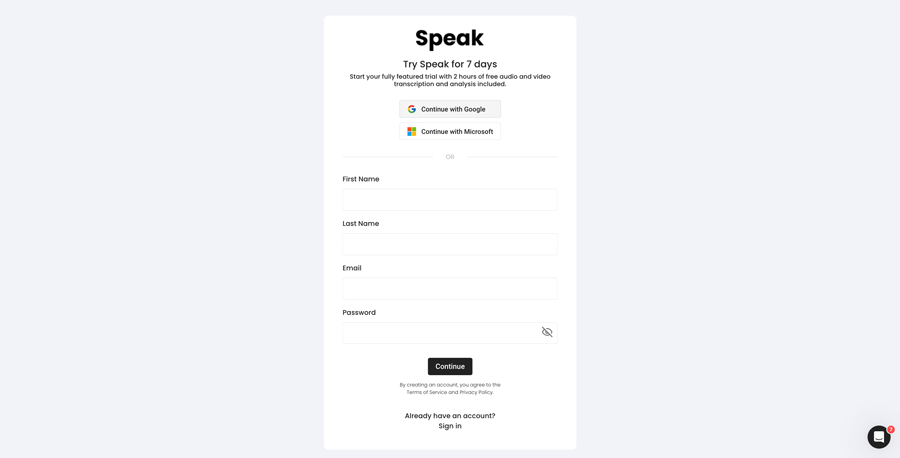
Passo 1: Registrazione a Speak
Registrarsi a Speak utilizzando questo link.
Once you register, you can instantly begin translating your English to Chinese (Traditional) file(s).
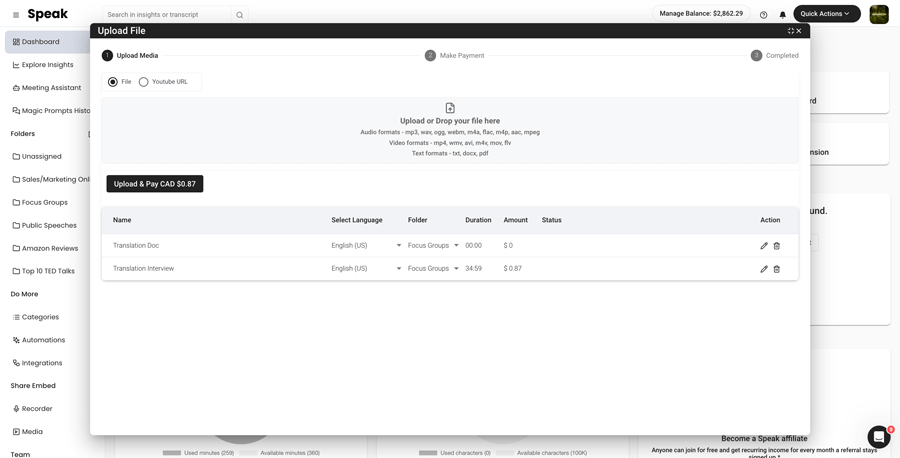
Fase 2: Caricare i file in inglese
Non appena si effettua il login, si viene reindirizzati alla dashboard.
A questo punto, è possibile selezionare l'azione rapida "Nuovo caricamento".
In Speak è possibile caricare, trascrivere e tradurre file audio, video e di testo in una sola volta! Se avete un video, potete usare il nostro Convertitore video-testo AI per convertire i video in testo; se si dispone di audio, è possibile utilizzare il nostro Convertitore audio-testo AI per convertire l'audio in testo. È anche possibile trascrivere i video di YouTube e utilizzare l'intelligenza artificiale per analizzare il testo.
Formati audio e video supportati
- Convertire MP4 in testo
- Convertire M4A in testo
- Convertire MP3 in testo
- Convertire OGG in testo
- Convertire MPEG in testo
- Convertire WEBM in testo
- Convertire MOV in testo
- Convertire M4P in testo
- Convertire WMV in testo
- Convertire WAV in testo
- Convertire M4V in testo
- Da audio-video a testo
- Convertire AVI in testo
- Convertire video in articoli
Lingue di trascrizione supportate
- Come trascrivere l'afrikaans
- Come trascrivere l'arabo in Egitto
- Come trascrivere l'arabo iracheno
- Come trascrivere Israele in arabo
- Come trascrivere la Giordania araba
- Come trascrivere l'arabo in Kuwait
- Come trascrivere il Libano arabo
- Come trascrivere l'arabo standard moderno del Bahrain
- Come trascrivere l'arabo standard moderno
- Come trascrivere l'arabo in Oman
- Come trascrivere l'arabo dell'Autorità Palestinese
- Come trascrivere l'arabo del Qatar
- Come trascrivere l'arabo in Arabia Saudita
- Come trascrivere l'arabo Repubblica Araba Siriana
- Come trascrivere l'arabo U.A.E.
- Come trascrivere l'armeno
- Come trascrivere il bulgaro
- Come trascrivere il catalano
- Come trascrivere il cinese cantonese tradizionale
- Come trascrivere il cinese semplificato
- Come trascrivere il croato
- Come trascrivere il ceco
- Come trascrivere il danese
- Come trascrivere l'olandese
- Come trascrivere l'inglese in Australia
- Come trascrivere l'inglese britannico
- Come trascrivere l'inglese indiano
- Come trascrivere l'irlandese inglese
- Come trascrivere l'inglese in Nuova Zelanda
- Come trascrivere lo scozzese inglese
- Come trascrivere l'inglese sudafricano
- Come trascrivere l'inglese Regno Unito
- Come trascrivere l'inglese Stati Uniti
- Come trascrivere l'estone
- Come trascrivere il farsi
- Come trascrivere il finlandese
- Come trascrivere il Canada francese
- Come trascrivere la Svizzera tedesca
- Come trascrivere il tedesco
- Come trascrivere il greco
- Come trascrivere il gujarati
- Come trascrivere l'ebraico
- Come trascrivere l'hindi
- Come trascrivere l'ungherese
- Come trascrivere l'islandese
- Come trascrivere l'indonesiano
- Come trascrivere le interviste
- Come trascrivere l'irlandese
- Come trascrivere l'italiano
- Come trascrivere il giapponese
- Come trascrivere il Kannada
- Come trascrivere il coreano
- Come trascrivere il lettone
- Come trascrivere il lituano
- Come trascrivere il malese
- Come trascrivere il malayalam
- Come trascrivere il norvegese
- Come trascrivere il persiano
- Come trascrivere il polacco
- Come trascrivere il portoghese brasiliano
- Come trascrivere il portoghese in Portogallo
- Come trascrivere il portoghese
- Come trascrivere il rumeno
- Come trascrivere il russo
- Come trascrivere lo slovacco
- Come trascrivere lo sloveno
- Come trascrivere lo spagnolo del Messico
- Come trascrivere lo svedese
- Come trascrivere il Tamil
- Come trascrivere il telugu
- Come trascrivere il thailandese
- Come trascrivere il turco
- Come trascrivere l'ucraino
- Come trascrivere il vietnamita
- Trascrivere il danese
- Trascrivere l'inglese
- Trascrivere il francese
- Trascrivere il tedesco
- Trascrivere il portoghese
- Trascrivere lo spagnolo
Abbiamo anche un Assistente riunioni AI e Annotatore AI per acquisire automaticamente le riunioni e un registratore vocale, registratore audio e video incorporabile, e registratore di schermo.
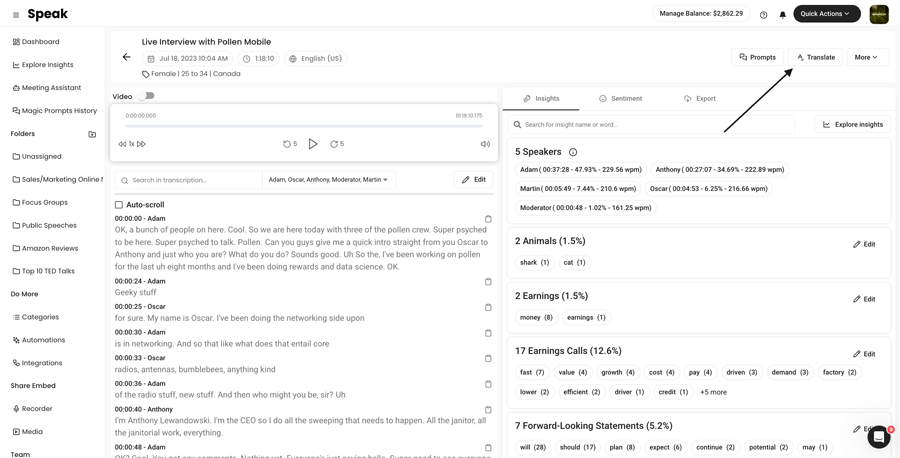
Step 3: Translate Your English file(s) to Chinese (Traditional)
Una volta caricato il file, è sufficiente visitare il file e selezionare "Traduci".
Se si tratta di un file audio e video, Speak chiederà se si desidera mantenere i nomi degli oratori e gli orari nella traduzione.
Volete tradurre molti file contemporaneamente? Nessun problema!
You can view the files you want to automatically translate from English to Chinese (Traditional) from the folder level and instantly translate as many files as you need with our artificial intelligence translation in just a few clicks.
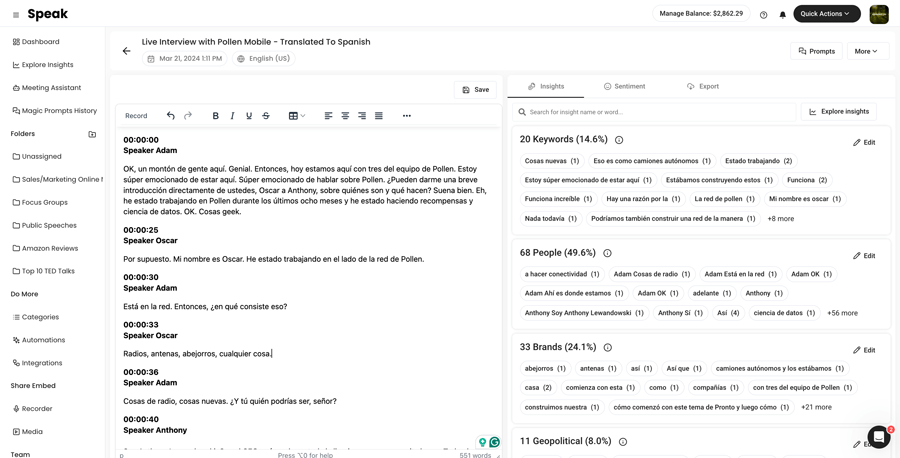
Step 4: That’s It! View, Analyze, Modify & Export Your New Chinese (Traditional) file(s)
Una volta terminata la traduzione, verrete avvisati e vedrete un nuovo documento nella stessa cartella in cui si trova il file originale.
Il file avrà lo stesso nome, ma con un trattino che indica che si tratta della versione tradotta.
Avete bisogno di supporto per la vostra traduzione in inglese?
Siamo sempre qui e felici di aiutarvi a Speak!
Inviateci un messaggio sulla live chat nell'angolo in basso a destra e ci assicureremo che siate impostati per il successo.
Siete interessati a tradurre l'inglese o altre lingue in altre lingue? Visualizza il nostro elenco completo di traduzioni supportate lingue qui.
Automatic, accurate, instant AI translation from English to Chinese (Traditional) is here for you.
Registrarsi a Speak utilizzando questo link and begin translating English to Chinese (Traditional) today.
Unlocking Global Opportunities: Translate English to Chinese (Traditional)
In today’s fast-paced, digital-first world, the ability to communicate across languages and cultures is more than just a nice-to-have; it’s a necessity. For businesses and researchers looking to make their mark on the global stage, translating content from English to Chinese (Traditional) is a key step in bridging communication gaps and unlocking a world of opportunities.
Why Translate English to Chinese (Traditional)?
Chinese (Traditional) is not just another language; it’s a gateway to engaging with one of the largest markets and most dynamic cultures in the world. By translating content, whether it’s audio, video, or text, from English to Chinese (Traditional), you’re opening doors to millions of potential customers, collaborators, and audiences.
The Value of Automatic Translation
Automatic translation, powered by AI and NLP (Natural Language Processing), has revolutionized how we approach language barriers. Companies like Speak AI are at the forefront of this transformation, providing seamless, accurate, and efficient translation services that save time, reduce costs, and enhance communication.
Benefits for Researchers and Businesses
Translating content automatically can significantly benefit researchers and businesses in several ways:
- Global Reach: Broaden your audience or research impact by making your work accessible to Traditional Chinese speakers.
- Conveniente: Automatic translation is a cost-efficient alternative to manual translation, reducing the need for expensive language services.
- Time-Saving: AI-driven translation drastically cuts down the time required to translate documents, allowing you to focus on your core activities.
- Accuracy and Context: Advanced NLP algorithms ensure translations are not only accurate but also contextually relevant.
Exploring the Global Landscape: English and Chinese (Traditional)
Where Are These Languages Popular?
English and Chinese (Traditional) are among the most spoken languages worldwide. English serves as a lingua franca in many parts of the globe, while Traditional Chinese is predominantly used in Taiwan, Hong Kong, and Macau. Impressively, these regions are not only cultural and economic hubs but also pivotal in international relations and global trade networks.
Interesting Statistics and History
The history of Traditional Chinese dates back thousands of years, making it one of the oldest written languages still in use today. Despite the adoption of Simplified Chinese in mainland China, Traditional Chinese has maintained its significance, with over 20 million people using it as their primary language.
Delving Into Languages: English vs. Chinese (Traditional)
Fatti divertenti
English and Chinese (Traditional) are fascinating in their uniqueness. For instance, Chinese is a tonal language, meaning the tone in which a word is spoken can change its meaning entirely. English, on the other hand, places a heavy emphasis on syntax and word order.
Differenze e somiglianze
While English and Chinese (Traditional) may seem worlds apart, they share common goals in communication and expression. Both languages have rich vocabularies and deep literary traditions that reflect the cultures they originated from. However, their writing systems, grammar rules, and phonetics are majorly different, offering unique challenges and rewards to learners and translators alike.
Speak AI: Your Partner in Breaking Language Barriers
At Speak AI, we understand the importance of accurate and nuanced translation. Our software integrates NLP, large language models, data visualization, and Generative AI to deliver top-quality English to Chinese (Traditional) translation. Whether you’re looking to automatically translate meetings, research papers, or global campaigns, we offer what you need with a 4.9 rating on G2 and a trusted user base of over 150K.
AI Meeting Assistant: A Game-Changer for Global Communication
Our AI Meeting Assistant is an innovative tool that joins meetings on platforms like Microsoft Teams, Zoom, Google Meet, and Webex. It automatically transcribes and analyzes conversations, offering real-time translation and insights. This tool is an invaluable asset for researchers and businesses aiming to excel in a multi-lingual, multi-cultural world.
The Path Forward
Translating English to Chinese (Traditional) is not just about converting words; it’s about connecting worlds. With the right tools and technologies, like those offered by Speak AI, businesses and researchers can overcome language barriers, embrace cultural diversity, and thrive in the global marketplace.
Embrace the future of communication. Explore how Speak AI can transform your approach to language and unlock the full potential of your global endeavors.
FAQ
What locations are English and Chinese (Traditional) popular?
English is a global lingua franca, while Traditional Chinese is primarily used in Taiwan, Hong Kong, and Macau. Both languages play crucial roles in international business, education, and diplomacy.
What are some fun facts about English and Chinese (Traditional)?
English’s syntax and word order drastically impact its meaning, whereas Chinese’s tone can change a word’s meaning. Both languages have evolved richly over centuries, reflecting their cultures and histories.
What are the differences and similarities between English and Chinese (Traditional)?
While vastly different in grammar, phonetics, and writing system, both languages serve the fundamental purpose of communication and expression, showcasing the diversity and unity of human language.
Tradurre l'inglese in queste altre lingue supportate:
- Tradurre dall'inglese all'arabo (Egitto)
- Tradurre dall'inglese all'arabo (Iraq)
- Tradurre dall'inglese all'arabo (Israele)
- Tradurre dall'inglese all'arabo (Giordania)
- Tradurre dall'inglese all'arabo (Kuwait)
- Tradurre dall'inglese all'arabo (Libano)
- Tradurre dall'inglese all'arabo (Oman)
- Tradurre dall'inglese all'arabo (Autorità Palestinese)
- Tradurre dall'inglese all'arabo (Qatar)
- Tradurre dall'inglese all'arabo (Arabia Saudita)
- Tradurre dall'inglese all'arabo (Repubblica Araba Siriana)
- Tradurre dall'inglese all'arabo (Emirati Arabi Uniti)
- Tradurre dall'inglese all'arabo Modern Standard (Bahrain)
- Tradurre dall'inglese all'armeno
- Tradurre dall'inglese al bulgaro
- Tradurre dall'inglese al catalano
- Tradurre dall'inglese al cinese (cantonese, tradizionale)
- Tradurre dall'inglese al cinese (semplificato)
- Tradurre dall'inglese al cinese (tradizionale)
- Tradurre dall'inglese al croato
- Tradurre dall'inglese al ceco
- Tradurre dall'inglese al danese
- Tradurre dall'inglese all'olandese
- Tradurre da inglese a inglese
- Tradurre da inglese a inglese (Australia)Tradurre da inglese a inglese (India)
- Tradurre da inglese a inglese (Irlanda)
- Tradurre da inglese a inglese (Nuova Zelanda)
- Tradurre da inglese a inglese (scozzese)
- Tradurre da inglese a inglese (Sudafrica)
- Tradurre da inglese a inglese (Regno Unito)
- Tradurre da inglese a inglese (Stati Uniti)
- Tradurre dall'inglese all'estone
- Tradurre dall'inglese al farsi
- Tradurre dall'inglese al finlandese
- Tradurre dall'inglese al francese
- Tradurre dall'inglese al francese (Canada)
- Tradurre dall'inglese al tedesco
- Tradurre dall'inglese al tedesco (Svizzera)
- Tradurre dall'inglese al greco
- Tradurre dall'inglese al gujarati
- Tradurre dall'inglese all'ebraico
- Tradurre dall'inglese all'hindi
- Tradurre dall'inglese all'ungherese
- Tradurre dall'inglese all'islandese
- Tradurre dall'inglese all'indonesiano
- Tradurre dall'inglese all'irlandese
- Tradurre dall'inglese all'italiano
- Tradurre dall'inglese al giapponese
- Tradurre dall'inglese al kannada
- Tradurre dall'inglese al coreano
- Tradurre dall'inglese al lettone
- Tradurre dall'inglese al lituano
- Tradurre dall'inglese al malese
- Tradurre dall'inglese al malayalam
- Tradurre dall'inglese al norvegese
- Tradurre dall'inglese al persiano
- Tradurre dall'inglese al polacco
- Tradurre dall'inglese al portoghese
- Tradurre dall'inglese al portoghese (brasiliano)
- Tradurre dall'inglese al portoghese (Portogallo)
- Tradurre dall'inglese al rumeno
- Tradurre dall'inglese al russo
- Tradurre dall'inglese al slovacco
- Tradurre dall'inglese allo sloveno
- Tradurre dall'inglese allo spagnolo
- Tradurre dall'inglese allo spagnolo (Messico)
- Tradurre dall'inglese allo svedese
- Tradurre dall'inglese al tamil
- Tradurre dall'inglese al telugu
- Tradurre dall'inglese al tailandese
- Tradurre dall'inglese al turco
- Tradurre dall'inglese all'ucraino
- Tradurre dall'inglese al vietnamita
Traduci & Trascrivi con Speak AI
Speak AI supporta la trascrizione e l'analisi in oltre 100 lingue. Carica il tuo audio o video e ottieni trascrizione potenziata da AI, assistenza di traduzione e analitiche NLP istantanee.
 English
 Español
 Français
 Italiano
 العربية
 Português do Brasil
 Nederlands
 Deutsch
 עִבְרִית
 Русский
 日本語
 Polski
 Čeština
 Українська
 Slovenščina
 Svenska
 Ελληνικά
 Norsk bokmål
 简体中文
 Türkçe
 Català
 Magyar
 한국어
 Slovenčina
 Suomi