
Comment créer des sous-titres chinois (traditionnels)
Are you looking for a way to create Chinese (Traditional) subtitles for your audio and video content? Subtitles and captions are important for making audio and video content accessible to a wider audience. In this article, we’ll explain what subtitles are, how they differ from captions, and how to create Chinese (Traditional) subtitles for your content using Speak AI’s natural language platform.
What Are Subtitles and How Are They Different From Captions?
Subtitles and captions are both forms of text that can be added to audio and video content. Subtitles are usually used for foreign language content, while captions are used for content in the same language as the audience. Subtitles represent the audio of the video in written form, while captions also include sound effects and speaker identification.
Why Create Chinese (Traditional) Subtitles?
Chinese (Traditional) is spoken by more than 1.3 billion people worldwide, primarily in East and Southeast Asia. It is the official language of Taiwan and one of the official languages of China, Singapore, and Hong Kong. Chinese (Traditional) is also spoken by many people in the United States, Canada, and other parts of the world.
Creating subtitles for audio and video content in Chinese (Traditional) can help make the content more accessible to a wider audience. Subtitles can help people with hearing impairments or those who don’t understand the language of the content to follow along with the audio and video. As a result, subtitles can help increase the reach of your content and engage more viewers.
How To Create Chinese (Traditional) Subtitles With Speak AI
Speak AI is a natural language platform that can help you create subtitles in Chinese (Traditional). The platform uses speech recognition and natural language processing technology to accurately transcribe audio and video content. Once the transcription is complete, you can create subtitles in Chinese (Traditional) in minutes.
Speak AI can help researchers, marketers, and businesses transcribe audio and video content quickly and accurately. The platform supports over 70 languages, including Chinese (Traditional), and can transcribe audio and video in any format. With Speak AI, you can quickly create subtitles in Chinese (Traditional) with no manual effort required.
Benefits Of Transcribing And Creating Subtitles In Chinese (Traditional)
Creating subtitles in Chinese (Traditional) can help you reach a wider audience and engage more viewers. Here are some of the benefits of transcribing and creating subtitles in Chinese (Traditional):
- Increases the reach of your content by making it accessible to a wider audience.
- Helps people with hearing impairments or those who don’t understand the language of the content to follow along with the audio and video.
- Saves time and effort by using automated transcription and subtitle creation tools.
- Improves the engagement and retention of viewers.
- Makes audio and video content searchable on search engines.
Conclusion
Creating subtitles in Chinese (Traditional) can help you reach a wider audience and engage more viewers. Speak AI’s natural language platform can help you quickly and accurately transcribe audio and video content in any format and create subtitles in Chinese (Traditional) in minutes. Try Speak AI today to take your content to the next level.
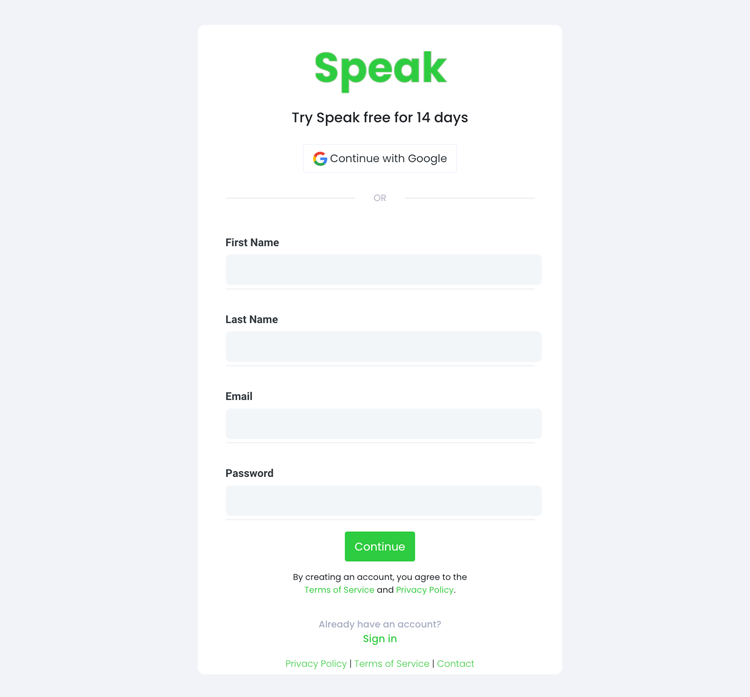
Étape 1 : Créer un compte Speak
To start your Chinese (Traditional) subtitling, you first need to créer un compte Speak. Pas d'inquiétude, c'est très facile à faire !
Our team is happy to give you a 7-day trial with trial credits for Chinese (Traditional) audio and video subtitling included.
To sign up for Speak and start your Chinese (Traditional) subtitling, visit the Speak app register page ici.
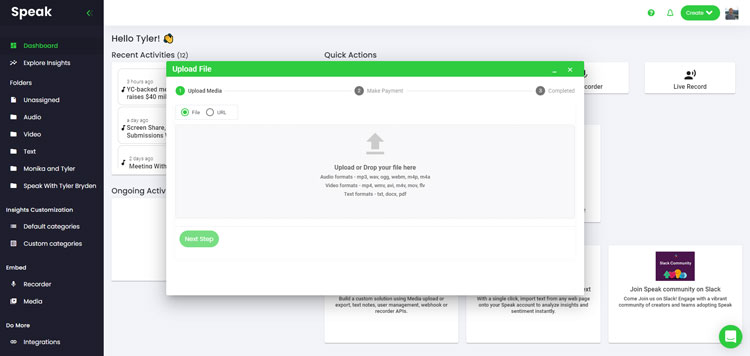
Step 2: Upload your Chinese (Traditional) file(s) for subtitling
Nous recommandons généralement les MP4 pour la vidéo et les MP3 pour l'audio.
However, we accept a range of audio and video file types. Once you upload your file all you have to do is select “Chinese (Traditional)” from the language dropdown menu to automatically subtitle in Chinese (Traditional).
You can upload your Chinese (Traditional) file for subtitling in several ways using Speak:
Accepted Chinese (Traditional) Audio File Types
- Chinese (Traditional) MP3
- Chinese (Traditional) M4A
- Chinese (Traditional) WAV
- Chinese (Traditional) OGG
- Chinese (Traditional) WEBM
- Chinese (Traditional) M4P
Accepted Chinese (Traditional) Video File Types
- Chinese (Traditional) MP4
- Chinese (Traditional) M4V
- Chinese (Traditional) WMV
- Chinese (Traditional) AVI
- Chinese (Traditional) MOV
- Chinese (Traditional) FLV
Publicly Available Chinese (Traditional) URLs
Vous pouvez également télécharger des médias sur Speak par le biais d'une adresse URL publique.
As long as the file type extension is available at the end of the URL you will have no problem importing your recording for automatic Chinese (Traditional) subtitling and analysis.
Chinese (Traditional) YouTube URLs
Speak est compatible avec les vidéos YouTube. Il suffit de copier l'URL de la vidéo YouTube (par exemple, https://www.youtube.com/watch?v=qKfcLcHeivc).
Speak trouvera automatiquement le fichier, calculera la longueur et importera la vidéo.
Veillez à utiliser le lien complet et non l'extrait abrégé de YouTube. En outre, veillez à supprimer le nom de la chaîne de l'URL.
Intégrations Speak
Comme indiqué, Speak contient également une série d'intégrations pour Zoom, Zapier, Vimeo et plus encore qui vous aideront à sous-titrer automatiquement vos médias.
Cette bibliothèque d'intégrations continue de s'enrichir ! Vous avez une demande ? N'hésitez pas à nous envoyer un message.
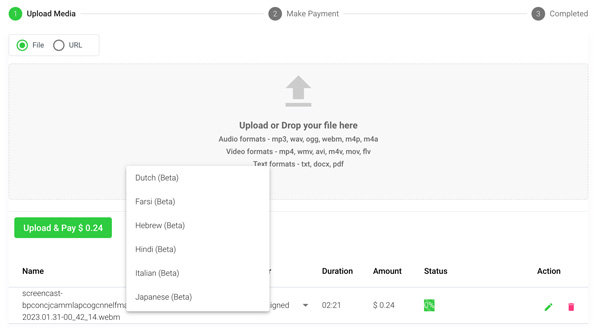
Étape 3 : Calculer et payer le total automatiquement
Once you have your Chinese (Traditional) audio or video file ready and load it into Speak, it will automatically calculate the total cost (trial credits are included in the trial – take advantage of it!).
Vous pouvez payer en souscrivant un plan personnalisé à l'aide de notre calculateur en temps réel avec minutes incluses.
Vous pouvez également ajouter un solde ou payer pour des téléchargements sans plan en utilisant votre carte de crédit.
Step 4: Wait for Speak to subtitle your Chinese (Traditional) audio or Chinese (Traditional) video
Our automated subtitling software will prepare your Chinese (Traditional) subtitles in as little as a few minutes. Generally, Speak takes about half the audio or video length to produce the subtitles and insights.
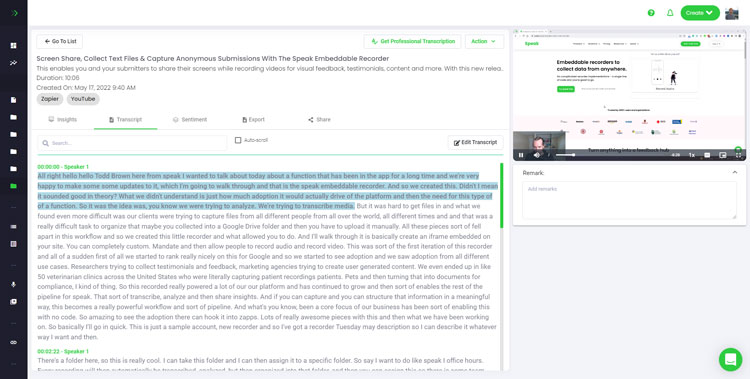
Once completed, you will get an email notification that your Chinese (Traditional) subtitles is complete. That email will contain a link back to the file so you can access the interactive media player with the Chinese (Traditional) subtitles, analysis, and export formats ready for you.
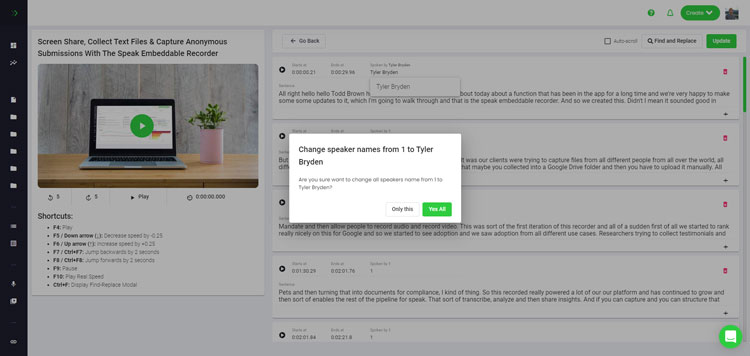
Step 5: View and edit your automated Chinese (Traditional) subtitles
Vous souhaitez modifier vous-même vos sous-titres ? Parfait ! Une fois vos sous-titres automatisés reçus, vous pouvez les modifier à tout moment.
Easily update speaker names, find and replace, and get your automatic Chinese (Traditional) subtitles up to full accuracy with our intuitive subtitles editing system.
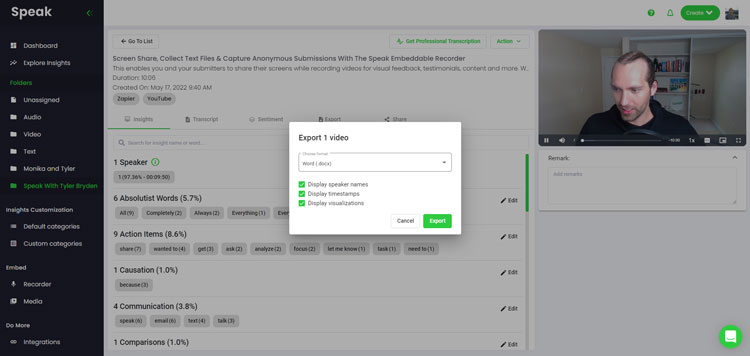
Step 6: Export your Chinese (Traditional) subtitles and share interactive media players
With Speak, you can easily export Chinese (Traditional) subtitles to many formats.
Below is a list of options for exporting your Chinese (Traditional) subtitles in Speak:
- Export Chinese (Traditional) subtitles to SRTs
- Export Chinese (Traditional) subtitles to VTTs
Un moyen plus efficace de partager des sous-titres est d'utiliser un médiathèque partageable qui comprend le fichier multimédia, les informations de l'IA et les sous-titres interactifs.
Il y a bien plus que vous pouvez faire avec Speak pour enrichir la valeur de vos médias et de vos sous-titres.
N'hésitez pas à nous envoyer un message sur le chat en direct - nous sommes toujours là pour vous aider !
We talked about Chinese (Traditional) subtitling here, but you may be interested in how to subtitle in other languages instantly and easily with Speak’s intuitive subtitling and natural language processing software.
Nous avons partagé ci-dessous des ressources sur toutes les langues que Speak peut vous aider à sous-titrer !
Join 300,000+ users finding radical efficiencies with their audio, video and text data to drive value.
How Much Does It Cost To Subtitle Chinese (Traditional)?
Speak offers highly competitive pricing for Chinese (Traditional) subtitling compared to other subtitling solutions. For a starting user, Speak offers automated Chinese (Traditional) subtitling from 2 credits per hour of audio on pay as you go (1 credit = US$1). Pro includes 25 credits per user per month.
Nous adaptons également nos prix en fonction du volume des médias et pouvons offrir des remises encore plus importantes aux gros clients.
So, if you have over 100 hours of Chinese (Traditional) subtitling per month please contact us through live chat and we will set you up with a customized price per minute to make Chinese (Traditional) subtitling even more affordable!
You can learn more about how to subtitle Chinese (Traditional) with Speak and the relevant pricing on the page de tarification du site web et le page de tarification in-app.
What Can You Subtitle In Chinese (Traditional)?
- Subtitle Chinese (Traditional) interviews
- Subtitle Chinese (Traditional) videos
- Subtitle Chinese (Traditional) audio
- Subtitle Chinese (Traditional) earnings calls
- Subtitle Chinese (Traditional) focus groups
- Subtitle Chinese (Traditional) meetings
- Subtitle Chinese (Traditional) phone calls
- Subtitle Chinese (Traditional) YouTube videos
- Subtitle Chinese (Traditional) Vimeo videos
- Subtitle Chinese (Traditional) Zoom recordings
- Subtitle Chinese (Traditional) Google Meet recordings
- Sous-titrer les enregistrements Microsoft Teams
- Subtitle Chinese (Traditional) podcasts
Et bien plus encore !
Quelles autres langues peuvent parler des sous-titres ?
Speak compte déjà des utilisateurs dans plus de 90 pays et nous recevons continuellement des demandes de sous-titrage et d'analyse dans différentes langues.
C'est pourquoi nous ajoutons continuellement de nouvelles langues à Speak ! Voici quelques-unes des langues qui s'ajoutent à la liste des langues proposées par Speak :
- Comment créer des sous-titres en afrikaans
- Comment créer des sous-titres en arabe (Égypte)
- Comment créer des sous-titres en arabe (Irak)
- Comment créer des sous-titres en arabe (Israël)
- Comment créer des sous-titres en arabe (Jordanie)
- Comment créer des sous-titres en arabe (Koweït)
- Comment créer des sous-titres en arabe (Liban)
- Comment créer des sous-titres en arabe (Oman)
- Comment créer des sous-titres en arabe (Autorité palestinienne)
- Comment créer des sous-titres en arabe (Qatar)
- Comment créer des sous-titres en arabe (Arabie saoudite)
- Comment créer des sous-titres en arabe (République arabe syrienne)
- Comment créer des sous-titres en arabe (Émirats arabes unis)
- Comment créer des sous-titres en arabe standard moderne (Bahreïn)
- Comment créer des sous-titres arméniens
- Comment créer des sous-titres bulgares
- Comment créer des sous-titres en catalans
- Comment créer des sous-titres chinois (cantonais, traditionnels)
- Comment créer des sous-titres en chinois (simplifié)
- Comment créer des sous-titres chinois (traditionnels)
- Comment créer des sous-titres en croate
- Comment créer des sous-titres en tchèque
- Comment créer des sous-titres en danois
- Comment créer des sous-titres en néerlandais
- Comment créer des sous-titres en anglais
- Comment créer des sous-titres en anglais (Australie)
- Comment créer des sous-titres anglais (indiens)
- Comment créer des sous-titres anglais (irlandais)
- Comment créer des sous-titres en anglais (Nouvelle-Zélande)
- Comment créer des sous-titres anglais (écossais)
- Comment créer des sous-titres en anglais (sud-africain)
- Comment créer des sous-titres en anglais (Royaume-Uni)
- Comment créer des sous-titres en anglais (États-Unis)
- Comment créer des sous-titres en estonien
- Comment créer des sous-titres en farsi
- Comment créer des sous-titres en finnois
- Comment créer des sous-titres français
- Comment créer des sous-titres en français (Canada)
- Comment créer des sous-titres allemands
- Comment créer des sous-titres en allemand (suisses)
- Comment créer des sous-titres grecs
- Comment créer des sous-titres en gujarati
- Comment créer des sous-titres en hébreu
- Comment créer des sous-titres en hindi
- Comment créer des sous-titres en hongrois
- Comment créer des sous-titres islandais
- Comment créer des sous-titres indonésiens
- Comment créer des sous-titres irlandais
- Comment créer des sous-titres italiens
- Comment créer des sous-titres japonais
- Comment créer des sous-titres en kannada
- Comment créer des sous-titres coréens
- Comment créer des sous-titres en letton
- Comment créer des sous-titres lituaniens
- Comment créer des sous-titres en malais
- Comment créer des sous-titres en malayalam
- Comment créer des sous-titres norvégiens
- Comment créer des sous-titres en persan
- Comment créer des sous-titres en polonais
- Comment créer des sous-titres en portugais
- Comment créer des sous-titres portugais (brésiliens)
- Comment créer des sous-titres en portugais (Portugal)
- Comment créer des sous-titres en roumain
- Comment créer des sous-titres en russe
- Comment créer des sous-titres en slovaque
- Comment créer des sous-titres en slovène
- Comment créer des sous-titres en espagnol
- Comment créer des sous-titres en espagnol (Mexique)
- Comment créer des sous-titres suédois
- Comment créer des sous-titres en tamoul
- Comment créer des sous-titres en télougou
- Comment créer des sous-titres en thaï
- Comment créer des sous-titres turcs
- Comment créer des sous-titres ukrainiens
- Comment créer des sous-titres vietnamiens
Il y en a maintenant beaucoup plus !
Vous pouvez voir la liste complète des langues prises en charge par Speak par le biais du logiciel et des API.
Explorez Speak AI
Speak AI est une plateforme de recherche en technologies vocales et en intelligence artificielle. Elle propose la transcription dans plus de 100 langues, l'analyse du traitement automatique du langage naturel (TALN), l'analyse des sentiments, des agents IA et du conseil aux entreprises.
 English
 Español
 Français
 Italiano
 العربية
 Português do Brasil
 Nederlands
 Deutsch
 עִבְרִית
 Русский
 日本語
 Polski
 Čeština
 Українська
 Slovenščina
 Svenska
 Ελληνικά
 Norsk bokmål
 简体中文
 Türkçe
 Català
 Magyar
 한국어
 Slovenčina
 Suomi