
Creating Chinese (Simplified) Captions with Speak AI
Are you looking for an efficient way to create captions in Chinese (Simplified)? Speak AI is the perfect platform to help you do just that. As a leading speech recognition and natural language platform, Speak AI has over 50,000 users and is trusted by researchers, marketers, and businesses all over the world.
What are Captions and How Are They Different from Subtitles?
Captions are a type of audio-visual text that is used to describe the spoken words, background noises, and music in audio and video recordings. Captions are different from subtitles in that they provide a more detailed account of the audio and video content, including descriptions of non-verbal elements such as laughter, music, and sound effects.
Where is Chinese (Simplified) Used?
Chinese (Simplified) is one of the most widely spoken languages in the world. It is the official language of mainland China, and is also used in Singapore, Malaysia, and other parts of the world. According to the 2019 census, Chinese (Simplified) is spoken by 1.2 billion people worldwide.
Why Should You Create Captions in Chinese (Simplified)?
Creating captions in Chinese (Simplified) can have numerous benefits. First, it can help to make audio and video content more accessible for viewers who are not native speakers of the language. Captions can also help to improve the quality of the content, as they provide more detailed descriptions of the audio and video elements. Finally, captions can also increase the reach of your content, as they can be used to target viewers in different parts of the world.
How Can Speak AI Help You Create Chinese (Simplified) Captions?
Speak AI is the perfect platform for creating captions in Chinese (Simplified). With its powerful speech recognition and natural language platform, it can help you create captions quickly and accurately. Speak AI uses sophisticated algorithms to analyze audio and video recordings and generate high-quality captions in Chinese (Simplified). It also offers a range of features to help you customize the captions, such as the ability to add timecodes, add descriptions of non-verbal elements, and adjust the font size and color.
The Benefits of Transcription and Captions
Creating captions and transcripts of audio and video recordings can have numerous benefits. Transcripts can be used to improve the searchability of audio and video content, as they make it easier for viewers to find the information they are looking for. Transcripts can also be used to create subtitles in different languages, allowing you to target viewers in different parts of the world. Finally, transcripts can be used to generate transcripts in other formats, such as text or HTML, which can be used for further analysis.
Conclusión
Creating captions in Chinese (Simplified) is an effective way to make audio and video content more accessible to viewers, improve the quality of the content, and increase its reach. Speak AI is the perfect platform for creating high-quality captions quickly and accurately. With its powerful speech recognition and natural language platform, Speak AI is trusted by researchers, marketers, and businesses all over the world. Sign up today and start creating captions in Chinese (Simplified)!
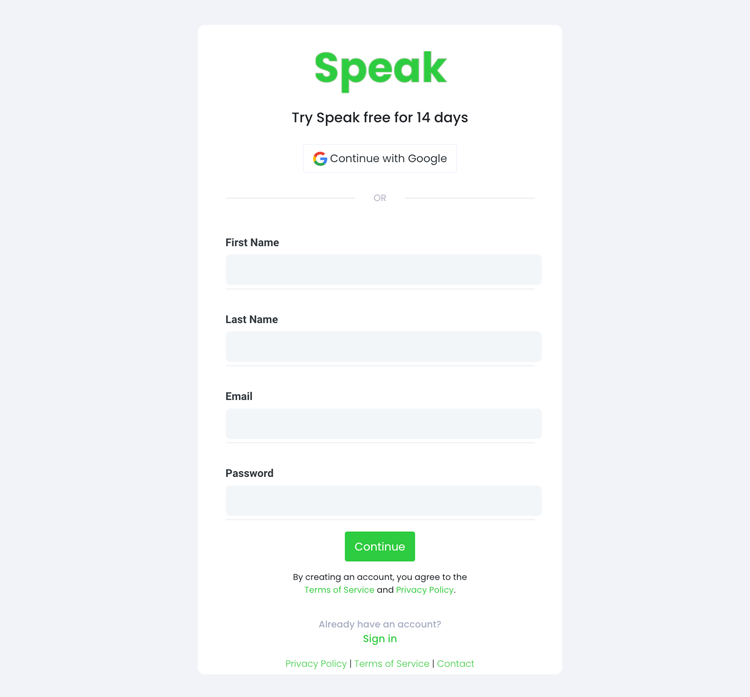
Paso 1: Crear una cuenta Speak
To start your Chinese (Simplified) captioning, you first need to crear una cuenta Speak. No te preocupes, es muy fácil de hacer.
Our team is happy to give you a 7-day trial with trial credits for Chinese (Simplified) audio and video captioning included.
To sign up for Speak and start your Chinese (Simplified) captioning, visit the Speak app register page here.
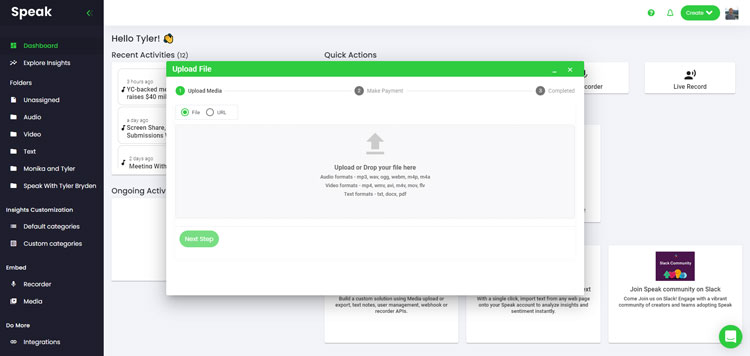
Step 2: Upload your Chinese (Simplified) file(s) for Captioning
Normalmente recomendamos MP4 para vídeo o MP3 para audio.
However, we accept a range of audio and video file types. Once you upload your file all you have to do is select “Chinese (Simplified)” from the language dropdown menu to automatically caption in Chinese (Simplified).
You can upload your Chinese (Simplified) file for captioning in several ways using Speak:
Tipos de archivos de audio aceptados en chino simplificado
- Chino (simplificado) MP3
- Chino (simplificado) M4A
- Chino (simplificado) WAV
- Chino (simplificado) OGG
- Chino (simplificado) WEBM
- Chino (simplificado) M4P
Tipos de archivos de vídeo aceptados en chino simplificado
- Chino (simplificado) MP4
- Chino (simplificado) M4V
- Chino (simplificado) WMV
- Chino (simplificado) AVI
- Chino (simplificado) MOV
- Chino (simplificado) FLV
URL chinas (simplificadas) de acceso público
También puedes subir archivos multimedia a Speak a través de una URL pública.
As long as the file type extension is available at the end of the URL you will have no problem importing your recording for automatic Chinese (Simplified) captioning and analysis.
URL de YouTube en chino (simplificado)
Speak es compatible con vídeos de YouTube. Todo lo que tienes que hacer es copiar la URL del vídeo de YouTube (por ejemplo, https://www.youtube.com/watch?v=qKfcLcHeivc).
Speak encontrará automáticamente el archivo, calculará la duración e importará el vídeo.
Asegúrate de utilizar el enlace completo y no el fragmento acortado de YouTube. Además, asegúrate de eliminar el nombre del canal de la URL.
Integraciones Speak
Como ya se ha mencionado, Speak también contiene una serie de integraciones para Zoom, ZapierVimeo y muchos más que te ayudarán a subtitular automáticamente tus archivos multimedia.
Esta biblioteca de integraciones sigue creciendo. ¿Tiene alguna petición? Envíenos un mensaje.
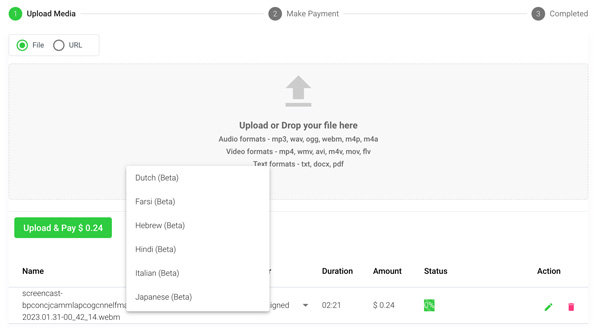
Paso 3: Calcular y pagar el total automáticamente
Once you have your Chinese (Simplified) audio or video file ready and load it into Speak, it will automatically calculate the total cost (trial credits are included in the trial – take advantage of it!).
Puede pagar suscribiéndose a un plan personalizado utilizando nuestra calculadora en tiempo real con minutos incluidos.
También puede añadir un saldo o pagar por las cargas sin plan utilizando su tarjeta de crédito.
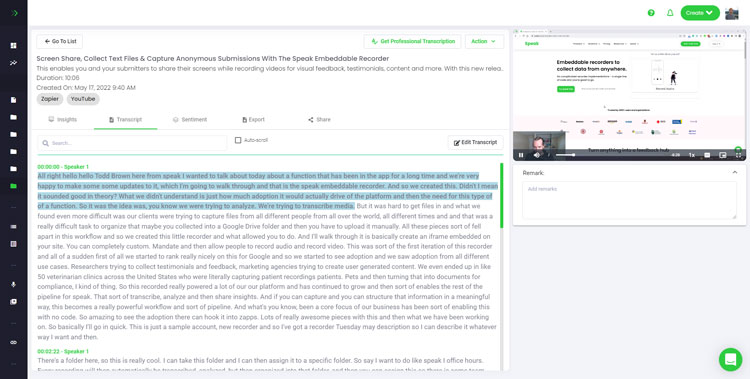
Step 4: Wait for Speak to caption your Chinese (Simplified) audio or Chinese (Simplified) video
Our automated captioning software will prepare your Chinese (Simplified) captions in as little as a few minutes. Generally, Speak takes about half the audio or video length to produce the captions and insights.
Once completed, you will get an email notification that your Chinese (Simplified) captions is complete. That email will contain a link back to the file so you can access the interactive media player with the Chinese (Simplified) captions, analysis, and export formats ready for you.
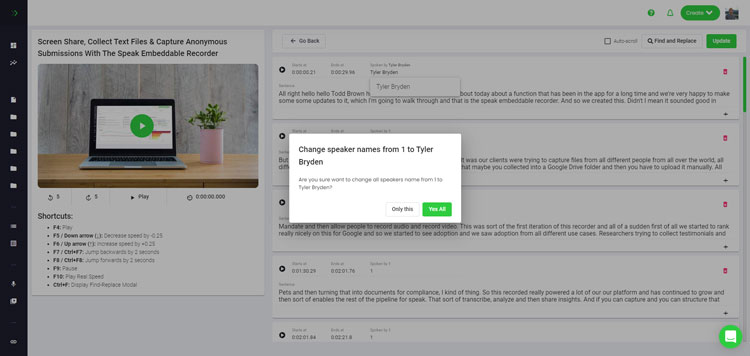
Step 5: View and edit your automated Chinese (Simplified) captions
¿Quieres encargarte tú mismo de la edición de los pies de foto? Muy bien. Cuando recibas los subtítulos automáticos, podrás editarlos en cualquier momento.
Easily update speaker names, find and replace, and get your automatic Chinese (Simplified) captions up to full accuracy with our intuitive captions editing system.
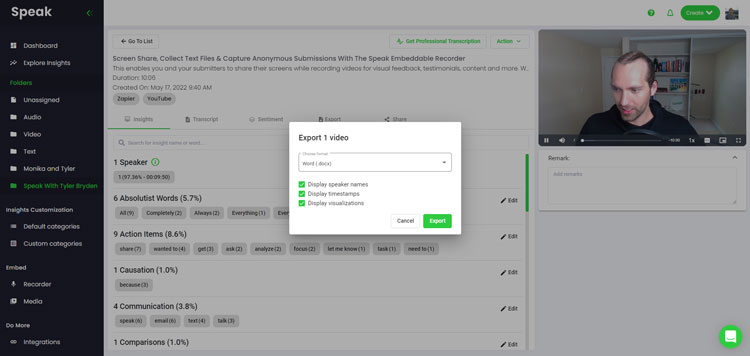
Step 6: Export your Chinese (Simplified) captions and share interactive media players
With Speak, you can easily export Chinese (Simplified) captions to many formats.
Below is a list of options for exporting your Chinese (Simplified) captions in Speak:
- Export Chinese (Simplified) captions to SRTs
- Export Chinese (Simplified) captions to VTTs
Una forma más eficaz de compartir subtítulos es a través de un mediateca para compartir que incluye el archivo multimedia, información sobre IA y subtítulos interactivos.
Puedes hacer mucho más con Speak para enriquecer el valor de tus medios y subtítulos.
No dude en enviarnos un mensaje al chat en directo: ¡siempre estamos aquí para ayudarle!
We talked about Chinese (Simplified) captioning here, but you may be interested in how to caption in other languages instantly and easily with Speak’s intuitive captioning and natural language processing software.
A continuación le ofrecemos recursos sobre todas las lenguas que Speak puede ayudarle a subtitular.
Join 300,000+ users finding radical efficiencies with their audio, video and text data to drive value.
How Much Does It Cost To Caption Chinese (Simplified)?
Speak offers highly competitive pricing for Chinese (Simplified) captioning compared to other captioning solutions. For a starting user, Speak offers automated Chinese (Simplified) captioning from 2 credits per hour of audio on pay as you go (1 credit = US$1). Pro includes 25 credits per user per month.
También escalamos nuestros precios en función del volumen de medios y podemos ofrecer descuentos aún mayores a los grandes clientes.
So, if you have over 100 hours of Chinese (Simplified) captioning per month please contact us through live chat and we will set you up with a customized price per minute to make Chinese (Simplified) captioning even more affordable!
You can learn more about how to caption Chinese (Simplified) with Speak and the relevant pricing on the página de precios del sitio web y el página de precios de la aplicación.
What Can You Caption In Chinese (Simplified)?
- Caption Chinese (Simplified) interviews
- Caption Chinese (Simplified) videos
- Caption Chinese (Simplified) audio
- Caption Chinese (Simplified) earnings calls
- Caption Chinese (Simplified) focus groups
- Caption Chinese (Simplified) meetings
- Caption Chinese (Simplified) phone calls
- Caption Chinese (Simplified) YouTube videos
- Caption Chinese (Simplified) Vimeo videos
- Caption Chinese (Simplified) Zoom recordings
- Caption Chinese (Simplified) Google Meet recordings
- Subtitular grabaciones de Microsoft Teams
- Caption Chinese (Simplified) podcasts
Y mucho más.
¿En qué otras lenguas puede hablarse el subtitulado?
Speak ya tiene usuarios de más de 90 países y continuamente recibimos peticiones para subtitular y analizar en distintos idiomas.
Por eso, ¡continuamente añadimos más idiomas a Speak! Estos son algunos de los idiomas que Speak ofrece:
- Cómo crear subtítulos en afrikáans
- Cómo crear subtítulos en árabe (Egipto)
- Cómo crear subtítulos en árabe (Iraq)
- Cómo crear subtítulos en árabe (Israel)
- Cómo crear subtítulos en árabe (Jordania)
- Cómo crear subtítulos en árabe (Kuwait)
- Cómo crear subtítulos en árabe (Líbano)
- Cómo crear subtítulos en árabe (Omán)
- Cómo crear subtítulos en árabe (Autoridad Palestina)
- Cómo crear subtítulos en árabe (Qatar)
- Cómo crear subtítulos en árabe (Arabia Saudí)
- Cómo crear subtítulos en árabe (República Árabe Siria)
- Cómo crear subtítulos en árabe (Emiratos Árabes Unidos)
- Cómo crear subtítulos en árabe estándar moderno (Bahréin)
- Cómo crear pies de foto armenios
- Cómo crear subtítulos en búlgaro
- Cómo crear subtítulos en catalán
- Cómo crear subtítulos en chino (cantonés, tradicional)
- Cómo crear subtítulos en chino (simplificado)
- Cómo crear subtítulos en chino (tradicional)
- Cómo crear subtítulos en croata
- Cómo crear pies de foto checos
- Cómo crear subtítulos en danés
- Cómo crear subtítulos en holandés
- Cómo crear subtítulos en inglés
- Cómo crear subtítulos en inglés (Australia)
- Cómo crear subtítulos en inglés (indio)
- Cómo crear subtítulos en inglés (irlandés)
- Cómo crear subtítulos en inglés (Nueva Zelanda)
- Cómo crear subtítulos en inglés (escocés)
- Cómo crear subtítulos en inglés (sudafricano)
- Cómo crear subtítulos en inglés (Reino Unido)
- Cómo crear subtítulos en inglés (Estados Unidos)
- Cómo crear subtítulos en estonio
- Cómo crear subtítulos en persa
- Cómo crear subtítulos en finés
- Cómo crear subtítulos en francés
- Cómo crear subtítulos en francés (Canadá)
- Cómo crear subtítulos en alemán
- Cómo crear subtítulos en alemán (suizo)
- Cómo crear pies de foto griegos
- Cómo crear subtítulos en gujarati
- Cómo crear subtítulos en hebreo
- Cómo crear subtítulos en hindi
- Cómo crear subtítulos en húngaro
- Cómo crear pies de foto islandeses
- Cómo crear subtítulos en indonesio
- Cómo crear pies de foto irlandeses
- Cómo crear pies de foto italianos
- Cómo crear subtítulos en japonés
- Cómo crear subtítulos en kannada
- Cómo crear pies de foto coreanos
- Cómo crear subtítulos en letón
- Cómo crear subtítulos en lituano
- Cómo crear subtítulos en malayo
- Cómo crear subtítulos en malayalam
- Cómo crear pies de foto noruegos
- Cómo crear pies de foto persas
- Cómo crear subtítulos en polaco
- Cómo crear subtítulos en portugués
- Cómo crear subtítulos en portugués (brasileño)
- Cómo crear subtítulos en portugués (Portugal)
- Cómo crear subtítulos en rumano
- Cómo crear subtítulos en ruso
- Cómo crear subtítulos en eslovaco
- Cómo crear subtítulos en esloveno
- Cómo crear subtítulos en español
- Cómo crear subtítulos en español (México)
- Cómo crear subtítulos en sueco
- Cómo crear subtítulos en tamil
- Cómo crear subtítulos en telugu
- Cómo crear subtítulos en tailandés
- Cómo crear subtítulos en turco
- Cómo crear pies de foto ucranianos
- Cómo crear subtítulos en vietnamita
¡Ahora hay muchos más añadidos!
Puede ver la lista completa de idiomas compatibles con Speak tanto a través del software como de las API.
Explora Hablar IA
Speak AI es una plataforma de investigación en tecnología de voz e inteligencia artificial. Ofrece transcripción en más de 100 idiomas, análisis de lenguaje natural (PLN), análisis de sentimientos, agentes de IA y consultoría empresarial.
 English
 Español
 Français
 Italiano
 العربية
 Português do Brasil
 Nederlands
 Deutsch
 עִבְרִית
 Русский
 日本語
 Polski
 Čeština
 Українська
 Slovenščina
 Svenska
 Ελληνικά
 Norsk bokmål
 简体中文
 Türkçe
 Català
 Magyar
 한국어
 Slovenčina
 Suomi