
How to Create Chinese (Cantonese, Traditional) Subtitles
Chinese (Cantonese, Traditional) is one of the most widely spoken languages in the world, with over 1.3 billion native speakers across countries like China, Hong Kong, Macau, Taiwan, and Singapore. This makes it one of the most important languages for businesses and researchers to understand and use.
Creating subtitles and transcripts for audio and video content in the Chinese (Cantonese, Traditional) language has many benefits, from improving accessibility and enabling content to reach new audiences, to understanding customer feedback and analyzing conversations.
What are Subtitles and How are they Different than Captions?
Subtitles are text versions of spoken dialogue in a video or audio file. They are a great way to increase the accessibility of a video, making it easier to follow the narrative and understand the content even if the audio is not clear or is inaudible.
Captions, on the other hand, include both dialogue and sound effects. Captions may also be used to add emphasis to a scene or for comedic effect.
Benefits of Transcription and Creating Subtitles in Chinese (Cantonese, Traditional)
Creating subtitles and transcripts in Chinese (Cantonese, Traditional) can be very beneficial for businesses, researchers, and marketers. Here are some of the benefits:
Reach New Audiences
By making your content accessible to those who speak Chinese (Cantonese, Traditional), you can reach new audiences and expand your presence in the global market. With subtitles, you can also make your content accessible to those who are deaf or hard of hearing.
Make Content Easier to Understand
Chinese (Cantonese, Traditional) subtitles can make videos easier to understand, as they provide the viewer with written dialogue that can be read and re-read as needed. This can be especially helpful when viewing content with unfamiliar accents or dialects, or when there is background noise that makes the audio difficult to understand.
Analyze Conversations
Creating subtitles and transcripts in Chinese (Cantonese, Traditional) can also be extremely useful for analysis. By transcribing audio and video, it’s easier to understand the conversations and gain insights into customer feedback. This can help businesses to better understand their customers and make informed decisions.
Drive Signups with Speak AI
Speak AI is a speech recognition and natural language platform with over 70,000 users. Creating subtitles and transcripts in Chinese (Cantonese, Traditional) can be a great way to drive sign-ups and get more users on the platform. With its powerful speech recognition technology, Speak AI can help researchers, marketers, and businesses to better understand their customers and gain valuable insights into their conversations.
Schlussfolgerung
Creating subtitles and transcripts in Chinese (Cantonese, Traditional) can be a great way to reach new audiences, make content easier to understand, and gain valuable insights into customer feedback. Speak AI is a powerful speech recognition and natural language platform that can help businesses and researchers to better understand their customers and drive more sign-ups.
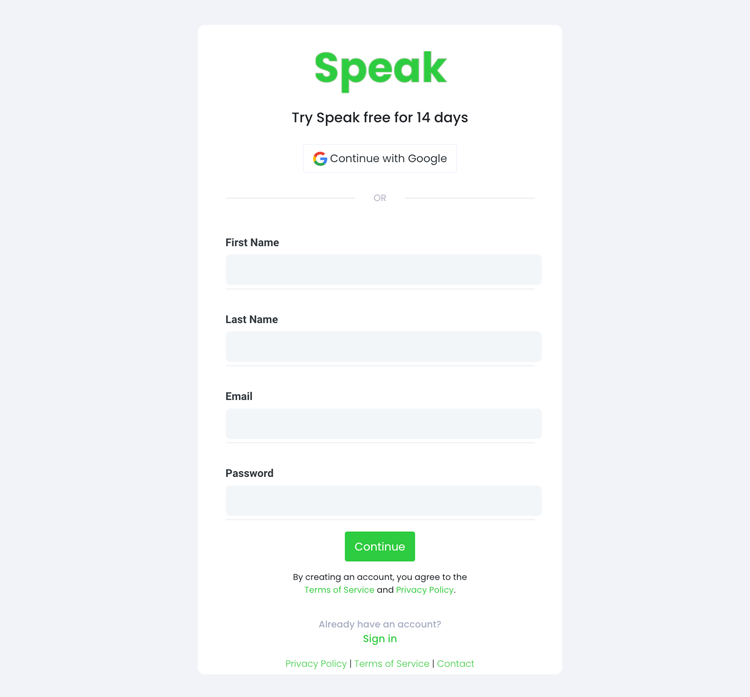
Schritt 1: Erstellen eines Speak-Kontos
To start your Chinese (Cantonese, Traditional) subtitling, you first need to ein Speak-Konto erstellen. Keine Sorge, das ist ganz einfach zu machen!
Our team is happy to give you a 7-day trial with trial credits for Chinese (Cantonese, Traditional) audio and video subtitling included.
To sign up for Speak and start your Chinese (Cantonese, Traditional) subtitling, visit the Speak app register page hier.
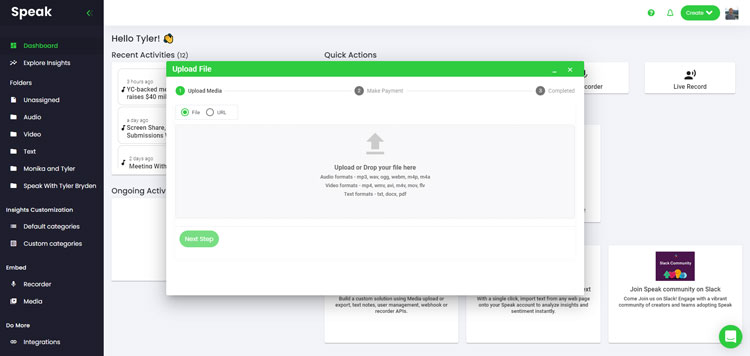
Step 2: Upload your Chinese (Cantonese, Traditional) file(s) for subtitling
Wir empfehlen in der Regel MP4s für Video und MP3s für Audio.
However, we accept a range of audio and video file types. Once you upload your file all you have to do is select “Chinese (Cantonese, Traditional)” from the language dropdown menu to automatically subtitle in Chinese (Cantonese, Traditional).
You can upload your Chinese (Cantonese, Traditional) file for subtitling in several ways using Speak:
Akzeptierte chinesische (Kantonesisch, Traditionell) Audiodateitypen
- Chinesisch (Kantonesisch, Traditionell) MP3
- Chinesisch (Kantonesisch, traditionell) M4A
- Chinesisch (Kantonesisch, Traditionell) WAV
- Chinesisch (Kantonesisch, Traditionell) OGG
- Chinesisch (Kantonesisch, Traditionell) WEBM
- Chinesisch (Kantonesisch, Traditionell) M4P
Akzeptierte chinesische (Kantonesisch, Traditionell) Videodateitypen
- Chinesisch (Kantonesisch, Traditionell) MP4
- Chinesisch (Kantonesisch, Traditionell) M4V
- Chinesisch (Kantonesisch, Traditionell) WMV
- Chinesisch (Kantonesisch, Traditionell) AVI
- Chinesisch (Kantonesisch, traditionell) MOV
- Chinesisch (Kantonesisch, Traditionell) FLV
Öffentlich verfügbare chinesische (Kantonesisch, Traditionell) URLs
Sie können Medien auch über eine öffentlich zugängliche URL auf Speak hochladen.
As long as the file type extension is available at the end of the URL you will have no problem importing your recording for automatic Chinese (Cantonese, Traditional) subtitling and analysis.
Chinesisch (Kantonesisch, Traditionell) YouTube URLs
Speak ist mit YouTube-Videos kompatibel. Alles, was Sie tun müssen, ist die URL des YouTube-Videos zu kopieren (zum Beispiel, https://www.youtube.com/watch?v=qKfcLcHeivc).
Speak findet die Datei automatisch, berechnet die Länge und importiert das Video.
Bitte stellen Sie sicher, dass Sie den vollständigen Link verwenden und nicht den verkürzten YouTube-Ausschnitt. Stellen Sie außerdem sicher, dass Sie den Kanalnamen aus der URL entfernen.
Sprechen Sie Integrationen
Wie bereits erwähnt, enthält Speak auch eine Reihe von Integrationen für Vergrößern, Zapier, Vimeo und mehr, die Ihnen dabei helfen, Ihre Medien automatisch mit Untertiteln zu versehen.
Die Bibliothek der Integrationen wird ständig erweitert! Haben Sie eine Anfrage? Schicken Sie uns einfach eine Nachricht.
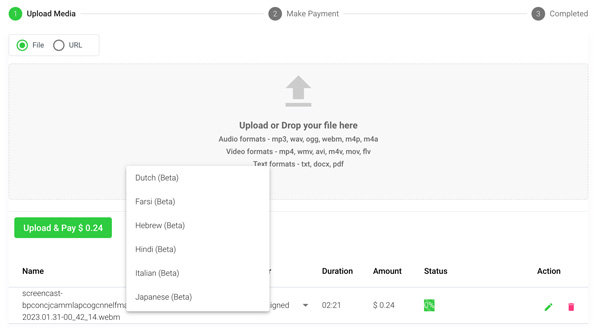
Schritt 3: Automatisches Berechnen und Bezahlen des Gesamtbetrags
Once you have your Chinese (Cantonese, Traditional) audio or video file ready and load it into Speak, it will automatically calculate the total cost (trial credits are included in the trial – take advantage of it!).
Sie können mit unserem Echtzeit-Rechner einen individuellen Tarif mit Inklusivminuten abschließen.
Sie können auch einen Saldo hinzufügen oder bezahlen Sie für Uploads ohne Plan mit Ihrem Kreditkarte.
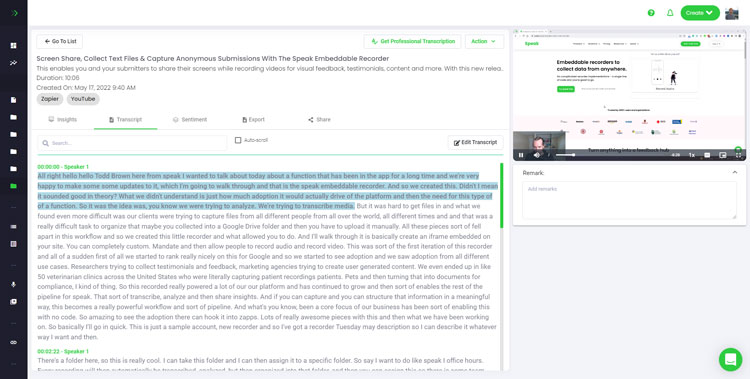
Step 4: Wait for Speak to subtitle your Chinese (Cantonese, Traditional) audio or Chinese (Cantonese, Traditional) video
Our automated subtitling software will prepare your Chinese (Cantonese, Traditional) subtitles in as little as a few minutes. Generally, Speak takes about half the audio or video length to produce the subtitles and insights.
Once completed, you will get an email notification that your Chinese (Cantonese, Traditional) subtitles is complete. That email will contain a link back to the file so you can access the interactive media player with the Chinese (Cantonese, Traditional) subtitles, analysis, and export formats ready for you.
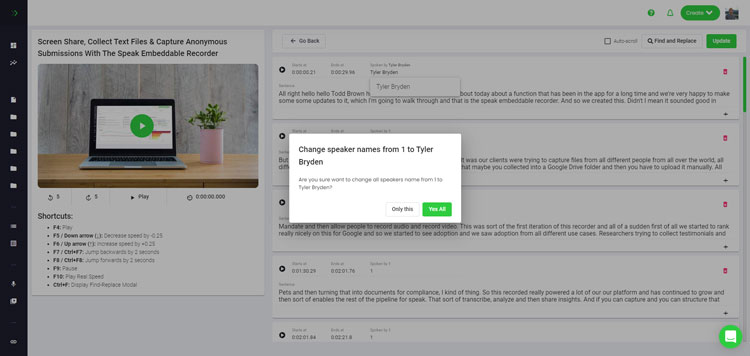
Step 5: View and edit your automated Chinese (Cantonese, Traditional) subtitles
Möchten Sie die Untertitel selbst bearbeiten? Kein Problem! Sobald Sie Ihre automatisierten Untertitel erhalten haben, können Sie diese jederzeit bearbeiten.
Easily update speaker names, find and replace, and get your automatic Chinese (Cantonese, Traditional) subtitles up to full accuracy with our intuitive subtitles editing system.
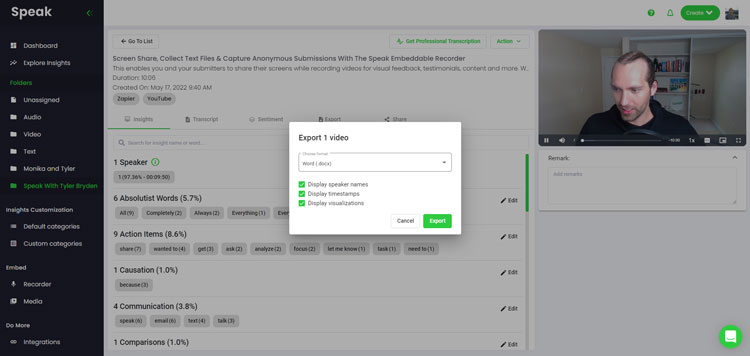
Step 6: Export your Chinese (Cantonese, Traditional) subtitles and share interactive media players
With Speak, you can easily export Chinese (Cantonese, Traditional) subtitles to many formats.
Below is a list of options for exporting your Chinese (Cantonese, Traditional) subtitles in Speak:
- Export Chinese (Cantonese, Traditional) subtitles to SRTs
- Export Chinese (Cantonese, Traditional) subtitles to VTTs
Eine effektivere Möglichkeit, Untertitel zu teilen, ist über eine gemeinsam nutzbare Mediathek Dazu gehören die Mediendatei, KI-Erkenntnisse und interaktive Untertitel.
Mit Speak können Sie noch viel mehr tun, um den Wert Ihrer Medien und Untertitel zu steigern.
Zögern Sie nicht, uns im Live-Chat eine Nachricht zu schicken - wir sind immer für Sie da!
We talked about Chinese (Cantonese, Traditional) subtitling here, but you may be interested in how to subtitle in other languages instantly and easily with Speak’s intuitive subtitling and natural language processing software.
Wir haben unten Ressourcen zu allen Sprachen freigegeben, in denen Speak Ihnen bei der Untertitelung helfen kann!
Join 300,000+ users finding radical efficiencies with their audio, video and text data to drive value.
How Much Does It Cost To Subtitle Chinese (Cantonese, Traditional)?
Speak offers highly competitive pricing for Chinese (Cantonese, Traditional) subtitling compared to other subtitling solutions. For a starting user, Speak offers automated Chinese (Cantonese, Traditional) subtitling from 2 credits per hour of audio on pay as you go (1 credit = US$1). Pro includes 25 credits per user per month.
Außerdem staffeln wir unsere Preise nach dem Medienvolumen und können Großkunden sogar noch höhere Rabatte anbieten.
So, if you have over 100 hours of Chinese (Cantonese, Traditional) subtitling per month please contact us through live chat and we will set you up with a customized price per minute to make Chinese (Cantonese, Traditional) subtitling even more affordable!
You can learn more about how to subtitle Chinese (Cantonese, Traditional) with Speak and the relevant pricing on the Website-Preisseite und die In-App-Preisseite.
What Can You Subtitle In Chinese (Cantonese, Traditional)?
- Subtitle Chinese (Cantonese, Traditional) interviews
- Subtitle Chinese (Cantonese, Traditional) videos
- Subtitle Chinese (Cantonese, Traditional) audio
- Subtitle Chinese (Cantonese, Traditional) earnings calls
- Subtitle Chinese (Cantonese, Traditional) focus groups
- Subtitle Chinese (Cantonese, Traditional) meetings
- Subtitle Chinese (Cantonese, Traditional) phone calls
- Subtitle Chinese (Cantonese, Traditional) YouTube videos
- Subtitle Chinese (Cantonese, Traditional) Vimeo videos
- Subtitle Chinese (Cantonese, Traditional) Zoom recordings
- Subtitle Chinese (Cantonese, Traditional) Google Meet recordings
- Untertitel für Microsoft Teams-Aufzeichnungen
- Subtitle Chinese (Cantonese, Traditional) podcasts
Und so viel mehr!
Welche anderen Sprachen können Untertitel sprechen?
Speak hat bereits Benutzer aus über 90 Ländern und wir erhalten ständig Anfragen, Untertitel und Analysen in verschiedenen Sprachen bereitzustellen.
Deshalb fügen wir Speak kontinuierlich weitere Sprachen hinzu! Hier sind nur einige der wachsenden Liste von Sprachen, die Speak anbietet:
- So erstellen Sie Afrikaans-Untertitel
- So erstellen Sie arabische (ägyptische) Untertitel
- So erstellen Sie arabische (Irak) Untertitel
- So erstellen Sie arabische (israelische) Untertitel
- So erstellen Sie arabische (Jordanien) Untertitel
- So erstellen Sie arabische (Kuwait) Untertitel
- So erstellen Sie arabische (libanesische) Untertitel
- So erstellen Sie arabische (Oman) Untertitel
- So erstellen Sie arabische Untertitel (Palästinensische Autonomiebehörde)
- So erstellen Sie arabische (Katar) Untertitel
- So erstellen Sie arabische Untertitel (Saudi-Arabien)
- So erstellen Sie arabische Untertitel (Syrische Arabische Republik)
- So erstellen Sie arabische Untertitel (Vereinigte Arabische Emirate)
- So erstellen Sie Untertitel im modernen arabischen Standard (Bahrain)
- So erstellen Sie armenische Untertitel
- So erstellen Sie bulgarische Untertitel
- So erstellen Sie katalanische Untertitel
- So erstellen Sie chinesische (kantonesische, traditionelle) Untertitel
- So erstellen Sie chinesische (vereinfachte) Untertitel
- So erstellen Sie chinesische (traditionelle) Untertitel
- So erstellen Sie kroatische Untertitel
- So erstellen Sie tschechische Untertitel
- So erstellen Sie dänische Untertitel
- So erstellen Sie niederländische Untertitel
- So erstellen Sie englische Untertitel
- So erstellen Sie englische (Australien) Untertitel
- So erstellen Sie englische (indische) Untertitel
- So erstellen Sie englische (irische) Untertitel
- So erstellen Sie englische (neuseeländische) Untertitel
- So erstellen Sie englische (schottische) Untertitel
- So erstellen Sie englische (südafrikanische) Untertitel
- So erstellen Sie englische Untertitel (Vereinigtes Königreich)
- So erstellen Sie englische (US-amerikanische) Untertitel
- So erstellen Sie estnische Untertitel
- So erstellen Sie Farsi-Untertitel
- So erstellen Sie finnische Untertitel
- So erstellen Sie französische Untertitel
- So erstellen Sie französische (Kanada) Untertitel
- So erstellen Sie deutsche Untertitel
- So erstellen Sie deutsche (schweizerische) Untertitel
- So erstellen Sie griechische Untertitel
- So erstellen Sie Gujarati-Untertitel
- So erstellen Sie hebräische Untertitel
- So erstellen Sie Hindi-Untertitel
- So erstellen Sie ungarische Untertitel
- So erstellen Sie isländische Untertitel
- So erstellen Sie indonesische Untertitel
- So erstellen Sie irische Untertitel
- So erstellen Sie italienische Untertitel
- So erstellen Sie japanische Untertitel
- So erstellen Sie Kannada-Untertitel
- So erstellen Sie koreanische Untertitel
- So erstellen Sie lettische Untertitel
- So erstellen Sie litauische Untertitel
- So erstellen Sie malaiische Untertitel
- So erstellen Sie Malayalam-Untertitel
- So erstellen Sie norwegische Untertitel
- So erstellen Sie persische Untertitel
- So erstellen Sie polnische Untertitel
- So erstellen Sie portugiesische Untertitel
- So erstellen Sie portugiesische (brasilianische) Untertitel
- So erstellen Sie portugiesische (Portugal) Untertitel
- So erstellen Sie rumänische Untertitel
- So erstellen Sie russische Untertitel
- So erstellen Sie slowakische Untertitel
- So erstellen Sie slowenische Untertitel
- So erstellen Sie spanische Untertitel
- So erstellen Sie spanische (mexikanische) Untertitel
- So erstellen Sie schwedische Untertitel
- So erstellen Sie tamilische Untertitel
- So erstellen Sie Telugu-Untertitel
- So erstellen Sie thailändische Untertitel
- So erstellen Sie türkische Untertitel
- So erstellen Sie ukrainische Untertitel
- So erstellen Sie vietnamesische Untertitel
Es sind jetzt viele weitere hinzugekommen!
Sie können sehen die gesamte Liste der von Speak unterstützten Sprachen sowohl über die Software als auch über APIs.
Entdecken Sie Speak AI
Speak AI ist eine Forschungsplattform für Sprachtechnologie und KI. Transkription in über 100 Sprachen, NLP-Analysen, Stimmungsanalysen, KI-Agenten und Unternehmensberatung.
 English
 Español
 Français
 Italiano
 العربية
 Português do Brasil
 Nederlands
 Deutsch
 עִבְרִית
 Русский
 日本語
 Polski
 Čeština
 Українська
 Slovenščina
 Svenska
 Ελληνικά
 Norsk bokmål
 简体中文
 Türkçe
 Català
 Magyar
 한국어
 Slovenčina
 Suomi