
How to Create Chinese (Cantonese, Traditional) Subtitles
Chinese (Cantonese, Traditional) is one of the most widely spoken languages in the world, with over 1.3 billion native speakers across countries like China, Hong Kong, Macau, Taiwan, and Singapore. This makes it one of the most important languages for businesses and researchers to understand and use.
Creating subtitles and transcripts for audio and video content in the Chinese (Cantonese, Traditional) language has many benefits, from improving accessibility and enabling content to reach new audiences, to understanding customer feedback and analyzing conversations.
What are Subtitles and How are they Different than Captions?
Subtitles are text versions of spoken dialogue in a video or audio file. They are a great way to increase the accessibility of a video, making it easier to follow the narrative and understand the content even if the audio is not clear or is inaudible.
Captions, on the other hand, include both dialogue and sound effects. Captions may also be used to add emphasis to a scene or for comedic effect.
Benefits of Transcription and Creating Subtitles in Chinese (Cantonese, Traditional)
Creating subtitles and transcripts in Chinese (Cantonese, Traditional) can be very beneficial for businesses, researchers, and marketers. Here are some of the benefits:
Reach New Audiences
By making your content accessible to those who speak Chinese (Cantonese, Traditional), you can reach new audiences and expand your presence in the global market. With subtitles, you can also make your content accessible to those who are deaf or hard of hearing.
Make Content Easier to Understand
Chinese (Cantonese, Traditional) subtitles can make videos easier to understand, as they provide the viewer with written dialogue that can be read and re-read as needed. This can be especially helpful when viewing content with unfamiliar accents or dialects, or when there is background noise that makes the audio difficult to understand.
Analyze Conversations
Creating subtitles and transcripts in Chinese (Cantonese, Traditional) can also be extremely useful for analysis. By transcribing audio and video, it’s easier to understand the conversations and gain insights into customer feedback. This can help businesses to better understand their customers and make informed decisions.
Drive Signups with Speak AI
Speak AI is a speech recognition and natural language platform with over 70,000 users. Creating subtitles and transcripts in Chinese (Cantonese, Traditional) can be a great way to drive sign-ups and get more users on the platform. With its powerful speech recognition technology, Speak AI can help researchers, marketers, and businesses to better understand their customers and gain valuable insights into their conversations.
Conclusió
Creating subtitles and transcripts in Chinese (Cantonese, Traditional) can be a great way to reach new audiences, make content easier to understand, and gain valuable insights into customer feedback. Speak AI is a powerful speech recognition and natural language platform that can help businesses and researchers to better understand their customers and drive more sign-ups.
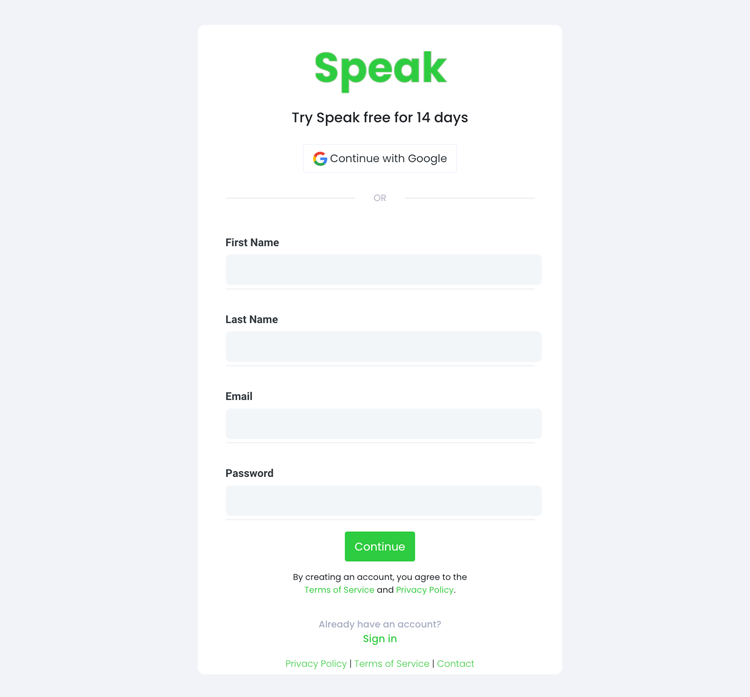
Pas 1: creeu un compte de Speak
To start your Chinese (Cantonese, Traditional) subtitling, you first need to crear un compte de Speak. No et preocupis, això és molt fàcil de fer!
Our team is happy to give you a 7-day trial with trial credits for Chinese (Cantonese, Traditional) audio and video subtitling included.
To sign up for Speak and start your Chinese (Cantonese, Traditional) subtitling, visit the Speak app register page aquí.
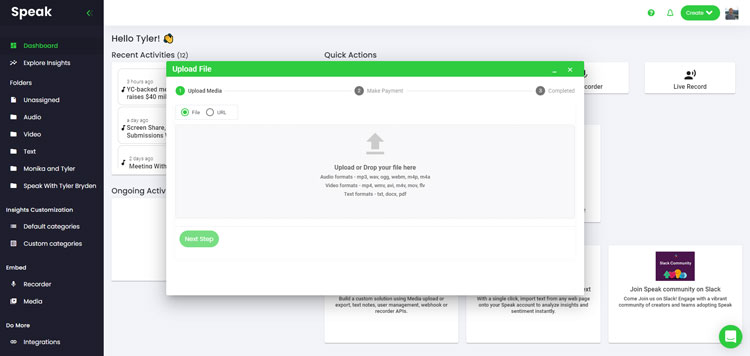
Step 2: Upload your Chinese (Cantonese, Traditional) file(s) for subtitling
Normalment recomanem MP4 per a vídeo o MP3 per àudio.
However, we accept a range of audio and video file types. Once you upload your file all you have to do is select “Chinese (Cantonese, Traditional)” from the language dropdown menu to automatically subtitle in Chinese (Cantonese, Traditional).
You can upload your Chinese (Cantonese, Traditional) file for subtitling in several ways using Speak:
Tipus de fitxers d'àudio xinès (cantonès, tradicional) acceptats
- Xinès (cantonès, tradicional) MP3
- Xinès (cantonès, tradicional) M4A
- Xinès (cantonès, tradicional) WAV
- Xinès (cantonès, tradicional) OGG
- Xinès (cantonès, tradicional) WEBM
- Xinès (cantonès, tradicional) M4P
Tipus de fitxers de vídeo xinès (cantonès, tradicional) acceptats
- Xinès (cantonès, tradicional) MP4
- Xinès (cantonès, tradicional) M4V
- WMV xinès (cantonès, tradicional).
- Xinès (cantonès, tradicional) AVI
- Xinès (cantonès, tradicional) MOV
- Xinès (cantonès, tradicional) FLV
URL xinesos (cantonès, tradicionals) disponibles públicament
També podeu penjar contingut multimèdia a Speak mitjançant un URL disponible públicament.
As long as the file type extension is available at the end of the URL you will have no problem importing your recording for automatic Chinese (Cantonese, Traditional) subtitling and analysis.
URL de YouTube xinesos (cantonès, tradicionals).
Speak és compatible amb vídeos de YouTube. Tot el que has de fer és copiar l'URL del vídeo de YouTube (per exemple, https://www.youtube.com/watch?v=qKfcLcHeivc).
Speak trobarà automàticament el fitxer, calcularà la durada i importarà el vídeo.
Assegureu-vos d'utilitzar l'enllaç complet i no el fragment de YouTube escurçat. A més, assegureu-vos d'eliminar el nom del canal de l'URL.
Parla Integracions
Com s'ha esmentat, Speak també conté una sèrie d'integracions per a Zoom, Zapier, Vimeo i més que t'ajudaran a subtitular automàticament els teus continguts multimèdia.
Aquesta biblioteca d'integracions segueix creixent! Tens una petició? Us animeu a enviar-nos un missatge.
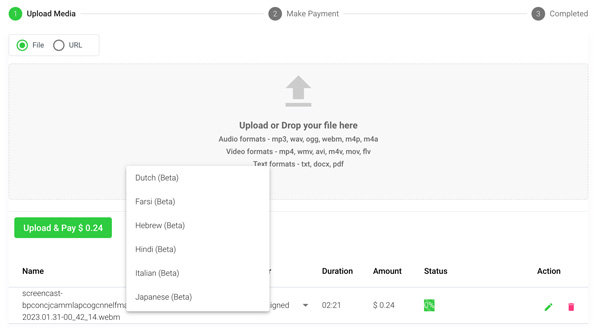
Pas 3: calculeu i pagueu el total automàticament
Once you have your Chinese (Cantonese, Traditional) audio or video file ready and load it into Speak, it will automatically calculate the total cost (trial credits are included in the trial – take advantage of it!).
Pots pagar subscrivint-te a un pla personalitzat mitjançant la nostra calculadora en temps real amb minuts inclosos.
També pots afegir un saldo o pagar les càrregues sense un pla utilitzant el vostre targeta de crèdit.
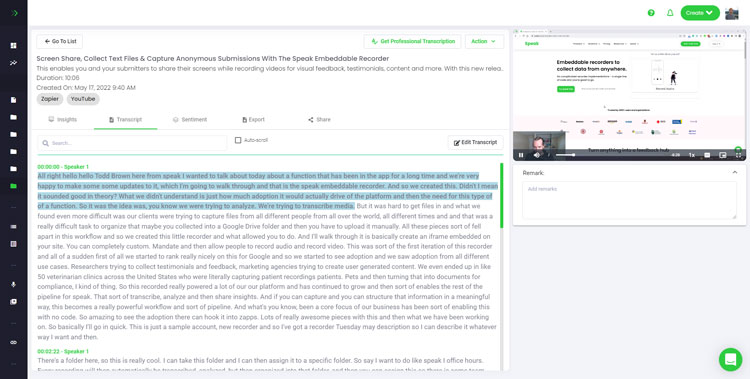
Step 4: Wait for Speak to subtitle your Chinese (Cantonese, Traditional) audio or Chinese (Cantonese, Traditional) video
Our automated subtitling software will prepare your Chinese (Cantonese, Traditional) subtitles in as little as a few minutes. Generally, Speak takes about half the audio or video length to produce the subtitles and insights.
Once completed, you will get an email notification that your Chinese (Cantonese, Traditional) subtitles is complete. That email will contain a link back to the file so you can access the interactive media player with the Chinese (Cantonese, Traditional) subtitles, analysis, and export formats ready for you.
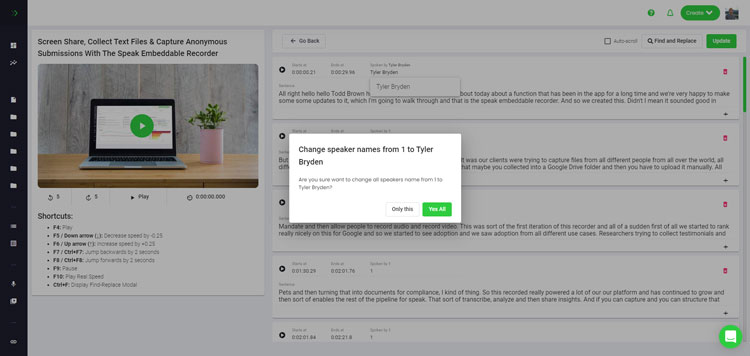
Step 5: View and edit your automated Chinese (Cantonese, Traditional) subtitles
Voleu fer les edicions dels subtítols vosaltres mateixos? Tot bé! Un cop hàgiu rebut els subtítols automàtics, tindreu l'opció d'editar-los en qualsevol moment.
Easily update speaker names, find and replace, and get your automatic Chinese (Cantonese, Traditional) subtitles up to full accuracy with our intuitive subtitles editing system.
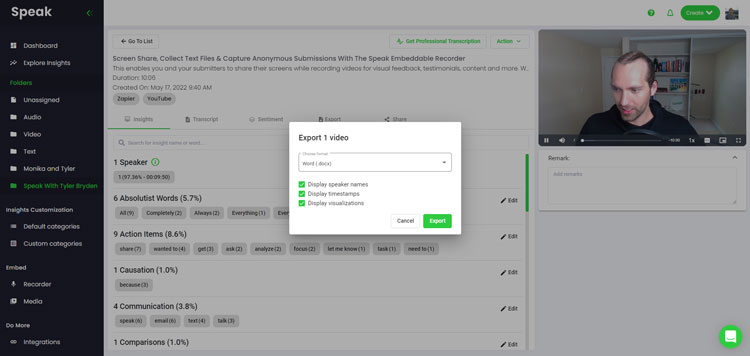
Step 6: Export your Chinese (Cantonese, Traditional) subtitles and share interactive media players
With Speak, you can easily export Chinese (Cantonese, Traditional) subtitles to many formats.
Below is a list of options for exporting your Chinese (Cantonese, Traditional) subtitles in Speak:
- Export Chinese (Cantonese, Traditional) subtitles to SRTs
- Export Chinese (Cantonese, Traditional) subtitles to VTTs
Una manera més eficaç de compartir subtítols és mitjançant un biblioteca multimèdia compartible que inclou el fitxer multimèdia, les estadístiques de la IA i els subtítols interactius.
Hi ha molt més que pots fer amb Speak per enriquir el valor dels teus continguts multimèdia i subtítols.
No dubteu a enviar-nos un missatge al xat en directe: sempre estem aquí per ajudar-vos!
We talked about Chinese (Cantonese, Traditional) subtitling here, but you may be interested in how to subtitle in other languages instantly and easily with Speak’s intuitive subtitling and natural language processing software.
A continuació, hem compartit recursos sobre tots els idiomes en què Speak us pot ajudar a subtitular!
Join 300,000+ users finding radical efficiencies with their audio, video and text data to drive value.
How Much Does It Cost To Subtitle Chinese (Cantonese, Traditional)?
Speak offers highly competitive pricing for Chinese (Cantonese, Traditional) subtitling compared to other subtitling solutions. For a starting user, Speak offers automated Chinese (Cantonese, Traditional) subtitling from 2 credits per hour of audio on pay as you go (1 credit = US$1). Pro includes 25 credits per user per month.
També escalem els nostres preus en funció del volum dels mitjans i podem oferir descomptes encara més grans als grans clients.
So, if you have over 100 hours of Chinese (Cantonese, Traditional) subtitling per month please contact us through live chat and we will set you up with a customized price per minute to make Chinese (Cantonese, Traditional) subtitling even more affordable!
You can learn more about how to subtitle Chinese (Cantonese, Traditional) with Speak and the relevant pricing on the pàgina de preus del lloc web i el pàgina de preus a l'aplicació.
What Can You Subtitle In Chinese (Cantonese, Traditional)?
- Subtitle Chinese (Cantonese, Traditional) interviews
- Subtitle Chinese (Cantonese, Traditional) videos
- Subtitle Chinese (Cantonese, Traditional) audio
- Subtitle Chinese (Cantonese, Traditional) earnings calls
- Subtitle Chinese (Cantonese, Traditional) focus groups
- Subtitle Chinese (Cantonese, Traditional) meetings
- Subtitle Chinese (Cantonese, Traditional) phone calls
- Subtitle Chinese (Cantonese, Traditional) YouTube videos
- Subtitle Chinese (Cantonese, Traditional) Vimeo videos
- Subtitle Chinese (Cantonese, Traditional) Zoom recordings
- Subtitle Chinese (Cantonese, Traditional) Google Meet recordings
- Subtitular les gravacions de Microsoft Teams
- Subtitle Chinese (Cantonese, Traditional) podcasts
I molt més!
En quins altres idiomes es poden parlar subtítols?
Speak ja té usuaris de més de 90 països i rebem contínuament sol·licituds per subtitular i analitzar en diferents idiomes.
Per tant, afegim contínuament més idiomes a Speak! Aquestes són només algunes de la llista creixent d'idiomes que ofereix Speak:
- Com crear subtítols en afrikaans
- Com crear subtítols en àrab (Egipte)
- Com crear subtítols en àrab (Iraq)
- Com crear subtítols en àrab (Israel)
- Com crear subtítols en àrab (jordà)
- Com crear subtítols en àrab (Kuwait)
- Com crear subtítols en àrab (líban)
- Com crear subtítols en àrab (Oman)
- Com crear subtítols en àrab (Autoritat Palestina)
- Com crear subtítols en àrab (Qatar)
- Com crear subtítols en àrab (Aràbia Saudita)
- Com crear subtítols en àrab (República Àrab Siriana)
- Com crear subtítols en àrab (Emirats Àrabs Units)
- Com crear subtítols en àrab modern estàndard (Bahrain)
- Com crear subtítols en armeni
- Com crear subtítols en búlgar
- Com crear subtítols en català
- Com crear subtítols xinesos (cantonès, tradicionals)
- Com crear subtítols en xinès (simplificat)
- Com crear subtítols xinesos (tradicionals)
- Com crear subtítols en croat
- Com crear subtítols en txec
- Com crear subtítols en danès
- Com crear subtítols en neerlandès
- Com crear subtítols en anglès
- Com crear subtítols en anglès (Austràlia)
- Com crear subtítols en anglès (indi)
- Com crear subtítols en anglès (irlandès)
- Com crear subtítols en anglès (Nova Zelanda)
- Com crear subtítols en anglès (escocès)
- Com crear subtítols en anglès (sud-africà)
- Com crear subtítols en anglès (Regne Unit)
- Com crear subtítols en anglès (Estats Units)
- Com crear subtítols en estonià
- Com crear subtítols en farsi
- Com crear subtítols en finès
- Com crear subtítols en francès
- Com crear subtítols en francès (Canadà)
- Com crear subtítols en alemany
- Com crear subtítols en alemany (suís)
- Com crear subtítols en grec
- Com crear subtítols en gujarati
- Com crear subtítols en hebreu
- Com crear subtítols en hindi
- Com crear subtítols en hongarès
- Com crear subtítols en islandès
- Com crear subtítols en indonesi
- Com crear subtítols en irlandesos
- Com crear subtítols en italian
- Com crear subtítols en japonès
- Com crear subtítols en kannada
- Com crear subtítols en coreà
- Com crear subtítols en letó
- Com crear subtítols en lituà
- Com crear subtítols en malai
- Com crear subtítols en malaiàlam
- Com crear subtítols en noruec
- Com crear subtítols en persa
- Com crear subtítols en polonès
- Com crear subtítols en portuguès
- Com crear subtítols en portuguès (brasiler)
- Com crear subtítols en portuguès (Portugal)
- Com crear subtítols en romanès
- Com crear subtítols en rus
- Com crear subtítols en eslovac
- Com crear subtítols en eslovè
- Com crear subtítols en castellà
- Com crear subtítols en espanyol (Mèxic)
- Com crear subtítols en suec
- Com crear subtítols en tàmil
- Com crear subtítols en telugu
- Com crear subtítols en tailandès
- Com crear subtítols en turc
- Com crear subtítols en ucraïnès
- Com crear subtítols en vietnamita
Ara n'hi ha molts més afegits!
Podeu veure tota la llista d'idiomes admesos per Speak mitjançant el programari i les API.
Explora Speak AI
Speak AI és una plataforma de recerca en tecnologia de veu i IA. Transcripció en més de 100 idiomes, anàlisi de PNL, anàlisi de sentiments, agents d'IA i consultoria empresarial.
 English
 Español
 Français
 Italiano
 العربية
 Português do Brasil
 Nederlands
 Deutsch
 עִבְרִית
 Русский
 日本語
 Polski
 Čeština
 Українська
 Slovenščina
 Svenska
 Ελληνικά
 Norsk bokmål
 简体中文
 Türkçe
 Català
 Magyar
 한국어
 Slovenčina
 Suomi