
How to Create Chinese (Cantonese, Traditional) Subtitles
Chinese (Cantonese, Traditional) is one of the most widely spoken languages in the world, with over 1.3 billion native speakers across countries like China, Hong Kong, Macau, Taiwan, and Singapore. This makes it one of the most important languages for businesses and researchers to understand and use.
Creating subtitles and transcripts for audio and video content in the Chinese (Cantonese, Traditional) language has many benefits, from improving accessibility and enabling content to reach new audiences, to understanding customer feedback and analyzing conversations.
What are Subtitles and How are they Different than Captions?
Subtitles are text versions of spoken dialogue in a video or audio file. They are a great way to increase the accessibility of a video, making it easier to follow the narrative and understand the content even if the audio is not clear or is inaudible.
Captions, on the other hand, include both dialogue and sound effects. Captions may also be used to add emphasis to a scene or for comedic effect.
Benefits of Transcription and Creating Subtitles in Chinese (Cantonese, Traditional)
Creating subtitles and transcripts in Chinese (Cantonese, Traditional) can be very beneficial for businesses, researchers, and marketers. Here are some of the benefits:
Reach New Audiences
By making your content accessible to those who speak Chinese (Cantonese, Traditional), you can reach new audiences and expand your presence in the global market. With subtitles, you can also make your content accessible to those who are deaf or hard of hearing.
Make Content Easier to Understand
Chinese (Cantonese, Traditional) subtitles can make videos easier to understand, as they provide the viewer with written dialogue that can be read and re-read as needed. This can be especially helpful when viewing content with unfamiliar accents or dialects, or when there is background noise that makes the audio difficult to understand.
Analyze Conversations
Creating subtitles and transcripts in Chinese (Cantonese, Traditional) can also be extremely useful for analysis. By transcribing audio and video, it’s easier to understand the conversations and gain insights into customer feedback. This can help businesses to better understand their customers and make informed decisions.
Drive Signups with Speak AI
Speak AI is a speech recognition and natural language platform with over 70,000 users. Creating subtitles and transcripts in Chinese (Cantonese, Traditional) can be a great way to drive sign-ups and get more users on the platform. With its powerful speech recognition technology, Speak AI can help researchers, marketers, and businesses to better understand their customers and gain valuable insights into their conversations.
Konklusjon
Creating subtitles and transcripts in Chinese (Cantonese, Traditional) can be a great way to reach new audiences, make content easier to understand, and gain valuable insights into customer feedback. Speak AI is a powerful speech recognition and natural language platform that can help businesses and researchers to better understand their customers and drive more sign-ups.
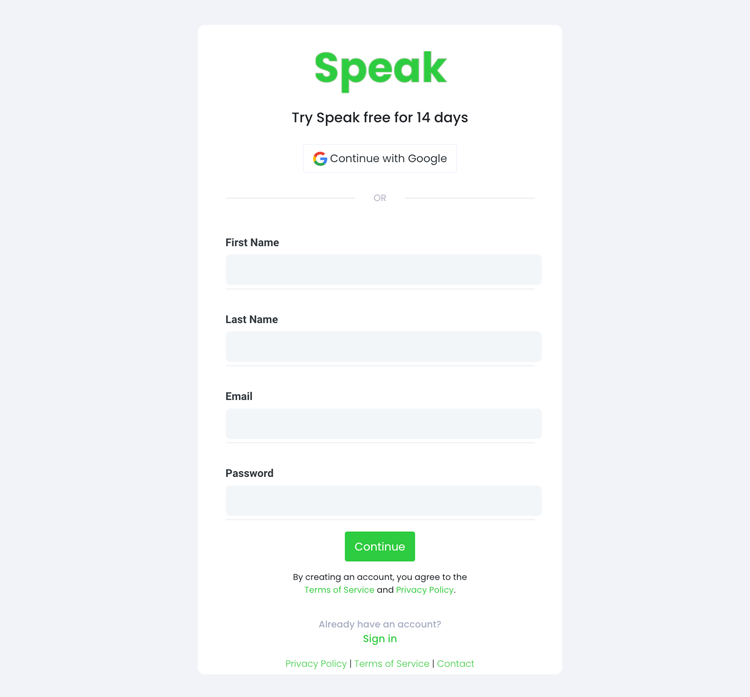
Trinn 1: Opprett en Speak-konto
To start your Chinese (Cantonese, Traditional) subtitling, you first need to opprette en Speak-konto. Ingen grunn til bekymring, dette er superenkelt å gjøre!
Our team is happy to give you a 7-day trial with trial credits for Chinese (Cantonese, Traditional) audio and video subtitling included.
To sign up for Speak and start your Chinese (Cantonese, Traditional) subtitling, visit the Speak app register page her.
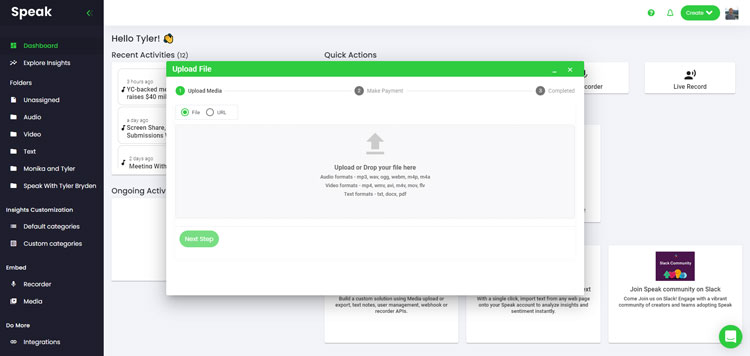
Step 2: Upload your Chinese (Cantonese, Traditional) file(s) for subtitling
Vi anbefaler vanligvis MP4-filer for video eller MP3-filer for lyd.
However, we accept a range of audio and video file types. Once you upload your file all you have to do is select “Chinese (Cantonese, Traditional)” from the language dropdown menu to automatically subtitle in Chinese (Cantonese, Traditional).
You can upload your Chinese (Cantonese, Traditional) file for subtitling in several ways using Speak:
Aksepterte lydfiltyper for kinesisk (kantonesisk, tradisjonell)
- Kinesisk (kantonesisk, tradisjonell) MP3
- Kinesisk (kantonesisk, tradisjonell) M4A
- Kinesisk (kantonesisk, tradisjonell) WAV
- Kinesisk (kantonesisk, tradisjonell) OGG
- Kinesisk (kantonesisk, tradisjonell) WEBM
- Kinesisk (kantonesisk, tradisjonell) M4P
Aksepterte kinesiske (kantonesisk, tradisjonell) videofiltyper
- Kinesisk (kantonesisk, tradisjonell) MP4
- Kinesisk (kantonesisk, tradisjonell) M4V
- Kinesisk (kantonesisk, tradisjonell) WMV
- Kinesisk (kantonesisk, tradisjonell) AVI
- Kinesisk (kantonesisk, tradisjonell) MOV
- Kinesisk (kantonesisk, tradisjonell) FLV
Offentlig tilgjengelige kinesiske (kantonesisk, tradisjonell) nettadresser
Du kan også laste opp medier til Speak via en offentlig tilgjengelig URL.
As long as the file type extension is available at the end of the URL you will have no problem importing your recording for automatic Chinese (Cantonese, Traditional) subtitling and analysis.
Kinesiske (kantonesisk, tradisjonell) YouTube-URL-er
Speak er kompatibel med YouTube-videoer. Alt du trenger å gjøre er å kopiere URL-en til YouTube-videoen (f.eks, https://www.youtube.com/watch?v=qKfcLcHeivc).
Speak finner filen automatisk, beregner lengden og importerer videoen.
Sørg for at du bruker den fullstendige lenken og ikke den forkortede YouTube-snutten. I tillegg må du sørge for å fjerne kanalnavnet fra URL-en.
Speak-integrasjoner
Som nevnt inneholder Speak også en rekke integrasjoner for Zoom, Zapier, Vimeo og mer som vil hjelpe deg med å automatisk undertekste mediene dine.
Dette biblioteket med integrasjoner fortsetter å vokse! Har du en forespørsel? Send oss gjerne en melding.
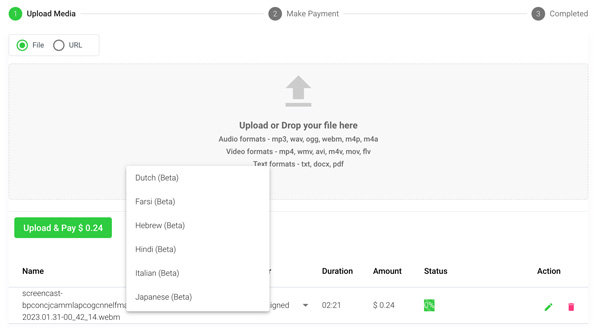
Trinn 3: Beregn og betal summen automatisk
Once you have your Chinese (Cantonese, Traditional) audio or video file ready and load it into Speak, it will automatically calculate the total cost (trial credits are included in the trial – take advantage of it!).
Du kan betale ved å abonnere på en personlig plan ved hjelp av vår sanntidskalkulator med inkluderte minutter.
Du kan også legge til en saldo eller betale for opplastinger uten abonnement ved hjelp av din kredittkort.
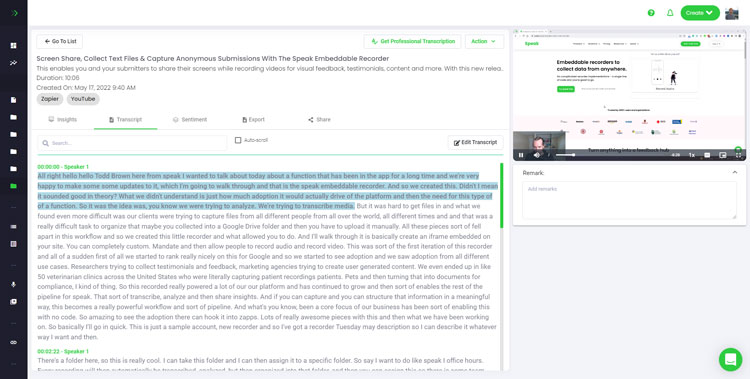
Step 4: Wait for Speak to subtitle your Chinese (Cantonese, Traditional) audio or Chinese (Cantonese, Traditional) video
Our automated subtitling software will prepare your Chinese (Cantonese, Traditional) subtitles in as little as a few minutes. Generally, Speak takes about half the audio or video length to produce the subtitles and insights.
Once completed, you will get an email notification that your Chinese (Cantonese, Traditional) subtitles is complete. That email will contain a link back to the file so you can access the interactive media player with the Chinese (Cantonese, Traditional) subtitles, analysis, and export formats ready for you.
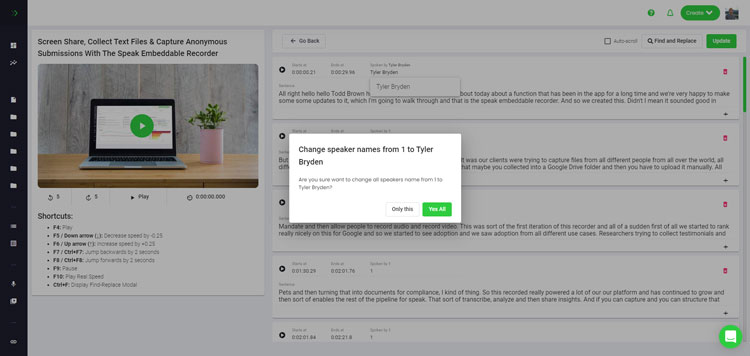
Step 5: View and edit your automated Chinese (Cantonese, Traditional) subtitles
Vil du redigere undertekstene selv? Alt i orden! Når du har mottatt de automatiske undertekstene, kan du når som helst redigere dem.
Easily update speaker names, find and replace, and get your automatic Chinese (Cantonese, Traditional) subtitles up to full accuracy with our intuitive subtitles editing system.
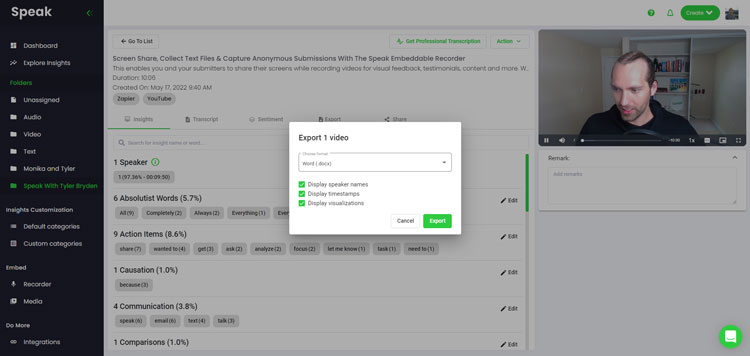
Step 6: Export your Chinese (Cantonese, Traditional) subtitles and share interactive media players
With Speak, you can easily export Chinese (Cantonese, Traditional) subtitles to many formats.
Below is a list of options for exporting your Chinese (Cantonese, Traditional) subtitles in Speak:
- Export Chinese (Cantonese, Traditional) subtitles to SRTs
- Export Chinese (Cantonese, Traditional) subtitles to VTTs
En mer effektiv måte å dele undertekster på er gjennom en delbart mediebibliotek som inkluderer mediefilen, AI-innsikt og interaktive undertekster.
Det er så mye mer du kan gjøre med Speak for å berike verdien av mediene og undertekstene dine.
Nøl aldri med å sende oss en melding på live chat - vi er alltid her for å hjelpe deg!
We talked about Chinese (Cantonese, Traditional) subtitling here, but you may be interested in how to subtitle in other languages instantly and easily with Speak’s intuitive subtitling and natural language processing software.
Vi har delt ressurser nedenfor om alle språkene Speak kan hjelpe deg med teksting!
Join 300,000+ users finding radical efficiencies with their audio, video and text data to drive value.
How Much Does It Cost To Subtitle Chinese (Cantonese, Traditional)?
Speak offers highly competitive pricing for Chinese (Cantonese, Traditional) subtitling compared to other subtitling solutions. For a starting user, Speak offers automated Chinese (Cantonese, Traditional) subtitling from 2 credits per hour of audio on pay as you go (1 credit = US$1). Pro includes 25 credits per user per month.
Vi skalerer også prisene våre basert på medievolum og kan tilby enda større rabatter til store kunder.
So, if you have over 100 hours of Chinese (Cantonese, Traditional) subtitling per month please contact us through live chat and we will set you up with a customized price per minute to make Chinese (Cantonese, Traditional) subtitling even more affordable!
You can learn more about how to subtitle Chinese (Cantonese, Traditional) with Speak and the relevant pricing on the nettstedets prisside og prissiden i appen.
What Can You Subtitle In Chinese (Cantonese, Traditional)?
- Subtitle Chinese (Cantonese, Traditional) interviews
- Subtitle Chinese (Cantonese, Traditional) videos
- Subtitle Chinese (Cantonese, Traditional) audio
- Subtitle Chinese (Cantonese, Traditional) earnings calls
- Subtitle Chinese (Cantonese, Traditional) focus groups
- Subtitle Chinese (Cantonese, Traditional) meetings
- Subtitle Chinese (Cantonese, Traditional) phone calls
- Subtitle Chinese (Cantonese, Traditional) YouTube videos
- Subtitle Chinese (Cantonese, Traditional) Vimeo videos
- Subtitle Chinese (Cantonese, Traditional) Zoom recordings
- Subtitle Chinese (Cantonese, Traditional) Google Meet recordings
- Teksting av Microsoft Teams-opptak
- Subtitle Chinese (Cantonese, Traditional) podcasts
Og så mye mer!
Hvilke andre språk kan undertekster brukes?
Speak har allerede brukere fra over 90 land, og vi får kontinuerlig forespørsler om å undertekste og analysere på forskjellige språk.
Derfor legger vi stadig til flere språk i Speak! Her er bare noen av de stadig flere språkene som Speak tilbyr:
- Slik lager du afrikaans-undertekster
- Slik lager du arabiske (Egypt) undertekster
- Slik lager du arabiske (Irak) undertekster
- Hvordan lage arabiske (Israel) undertekster
- Slik lager du arabiske (Jordan) undertekster
- Slik lager du arabiske (Kuwait) undertekster
- Slik lager du arabiske (Libanon) undertekster
- Slik lager du arabiske (Oman) undertekster
- Hvordan lage arabiske undertekster (fra den palestinske selvstyremyndigheten)
- Slik lager du arabiske (Qatar) undertekster
- Hvordan lage arabiske (Saudi-Arabia) undertekster
- Hvordan lage arabiske undertekster (Syria)
- Slik lager du arabiske undertekster (De forente arabiske emirater)
- Slik lager du moderne standard arabiske undertekster (Bahrain)
- Slik lager du armenske undertekster
- Slik lager du bulgarske undertekster
- Slik lager du katalanske undertekster
- Slik lager du kinesiske (kantonesiske, tradisjonelle) undertekster
- Slik lager du kinesiske (forenklede) undertekster
- Slik lager du kinesiske (tradisjonelle) undertekster
- Slik lager du kroatiske undertekster
- Slik lager du tsjekkiske undertekster
- Slik lager du danske undertekster
- Slik lager du nederlandske undertekster
- Slik lager du engelske undertekster
- Slik lager du engelske (Australske) undertekster
- Slik lager du engelske (indiske) undertekster
- Slik lager du engelske (irske) undertekster
- Slik lager du engelske (New Zealand) undertekster
- Slik lager du engelske (skotske) undertekster
- Slik lager du engelske (sørafrikanske) undertekster
- Slik lager du engelske (Storbritannia) undertekster
- Slik lager du engelske (USA) undertekster
- Slik lager du estiske undertekster
- Slik lager du farsi-undertekster
- Slik lager du finske undertekster
- Slik lager du franske undertekster
- Slik lager du franske (Canada) undertekster
- Slik lager du tyske undertekster
- Slik lager du tyske (sveitsiske) undertekster
- Slik lager du greske undertekster
- Slik lager du gujarati-undertekster
- Slik lager du hebraiske undertekster
- Slik lager du hindi-undertekster
- Slik lager du ungarske undertekster
- Slik lager du islandske undertekster
- Slik lager du indonesiske undertekster
- Slik lager du irske undertekster
- Slik lager du italienske undertekster
- Slik lager du japanske undertekster
- Slik lager du kannada-undertekster
- Slik lager du koreanske undertekster
- Slik lager du latviske undertekster
- Slik lager du litauiske undertekster
- Slik lager du malaysiske undertekster
- Slik lager du undertekster på malayalam
- Slik lager du norske undertekster
- Slik lager du persiske undertekster
- Slik lager du polske undertekster
- Slik lager du portugisiske undertekster
- Slik lager du portugisiske (brasilianske) undertekster
- Slik lager du portugisiske (Portugal) undertekster
- Slik lager du rumenske undertekster
- Slik lager du russiske undertekster
- Slik lager du slovakiske undertekster
- Slik lager du slovenske undertekster
- Slik lager du spanske undertekster
- Slik lager du spanske (mexico) undertekster
- Slik lager du svenske undertekster
- Slik lager du tamilske undertekster
- Slik lager du telugu-undertekster
- Slik lager du thailandske undertekster
- Slik lager du tyrkiske undertekster
- Slik lager du ukrainske undertekster
- Slik lager du vietnamesiske undertekster
Det er nå lagt til mange flere!
Du kan se hele listen over språk Speak støtter gjennom både programvaren og API-ene.
Utforsk Speak AI
Speak AI er en taleteknologi- og AI-forskningsplattform. Transkripsjon på 100+ språk, NLP-analyse, sentimentanalyse, AI-agenter og bedriftsrådgivning.
 English
 Español
 Français
 Italiano
 العربية
 Português do Brasil
 Nederlands
 Deutsch
 עִבְרִית
 Русский
 日本語
 Polski
 Čeština
 Українська
 Slovenščina
 Svenska
 Ελληνικά
 Norsk bokmål
 简体中文
 Türkçe
 Català
 Magyar
 한국어
 Slovenčina
 Suomi