
How To Translate German (Swiss) to English
Translating German (Swiss) to English is super simple!
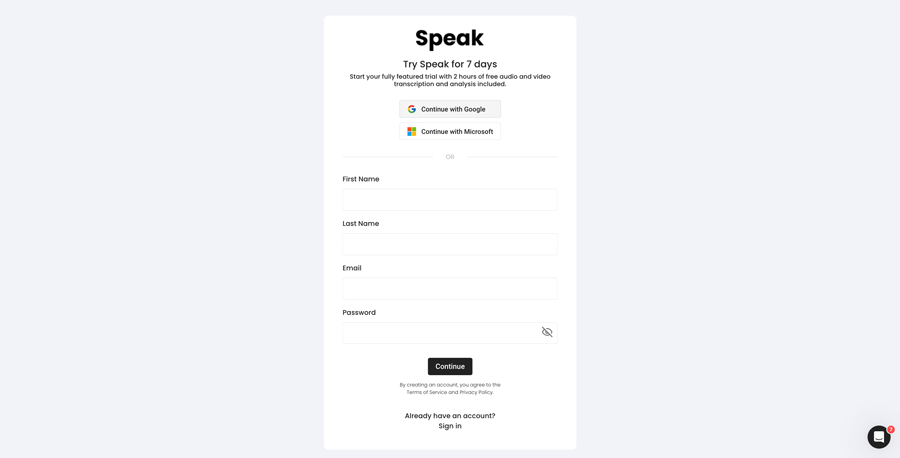
Étape 1 : S'inscrire à Speak
S'inscrire à Speak en utilisant ce lien.
Once you register, you can instantly begin translating your German (Swiss) to English file(s).
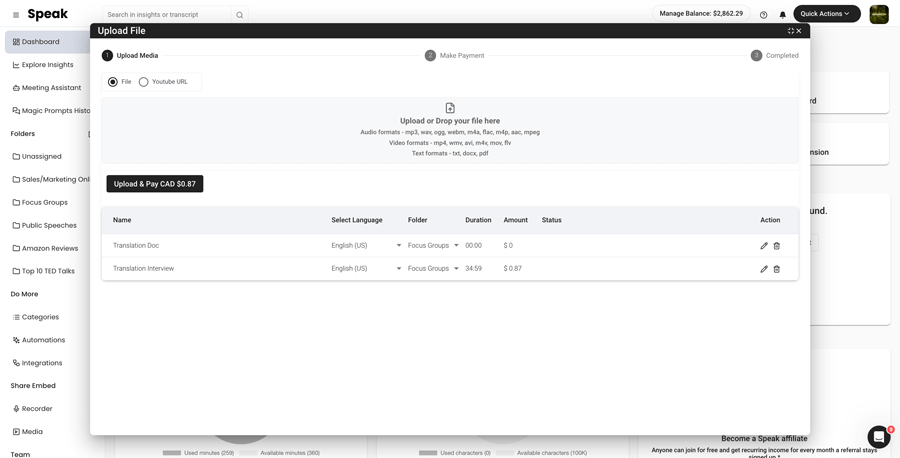
Step 2: Upload Your German (Swiss) file(s)
Dès que vous vous connectez, vous êtes redirigé vers le tableau de bord.
Une fois sur place, vous pouvez sélectionner l'action rapide "Nouveau téléchargement".
Dans Speak, vous pouvez télécharger, transcrire et traduire des fichiers audio, vidéo et texte en une seule fois ! Si vous avez une vidéo, vous pouvez utiliser notre Convertisseur vidéo-texte AI pour convertir la vidéo en texte ; si vous avez de l'audio, vous pouvez utiliser notre Convertisseur audio/texte AI pour convertir de l'audio en texte. Vous pouvez également transcrire des vidéos YouTube et utiliser l'IA pour analyser le texte.
Formats audio et vidéo pris en charge
- Convertir MP4 en texte
- Convertir M4A en texte
- Convertir un fichier MP3 en texte
- Convertir OGG en texte
- Convertir MPEG en texte
- Convertir WEBM en texte
- Convertir MOV en texte
- Convertir M4P en texte
- Convertir WMV en texte
- Convertir WAV en texte
- Convertir M4V en texte
- Audio Video to Text
- Convertir AVI en texte
- Convertir une vidéo en article
Langues de transcription prises en charge
- Comment transcrire l'afrikaans
- Comment transcrire l'arabe égyptien
- Comment transcrire l'arabe en Irak
- Comment transcrire l'arabe d'Israël
- Comment transcrire l'arabe jordanien
- Comment transcrire l'arabe au Koweït
- Comment transcrire l'arabe au Liban
- Comment transcrire l'arabe moderne standard Bahreïn
- Comment transcrire l'arabe moderne standard
- Comment transcrire l'arabe Oman
- Comment transcrire l'arabe Autorité palestinienne
- Comment transcrire l'arabe du Qatar
- Comment transcrire l'arabe en Arabie Saoudite
- Comment transcrire l'arabe République arabe syrienne
- Comment transcrire l'arabe E.A.U.
- Comment transcrire l'arménien
- Comment transcrire le bulgare
- Comment transcrire le catalan
- Comment transcrire le chinois cantonais traditionnel
- Comment transcrire le chinois simplifié
- Comment transcrire le croate
- Comment transcrire le tchèque
- Comment transcrire le danois
- Comment transcrire le néerlandais
- Comment transcrire l'anglais en Australie
- Comment transcrire l'anglais britannique
- Comment transcrire l'anglais indien
- Comment transcrire l'anglais irlandais
- Comment transcrire l'anglais en Nouvelle-Zélande
- Comment transcrire l'anglais écossais
- Comment transcrire l'anglais en Afrique du Sud
- Comment transcrire l'anglais Royaume-Uni
- Comment transcrire l'anglais États-Unis
- Comment transcrire l'estonien
- Comment transcrire le farsi
- Comment transcrire le finnois
- Comment transcrire le français au Canada
- Comment transcrire le suisse allemand
- Comment transcrire l'allemand
- Comment transcrire le grec
- Comment transcrire le gujarati
- Comment transcrire l'hébreu
- Comment transcrire l'hindi
- Comment transcrire le hongrois
- Comment transcrire l'islandais
- Comment transcrire l'indonésien
- Comment transcrire des entretiens
- Comment transcrire l'irlandais
- Comment transcrire l'italien
- Comment transcrire le japonais
- Comment transcrire en Kannada
- Comment transcrire le coréen
- Comment transcrire le letton
- Comment transcrire le lituanien
- Comment transcrire le malais
- Comment transcrire le malayalam
- Comment transcrire le norvégien
- Comment transcrire le persan
- Comment transcrire le polonais
- Comment transcrire le portugais brésilien
- Comment transcrire le portugais Portugal
- Comment transcrire le portugais
- Comment transcrire le roumain
- Comment transcrire le russe
- Comment transcrire le slovaque
- Comment transcrire le slovène
- Comment transcrire l'espagnol au Mexique
- Comment transcrire le suédois
- Comment transcrire le tamoul
- Comment transcrire le télougou
- Comment transcrire le thaïlandais
- Comment transcrire le turc
- Comment transcrire l'ukrainien
- Comment transcrire le vietnamien
- Transcrire le danois
- Transcrire l'anglais
- Transcrire le français
- Transcrire l'allemand
- Transcrire le portugais
- Transcrire l'espagnol
Nous disposons également d'un Assistant de réunion AI et Notetaker AI pour capturer automatiquement les réunions ainsi qu'un enregistreur vocal, enregistreur audio et vidéo intégrableet enregistreur d'écran.
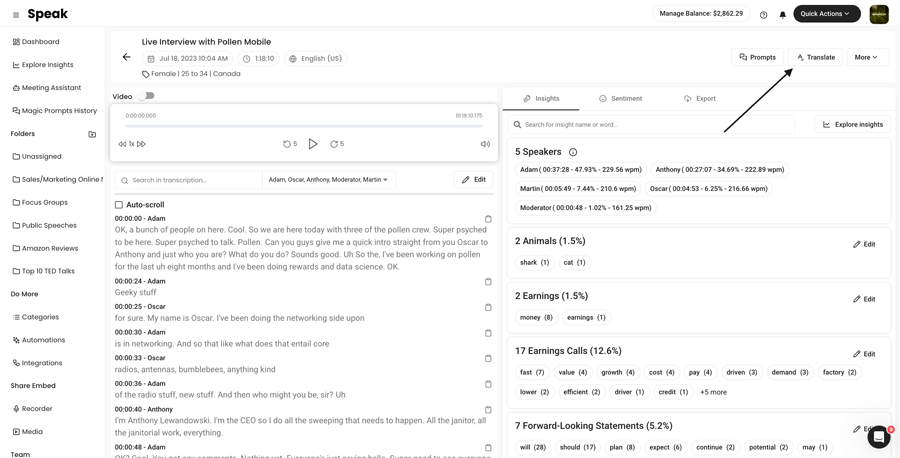
Step 3: Translate Your German (Swiss) file(s) to English
Une fois le fichier téléchargé, il vous suffit d'accéder à votre fichier et de sélectionner "Traduire".
S'il s'agit d'un fichier audio et vidéo, Speak vous demandera si vous souhaitez conserver les noms des locuteurs et les horodatages dans la traduction.
Vous souhaitez traduire plusieurs fichiers à la fois ? Pas de problème !
You can view the files you want to automatically translate from German (Swiss) to English from the folder level and instantly translate as many files as you need with our artificial intelligence translation in just a few clicks.
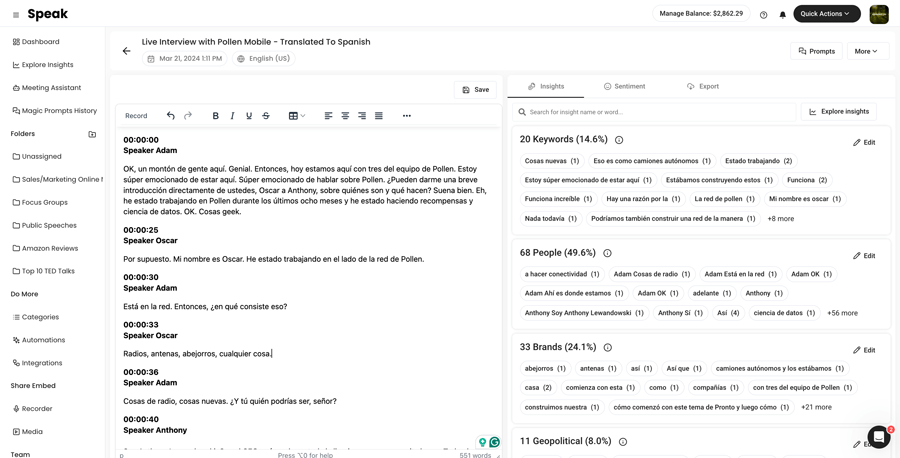
Étape 4 : C'est tout ! Visualisez, analysez, modifiez et exportez votre (vos) nouveau(x) fichier(s) en anglais.
Une fois la traduction effectuée, vous serez alerté et vous verrez un nouveau document dans le même dossier que le fichier original.
Le fichier portera le même nom, mais un tiret indiquera qu'il s'agit de la version traduite.
Need support with your German (Swiss) translation?
Nous sommes toujours là et heureux de vous aider à Speak !
Il vous suffit de nous envoyer un message sur le chat en direct dans le coin inférieur droit et nous nous assurerons que vous êtes prêt à réussir.
Interested in translating German (Swiss) or other languages to different languages? View our entire list of supported translation langues ici.
Automatic, accurate, instant AI translation from German (Swiss) to English is here for you.
S'inscrire à Speak en utilisant ce lien and begin translating German (Swiss) to English today.
Unlocking Global Communication: The Power of Translating German (Swiss) to English
In the interconnected world we live in, the ability to communicate effectively across language barriers is not just an advantage; it’s essential. Swiss German to English translation, especially facilitated by AI and automatic translation technologies, offers a bridge between cultures, economies, and industries. Speak AI, with its cutting-edge NLP, transcription software, and AI Meeting Assistant, is at the forefront of making these translations not only possible but also accurate and efficient.
Why Translate German (Swiss) to English?
German (Swiss), while similar to Standard German, possesses unique qualities and nuances that require special consideration during translation. English, a global lingua franca, opens doors to international business, research, and collaboration opportunities. The translation from Swiss German to English allows for:
– Enhanced Business Operations: Businesses can expand their reach, access new markets, and build relationships with partners and customers globally.
– Academic and Research Collaboration: Researchers can share findings, collaborate on projects, and access a broader database of knowledge.
– Efficient Information Exchange: Instant translation technologies enable real-time communication, breaking down language barriers in meetings and conferences.
Efficacité en termes de coûts et de délais
The traditional translation process can be time-consuming and expensive. However, with Speak AI’s automatic translation capabilities:
– Reduce Translation Time: Instant translation of audio, video, and text materials eliminates lengthy wait times associated with manual translations.
– Cost-Effective Solutions: Automating the translation process significantly reduces costs, making it an affordable option for businesses and researchers alike.
– Ensure Accuracy: Speak AI’s technology is designed to understand and translate the nuances of Swiss German, resulting in precise and reliable translations.
How Speak AI Enhances Translation from German (Swiss) to English
Speak AI’s integrated NLP, large language models, and AI Meeting Assistant revolutionize how translation is approached by:
– Seamless Integration in Meetings: AI Meeting Assistant joins platforms like Microsoft Teams, Zoom, Google Meet, and Webex calls to automatically transcribe and analyze conversations in real-time.
– Visualisation des données : Translate and visualize data for easier understanding and decision-making in multinational teams.
– Generative AI for Rich Content: Beyond translation, generating summaries, insights, and action points from the transcribed text.
Use Cases Tailored for Researchers and Businesses
– International Research Collaborations: Automatically translate research papers, facilitating global partnerships.
– Global Business Expansion: Product manuals, websites, and marketing materials translated effortlessly, ensuring consistent messaging across different languages.
– Cross-Border Customer Support: Offer support in Swiss German and English, improving customer satisfaction and loyalty.
Understanding the Linguistic Landscape
Popularity and Distribution
Swiss German is predominantly spoken in Switzerland, a country with a rich multilingual heritage, whereas English, as the world’s third most spoken language, has over 1.5 billion speakers globally.
Key Differences and Similarities
– Differences: Swiss German differs significantly in phonetics, vocabulary, and syntax from Standard German. English, with its Germanic roots, shares some similarities but also has vast differences, notably in grammar and vocabulary.
– Similarities: Both languages have Germanic roots, leading to some lexical similarities. This shared heritage can facilitate the translation process, especially when powered by AI that understands these nuances.
Fun Facts: Bridging Cultures through Language
– Swiss German boasts numerous dialects, varying greatly from region to region.
– English incorporates words from over 350 languages, reflecting its global nature.
– Switzerland’s multilingualism means many Swiss Germans are already proficient in English, highlighting the importance of seamless translation for nuanced communication.
Conclusion: The Future Is in Automatic Translation
Advancements in AI and NLP technologies suggest a future where language barriers cease to obstruct global communication. Services like Speak AI not only make translating from German (Swiss) to English more accessible but also ensure these translations are more accurate and nuanced than ever before. The era of seamless, instant communication across languages is here, heralding new opportunities for collaboration, understanding, and connectivity across the globe.
Speak AI is committed to leading this change, driven by its highly rated AI Meeting Assistant, powerful NLP and AI capabilities, and dedication to breaking down language barriers for over 150K users worldwide. Experience the future of translation and take your business and research to a global stage with Speak AI.
—
FAQ
What locations are German (Swiss) and English popular?
German (Swiss) is primarily spoken in Switzerland, a country known for its linguistic diversity. English, on the other hand, is a global language spoken by an estimated 1.5 billion people worldwide, serving as the primary language in countries such as the United States, the United Kingdom, Canada, Australia, and many others.
Fournissez des statistiques intéressantes sur les pays, les populations et l’histoire.
Switzerland has a population of approximately 8.5 million people, with Swiss German being the most spoken language in the country. English, as the third most spoken language in the world, plays a pivotal role in international business, science, and pop culture, emphasizing the importance of effective translation services.
What are some fun facts about German (Swiss) and English?
Swiss German is not a written language; it’s primarily spoken, making the translation into written English a unique challenge. English has absorbed vocabulary from over 350 languages throughout its history, showcasing its adaptability and global reach.
What are the differences and similarities between German (Swiss) and English?
The main differences lie in grammar, vocabulary, and pronunciation, with Swiss German having numerous dialects that differ significantly from standard German. The similarities between the two, stemming from their Germanic roots, aid in the translation process, especially when leveraging AI technologies capable of understanding these nuanced aspects.
Translate German (Swiss) To These Other Supported Languages:
Foire aux questions
How do I translate Swiss German to English?
Register for Speak, upload your German (Swiss) file, choose English as the target language, then view, analyze, edit and export the translated file.
Can I translate Swiss German audio or video to English?
Yes. Upload the recording and Speak AI transcribes the speech, then translates the transcript into English. Dialect-heavy audio can be harder to transcribe, so review the result before relying on it.
Is Swiss German the same as standard German?
No. Swiss German is a group of Alemannic dialects that are mostly spoken, while written Swiss text normally uses Standard German with some local spelling differences.
Can I edit the English translation?
Yes. After translation you can view the English file, edit it, run AI analysis on it and export it from Speak AI.
Traduire & Transcrire avec Speak AI
Speak AI prend en charge la transcription et l’analyse en plus de 100 langues. Téléchargez votre audio ou vidéo et obtenez une transcription alimentée par IA, une aide à la traduction et des analyses NLP instantanées.
 English
 Español
 Français
 Italiano
 العربية
 Português do Brasil
 Nederlands
 Deutsch
 עִבְרִית
 Русский
 日本語
 Polski
 Čeština
 Українська
 Slovenščina
 Svenska
 Ελληνικά
 Norsk bokmål
 简体中文
 Türkçe
 Català
 Magyar
 한국어
 Slovenčina
 Suomi