
How To Translate Yiddish to English (United States)
Translating Yiddish to English (United States) is super simple!
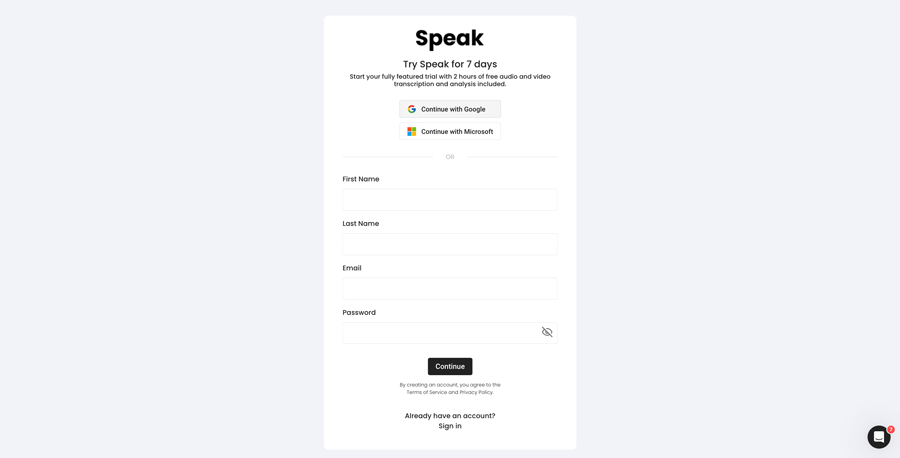
Étape 1 : S'inscrire à Speak
S'inscrire à Speak en utilisant ce lien.
Once you register, you can instantly begin translating your Yiddish to English (United States) file(s).
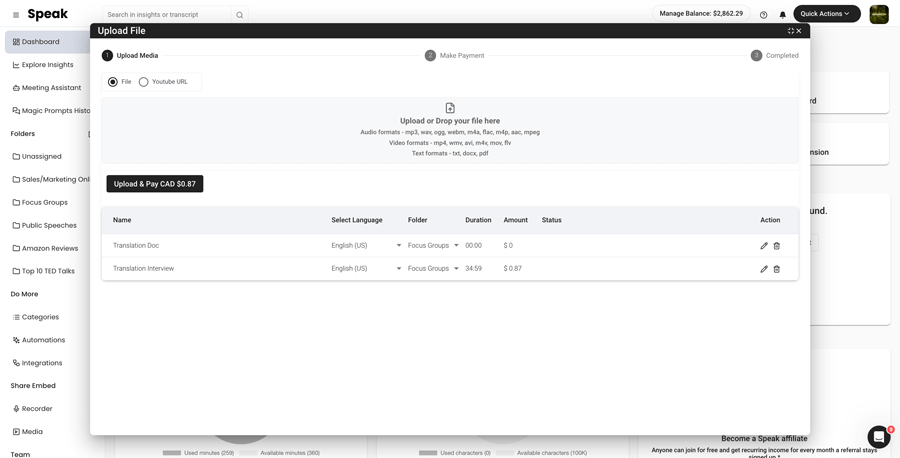
Step 2: Upload Your Yiddish file(s)
Dès que vous vous connectez, vous êtes redirigé vers le tableau de bord.
Une fois sur place, vous pouvez sélectionner l'action rapide "Nouveau téléchargement".
Dans Speak, vous pouvez télécharger, transcrire et traduire des fichiers audio, vidéo et texte en une seule fois ! Si vous avez une vidéo, vous pouvez utiliser notre Convertisseur vidéo-texte AI pour convertir la vidéo en texte ; si vous avez de l'audio, vous pouvez utiliser notre Convertisseur audio/texte AI pour convertir de l'audio en texte. Vous pouvez également transcrire des vidéos YouTube et utiliser l'IA pour analyser le texte.
Formats audio et vidéo pris en charge
- Convertir MP4 en texte
- Convertir M4A en texte
- Convertir un fichier MP3 en texte
- Convertir OGG en texte
- Convertir MPEG en texte
- Convertir WEBM en texte
- Convertir MOV en texte
- Convertir M4P en texte
- Convertir WMV en texte
- Convertir WAV en texte
- Convertir M4V en texte
- Audio Video to Text
- Convertir AVI en texte
- Convertir une vidéo en article
Langues de transcription prises en charge
- Comment transcrire l'afrikaans
- Comment transcrire l'arabe égyptien
- Comment transcrire l'arabe en Irak
- Comment transcrire l'arabe d'Israël
- Comment transcrire l'arabe jordanien
- Comment transcrire l'arabe au Koweït
- Comment transcrire l'arabe au Liban
- Comment transcrire l'arabe moderne standard Bahreïn
- Comment transcrire l'arabe moderne standard
- Comment transcrire l'arabe Oman
- Comment transcrire l'arabe Autorité palestinienne
- Comment transcrire l'arabe du Qatar
- Comment transcrire l'arabe en Arabie Saoudite
- Comment transcrire l'arabe République arabe syrienne
- Comment transcrire l'arabe E.A.U.
- Comment transcrire l'arménien
- Comment transcrire le bulgare
- Comment transcrire le catalan
- Comment transcrire le chinois cantonais traditionnel
- Comment transcrire le chinois simplifié
- Comment transcrire le croate
- Comment transcrire le tchèque
- Comment transcrire le danois
- Comment transcrire le néerlandais
- Comment transcrire l'anglais en Australie
- Comment transcrire l'anglais britannique
- Comment transcrire l'anglais indien
- Comment transcrire l'anglais irlandais
- Comment transcrire l'anglais en Nouvelle-Zélande
- Comment transcrire l'anglais écossais
- Comment transcrire l'anglais en Afrique du Sud
- Comment transcrire l'anglais Royaume-Uni
- Comment transcrire l'anglais États-Unis
- Comment transcrire l'estonien
- Comment transcrire le farsi
- Comment transcrire le finnois
- Comment transcrire le français au Canada
- Comment transcrire le suisse allemand
- Comment transcrire l'allemand
- Comment transcrire le grec
- Comment transcrire le gujarati
- Comment transcrire l'hébreu
- Comment transcrire l'hindi
- Comment transcrire le hongrois
- Comment transcrire l'islandais
- Comment transcrire l'indonésien
- Comment transcrire des entretiens
- Comment transcrire l'irlandais
- Comment transcrire l'italien
- Comment transcrire le japonais
- Comment transcrire en Kannada
- Comment transcrire le coréen
- Comment transcrire le letton
- Comment transcrire le lituanien
- Comment transcrire le malais
- Comment transcrire le malayalam
- Comment transcrire le norvégien
- Comment transcrire le persan
- Comment transcrire le polonais
- Comment transcrire le portugais brésilien
- Comment transcrire le portugais Portugal
- Comment transcrire le portugais
- Comment transcrire le roumain
- Comment transcrire le russe
- Comment transcrire le slovaque
- Comment transcrire le slovène
- Comment transcrire l'espagnol au Mexique
- Comment transcrire le suédois
- Comment transcrire le tamoul
- Comment transcrire le télougou
- Comment transcrire le thaïlandais
- Comment transcrire le turc
- Comment transcrire l'ukrainien
- Comment transcrire le vietnamien
- Transcrire le danois
- Transcrire l'anglais
- Transcrire le français
- Transcrire l'allemand
- Transcrire le portugais
- Transcrire l'espagnol
Nous disposons également d'un Assistant de réunion AI et Notetaker AI pour capturer automatiquement les réunions ainsi qu'un enregistreur vocal, enregistreur audio et vidéo intégrableet enregistreur d'écran.
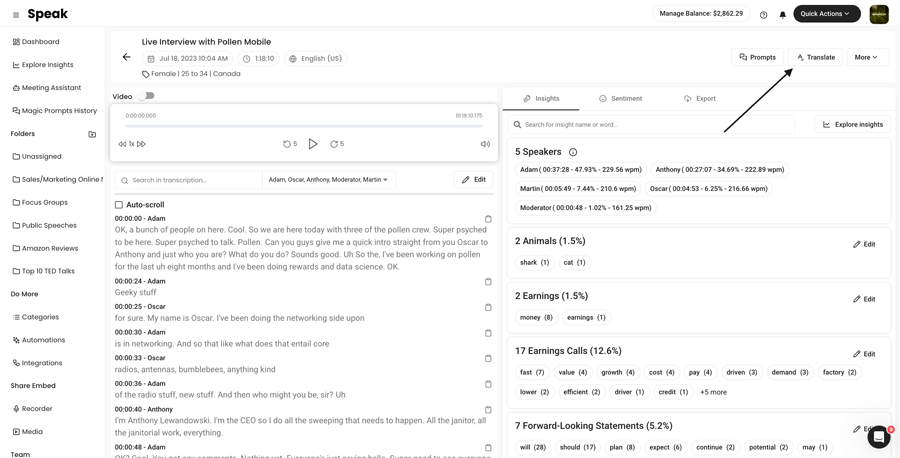
Step 3: Translate Your Yiddish file(s) to English (United States)
Une fois le fichier téléchargé, il vous suffit d'accéder à votre fichier et de sélectionner "Traduire".
S'il s'agit d'un fichier audio et vidéo, Speak vous demandera si vous souhaitez conserver les noms des locuteurs et les horodatages dans la traduction.
Vous souhaitez traduire plusieurs fichiers à la fois ? Pas de problème !
You can view the files you want to automatically translate from Yiddish to English (United States) from the folder level and instantly translate as many files as you need with our artificial intelligence translation in just a few clicks.
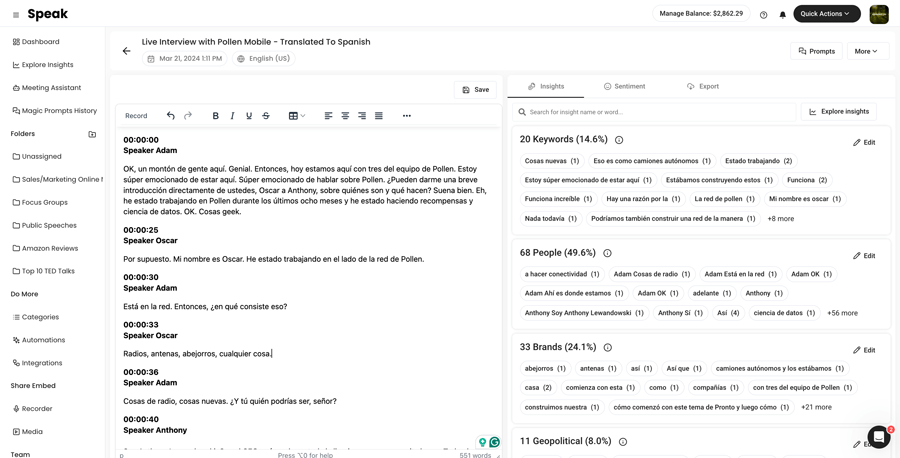
Étape 4 : C’est Tout ! Consultez, Analysez, Modifiez & Exportez Votre Nouveau fichier English (United States)
Une fois la traduction effectuée, vous serez alerté et vous verrez un nouveau document dans le même dossier que le fichier original.
Le fichier portera le même nom, mais un tiret indiquera qu'il s'agit de la version traduite.
Need support with your Yiddish translation?
Nous sommes toujours là et heureux de vous aider à Speak !
Il vous suffit de nous envoyer un message sur le chat en direct dans le coin inférieur droit et nous nous assurerons que vous êtes prêt à réussir.
Interested in translating Yiddish or other languages to different languages? View our entire list of supported translation langues ici.
Automatic, accurate, instant AI translation from Yiddish to English (United States) is here for you.
S'inscrire à Speak en utilisant ce lien and begin translating Yiddish to English (United States) today.
Translate Yiddish to English (United States) with AI Translation
Locations where Yiddish and English (United States) are Popular
Yiddish is a language that originated in Central Europe among Ashkenazi Jews, combining elements of German dialects with Hebrew, Aramaic, and Slavic languages. Historically, Yiddish was spoken by Jewish communities in countries such as Germany, Poland, Russia, and the United States.
English (United States) is the primary language spoken in the United States, a country known for its cultural diversity and influence around the world. With over 300 million English speakers, the United States has a rich linguistic landscape that includes various regional accents and dialects.
Facts:
- Yiddish has its roots in the Ashkenazi Jewish communities of Central and Eastern Europe.
- English is the third most spoken language in the world, with the United States being one of the largest English-speaking countries.
- The United States has a diverse population with various ethnicities, leading to the evolution of unique American English dialects.
Facts about Yiddish and English (United States)
Yiddish:
- Yiddish is written in the Hebrew alphabet and is commonly used in religious texts and literature.
- Yiddish has influenced many English words, such as “klutz” and “schlep,” which have been adopted into everyday American English.
- Yiddish culture encompasses music, theater, and cuisine, contributing to the cultural tapestry of Jewish communities worldwide.
English (United States):
- American English has been shaped by various linguistic influences, including Native American languages, Spanish, French, and German.
- American English is known for its flexibility and adaptability, with new words and phrases constantly being added to reflect cultural changes.
- The United States is home to many English dialects, from Southern accents to New York City slang, showcasing the country’s linguistic diversity.
Differences and Similarities between Yiddish and English (United States)
While Yiddish and English are distinct languages with different origins and linguistic structures, they both play significant roles in the cultural identities of their speakers.
Differences:
- Yiddish is a fusion of Germanic and Hebrew elements, while English has evolved from Old English and Latin roots.
- Yiddish uses the Hebrew alphabet, whereas English uses the Latin alphabet.
- Yiddish grammar and syntax differ from English, with unique rules for sentence structure and word formation.
Similarities:
- Both Yiddish and English have borrowed words from other languages, enriching their vocabularies with diverse influences.
- Yiddish and English are used in literature, media, and everyday communication, reflecting the cultural heritage of their speakers.
- Advances in AI translation technology have made it easier to bridge the gap between Yiddish and English, facilitating seamless communication and understanding.
By leveraging AI translation tools, researchers, businesses, and individuals can overcome language barriers and access a wealth of information in various languages, including Yiddish and English. Whether translating historical documents, conducting multilingual research, or communicating with international partners, AI translation offers a convenient and efficient solution for linguistic challenges.
Experience the power of AI translation with Speak AI’s innovative language technology, providing accurate and reliable translations for your Yiddish to English (United States) needs.
 English
 Español
 Français
 Italiano
 العربية
 Português do Brasil
 Nederlands
 Deutsch
 עִבְרִית
 Русский
 日本語
 Polski
 Čeština
 Українська
 Slovenščina
 Svenska
 Ελληνικά
 Norsk bokmål
 简体中文
 Türkçe
 Català
 Magyar
 한국어
 Slovenčina
 Suomi