
How To Translate English to Chinese (Traditional)
Translating English to Chinese (Traditional) is super simple!
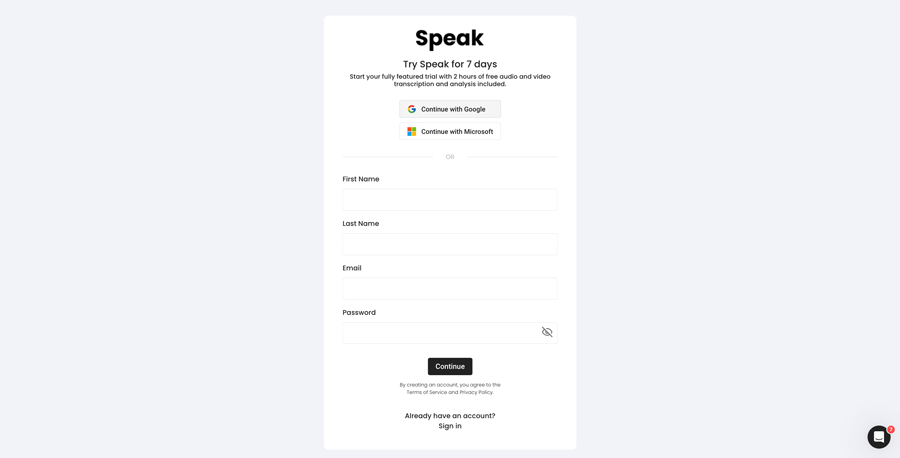
步骤 1:注册 Speak
使用以下方式注册 Speak 此链接.
Once you register, you can instantly begin translating your English to Chinese (Traditional) file(s).
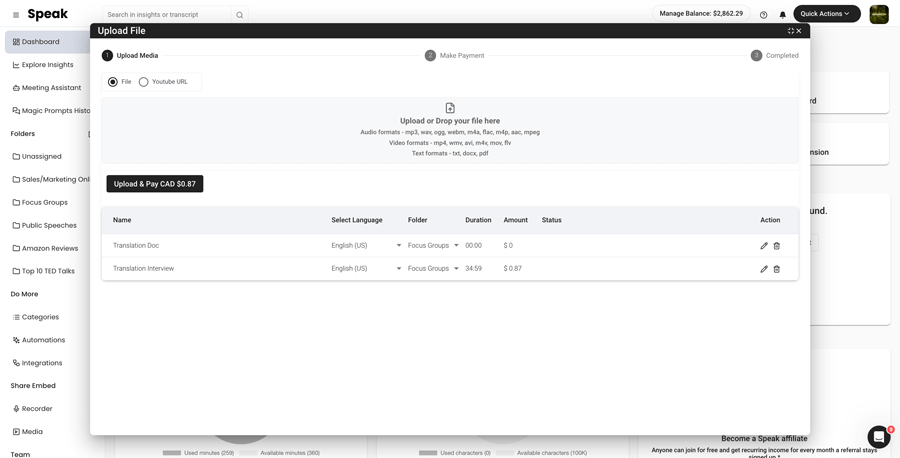
Step 2: Upload Your English file(s)
登录后,您将立即被重定向到仪表板。
到达那里后,你可以选择快速操作 “新上传”。
在 Speak 中,您可以一次性无缝上传、转录和翻译音频、视频和文本文件!如果您有视频,可以使用我们的 AI 视频文本转换器 将视频转换为文本;如果有音频,可以使用我们的 AI 音频到文本转换器 将音频转换为文本。您还可以 转录 YouTube 视频 和 用人工智能分析文本.
支持的音频和视频格式
- 将 MP4 转换为文本
- 将 M4A 转为文本
- 将 MP3 转换为文本
- 将 OGG 转为文本
- 将 MPEG 转换为文本
- 将 WEBM 转换为文本
- 将 MOV 转换为文本
- 将 M4P 转为文本
- 将 WMV 转换为文本
- 将 WAV 转换为文本
- 将 M4V 转换为文本
- 音频视频转文字
- 将 AVI 转换为文本
- 将视频转换为文章
支持的转录语言
- 如何转录南非荷兰语
- 如何转录埃及阿拉伯语
- 如何转录阿拉伯语伊拉克方言
- 如何转录阿拉伯以色列语
- 如何转录阿拉伯约旦语
- 如何转录阿拉伯科威特语
- 如何转录阿拉伯语黎巴嫩方言
- 如何转录阿拉伯现代标准巴林语
- 如何转录阿拉伯现代标准语
- 如何转录阿拉伯语阿曼方言
- 如何转录阿拉伯巴勒斯坦权力机构
- 如何转录卡塔尔阿拉伯语
- 如何转录阿拉伯语沙特阿拉伯
- 如何转录阿拉伯叙利亚阿拉伯共和国
- 如何转录阿联酋阿拉伯语
- 如何转录亚美尼亚语
- 如何转录保加利亚语
- 如何转写加泰罗尼亚语
- 如何转录中文粤语繁体
- 如何转录简体中文
- 如何转录克罗地亚语
- 如何转录捷克语
- 如何转录丹麦语
- 如何转录荷兰语
- 如何转录英语澳大利亚方言
- 如何转录英式英语
- 如何转录印度英语
- 如何转录爱尔兰英语
- 如何转录英语新西兰
- 如何转录英文苏格兰语
- 如何转录英语南非口音
- 如何转录英国英语
- 如何转录英语美国口音
- 如何转录爱沙尼亚语
- 如何转录波斯语
- 如何转录芬兰语
- 如何转录加拿大法语
- 如何转录瑞士德语
- 如何转录德语
- 如何转录希腊语
- 如何转录古吉拉特语
- 如何转录希伯来语
- 如何转录印地语
- 如何转录匈牙利语
- 如何转录冰岛语
- 如何转录印度尼西亚语
- 如何转录访谈
- 如何转录爱尔兰语
- 如何转录意大利语
- 如何转录日语
- 如何转录卡纳达语
- 如何转录韩语
- 如何转录拉脱维亚语
- 如何转录立陶宛语
- 如何转录马来语
- 如何转录马拉雅拉姆语
- 如何转录挪威语
- 如何转录波斯语
- 如何转录波兰语
- 如何转录巴西葡萄牙语
- 如何转录葡萄牙语葡萄牙
- 如何转录葡萄牙语
- 如何转录罗马尼亚语
- 如何转录俄语
- 如何转录斯洛伐克语
- 如何转录斯洛文尼亚语
- 如何转录墨西哥西班牙语
- 如何转录瑞典语
- 如何转录泰米尔语
- 如何转录泰卢固语
- 如何转录泰语
- 如何转录土耳其语
- 如何转录乌克兰语
- 如何转录越南语
- 转录丹麦语
- 转录英语
- 转录法语
- 转录德语
- 转录葡萄牙语
- 转录西班牙语
我们还有一个 人工智能会议助理 和 人工智能记事本 自动捕捉会议以及 录音机, 可嵌入式录音机和录像机和 屏幕录制.
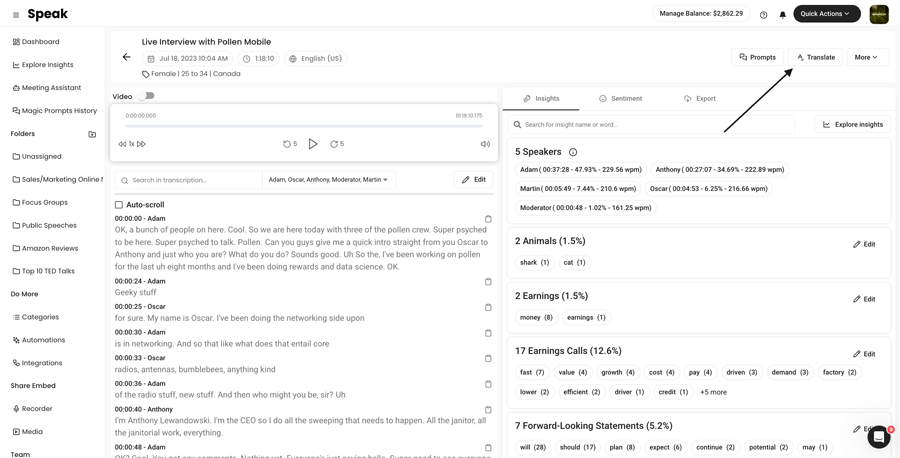
Step 3: Translate Your English file(s) to Chinese (Traditional)
文件上传后,只需访问您的文件并选择 “翻译”
如果是音频和视频文件,Speak 会询问您是否希望在翻译中保留说话人姓名和时间戳。
想要一次转录多个文件?没问题!
You can view the files you want to automatically translate from English to Chinese (Traditional) from the folder level and instantly translate as many files as you need with our artificial intelligence translation in just a few clicks.
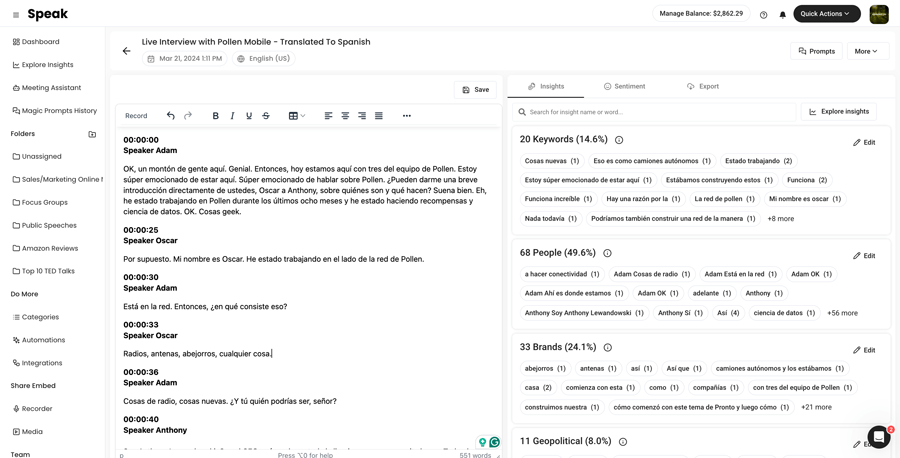
Step 4: That’s It! View, Analyze, Modify & Export Your New Chinese (Traditional) file(s)
翻译完成后,您将收到警报,并在原始文件所在的同一文件夹中看到一个新文档。
该文件将使用相同的名称,但带有破折号表示这是翻译版本。
Need support with your English translation?
我们始终在这里,很乐意为您效劳 Speak!
只需在右下角的实时聊天中向我们发送消息,我们将确保您获得成功所需的支持。
Interested in translating English or other languages to different languages? View our entire list of supported translation 此处的语言.
Automatic, accurate, instant AI translation from English to Chinese (Traditional) is here for you.
使用以下方式注册 Speak 此链接 and begin translating English to Chinese (Traditional) today.
Unlocking Global Opportunities: Translate English to Chinese (Traditional)
In today’s fast-paced, digital-first world, the ability to communicate across languages and cultures is more than just a nice-to-have; it’s a necessity. For businesses and researchers looking to make their mark on the global stage, translating content from English to Chinese (Traditional) is a key step in bridging communication gaps and unlocking a world of opportunities.
Why Translate English to Chinese (Traditional)?
Chinese (Traditional) is not just another language; it’s a gateway to engaging with one of the largest markets and most dynamic cultures in the world. By translating content, whether it’s audio, video, or text, from English to Chinese (Traditional), you’re opening doors to millions of potential customers, collaborators, and audiences.
The Value of Automatic Translation
Automatic translation, powered by AI and NLP (Natural Language Processing), has revolutionized how we approach language barriers. Companies like Speak AI are at the forefront of this transformation, providing seamless, accurate, and efficient translation services that save time, reduce costs, and enhance communication.
Benefits for Researchers and Businesses
Translating content automatically can significantly benefit researchers and businesses in several ways:
- Global Reach: Broaden your audience or research impact by making your work accessible to Traditional Chinese speakers.
- 成本效益: Automatic translation is a cost-efficient alternative to manual translation, reducing the need for expensive language services.
- Time-Saving: AI-driven translation drastically cuts down the time required to translate documents, allowing you to focus on your core activities.
- Accuracy and Context: Advanced NLP algorithms ensure translations are not only accurate but also contextually relevant.
Exploring the Global Landscape: English and Chinese (Traditional)
Where Are These Languages Popular?
English and Chinese (Traditional) are among the most spoken languages worldwide. English serves as a lingua franca in many parts of the globe, while Traditional Chinese is predominantly used in Taiwan, Hong Kong, and Macau. Impressively, these regions are not only cultural and economic hubs but also pivotal in international relations and global trade networks.
Interesting Statistics and History
The history of Traditional Chinese dates back thousands of years, making it one of the oldest written languages still in use today. Despite the adoption of Simplified Chinese in mainland China, Traditional Chinese has maintained its significance, with over 20 million people using it as their primary language.
Delving Into Languages: English vs. Chinese (Traditional)
Fun Facts
English and Chinese (Traditional) are fascinating in their uniqueness. For instance, Chinese is a tonal language, meaning the tone in which a word is spoken can change its meaning entirely. English, on the other hand, places a heavy emphasis on syntax and word order.
差异与相似之处
While English and Chinese (Traditional) may seem worlds apart, they share common goals in communication and expression. Both languages have rich vocabularies and deep literary traditions that reflect the cultures they originated from. However, their writing systems, grammar rules, and phonetics are majorly different, offering unique challenges and rewards to learners and translators alike.
Speak AI: Your Partner in Breaking Language Barriers
At Speak AI, we understand the importance of accurate and nuanced translation. Our software integrates NLP, large language models, data visualization, and Generative AI to deliver top-quality English to Chinese (Traditional) translation. Whether you’re looking to automatically translate meetings, research papers, or global campaigns, we offer what you need with a 4.9 rating on G2 and a trusted user base of over 150K.
AI Meeting Assistant: A Game-Changer for Global Communication
Our AI Meeting Assistant is an innovative tool that joins meetings on platforms like Microsoft Teams, Zoom, Google Meet, and Webex. It automatically transcribes and analyzes conversations, offering real-time translation and insights. This tool is an invaluable asset for researchers and businesses aiming to excel in a multi-lingual, multi-cultural world.
The Path Forward
Translating English to Chinese (Traditional) is not just about converting words; it’s about connecting worlds. With the right tools and technologies, like those offered by Speak AI, businesses and researchers can overcome language barriers, embrace cultural diversity, and thrive in the global marketplace.
Embrace the future of communication. Explore how Speak AI can transform your approach to language and unlock the full potential of your global endeavors.
常问问题
What locations are English and Chinese (Traditional) popular?
English is a global lingua franca, while Traditional Chinese is primarily used in Taiwan, Hong Kong, and Macau. Both languages play crucial roles in international business, education, and diplomacy.
What are some fun facts about English and Chinese (Traditional)?
English’s syntax and word order drastically impact its meaning, whereas Chinese’s tone can change a word’s meaning. Both languages have evolved richly over centuries, reflecting their cultures and histories.
What are the differences and similarities between English and Chinese (Traditional)?
While vastly different in grammar, phonetics, and writing system, both languages serve the fundamental purpose of communication and expression, showcasing the diversity and unity of human language.
Translate English To These Other Supported Languages:
- Translate English-to-Arabic (Egypt)
- Translate English-to-Arabic (Iraq)
- Translate English-to-Arabic (Israel)
- Translate English-to-Arabic (Jordan)
- Translate English-to-Arabic (Kuwait)
- Translate English-to-Arabic (Lebanon)
- Translate English-to-Arabic (Oman)
- Translate English-to-Arabic (Palestinian Authority)
- Translate English-to-Arabic (Qatar)
- Translate English-to-Arabic (Saudi Arabia)
- Translate English-to-Arabic (Syrian Arab Republic)
- Translate English-to-Arabic (United Arab Emirates)
- Translate English-to-Arabic Modern Standard (Bahrain)
- Translate English-to-Armenian
- Translate English-to-Bulgarian
- Translate English-to-Catalan
- Translate English-to-Chinese (Cantonese, Traditional)
- Translate English-to-Chinese (Simplified)
- Translate English-to-Chinese (Traditional)
- Translate English-to-Croatian
- Translate English-to-Czech
- Translate English-to-Danish
- Translate English-to-Dutch
- Translate English-to-English
- Translate English-to-English (Australia)Translate English-to-English (India)
- Translate English-to-English (Ireland)
- Translate English-to-English (New Zealand)
- Translate English-to-English (Scottish)
- Translate English-to-English (South African)
- Translate English-to-English (United Kingdom)
- Translate English-to-English (United States)
- Translate English-to-Estonian
- Translate English-to-Farsi
- Translate English-to-Finnish
- Translate English-to-French
- Translate English-to-French (Canada)
- Translate English-to-German
- Translate English-to-German (Swiss)
- Translate English-to-Greek
- Translate English-to-Gujarati
- Translate English-to-Hebrew
- Translate English-to-Hindi
- Translate English-to-Hungarian
- Translate English-to-Icelandic
- Translate English-to-Indonesian
- Translate English-to-Irish
- Translate English-to-Italian
- Translate English-to-Japanese
- Translate English-to-Kannada
- Translate English-to-Korean
- Translate English-to-Latvian
- Translate English-to-Lithuanian
- Translate English-to-Malay
- Translate English-to-Malayalam
- Translate English-to-Norwegian
- Translate English-to-Persian
- Translate English-to-Polish
- Translate English-to-Portuguese
- Translate English-to-Portuguese (Brazilian)
- Translate English-to-Portuguese (Portugal)
- Translate English-to-Romanian
- Translate English-to-Russian
- Translate English-to-Slovak
- Translate English-to-Slovenian
- Translate English-to-Spanish
- Translate English-to-Spanish (Mexico)
- Translate English-to-Swedish
- Translate English-to-Tamil
- Translate English-to-Telugu
- Translate English-to-Thai
- Translate English-to-Turkish
- Translate English-to-Ukrainian
- Translate English-to-Vietnamese
Translate & Transcribe with Speak AI
Speak AI supports transcription and analysis in 100+ languages. Upload your audio or video and get instant AI-powered transcription, translation assistance, and NLP analytics.
 English
 Español
 Français
 Italiano
 العربية
 Português do Brasil
 Nederlands
 Deutsch
 עִבְרִית
 Русский
 日本語
 Polski
 Čeština
 Українська
 Slovenščina
 Svenska
 Ελληνικά
 Norsk bokmål
 简体中文
 Türkçe
 Català
 Magyar
 한국어
 Slovenčina
 Suomi