
How To Translate English to Hausa
Translating English to Hausa is super simple!
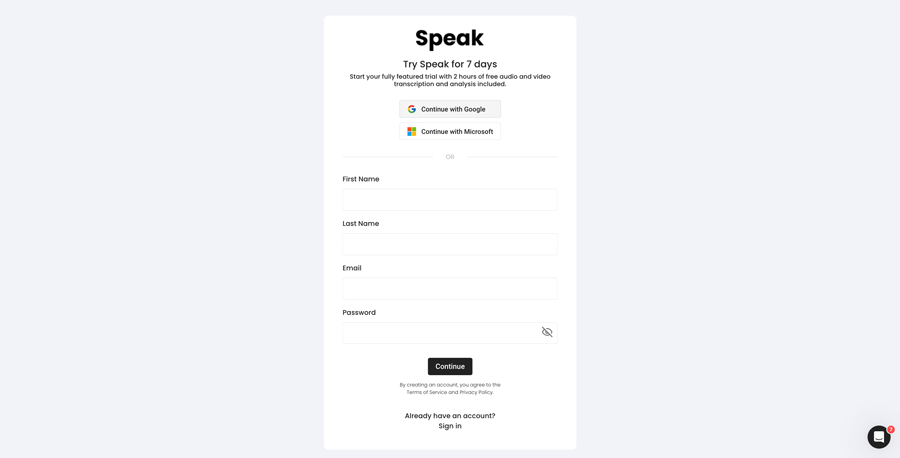
ステップ1:スピークの登録
以下の方法でスピークに登録する。 このリンク.
Once you register, you can instantly begin translating your English to Hausa file(s).
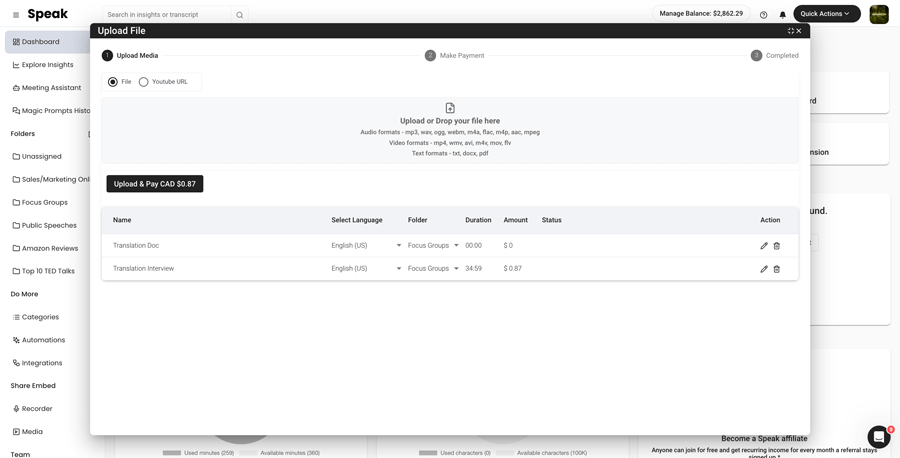
Step 2: Upload Your English file(s)
ログインするとすぐにダッシュボードにリダイレクトされます。
そこでクイックアクションの「新規アップロード」を選択します。
Speakでは、オーディオ、ビデオ、テキストファイルを一度にシームレスにアップロード、書き起こし、翻訳することができます!ビデオをお持ちの場合は AIビデオテキストコンバータ を使ってビデオをテキストに変換できます。 AI音声テキスト変換 を使って音声をテキストに変換することができます。また YouTubeの動画を書き起こす そして AIを使ってテキストを分析する.
対応オーディオ・ビデオフォーマット
- MP4をテキストに変換する
- M4Aをテキストに変換する
- MP3をテキストに変換する
- OGGをテキストに変換する
- MPEGをテキストに変換する
- WEBMをテキストに変換する
- MOVをテキストに変換する
- M4Pをテキストに変換する
- WMVをテキストに変換する
- WAVをテキストに変換する
- M4Vをテキストに変換する
- オーディオ・ビデオからテキストへ
- AVIをテキストに変換する
- 動画を記事に変換する
対応テープ起こし言語
- アフリカーンス語の書き下し文
- エジプト・アラビア語の書き下し文
- イラク語の書き起こし
- アラビア語イスラエル語テープ起こし
- ヨルダン語テープ起こし
- アラビア語テープ起こし クウェート
- アラビア語レバノンの書き起こし方法
- アラビア語現代標準バーレーン語書き下し文の書き方
- アラビア語現代標準の書き下し方
- アラビア語テープ起こし オマーン
- アラビア語書き起こし ハウツー パレスチナ自治区
- アラビア語カタールのテープ起こし
- サウジアラビア語テープ起こし講座
- アラビア語テープ起こし シリア・アラブ共和国
- アラビア語のテープ起こし U.A.E.
- アルメニア語のテープ起こし
- ブルガリア語のテープ起こし
- カタロニア語の書き下し文
- 中国語(広東語・繁体字)の書き取り方法
- 中国語簡体字の書き写し方
- クロアチア語のテープ起こし
- チェコ語のテープ起こし
- デンマーク語の書き下し文
- オランダ語のテープ起こし
- 英語テープ起こし オーストラリア
- イギリス英語の書き起こし
- インディアン英語テープ起こし
- アイルランド語の書き下し文
- ニュージーランドの英語テープ起こし
- スコットランドの英語書き起こし
- 南アフリカの英語テープ起こし
- 英語テープ起こし イギリス
- 英語テープ起こし アメリカ
- エストニア語のテープ起こし
- ペルシャ語の書き下し文
- フィンランド語のテープ起こし
- カナダ・フランス語のテープ起こし
- ドイツ語スイス語テープ起こし
- ドイツ語のテープ起こし
- ギリシャ語の書き下し文
- グジャラート語のテープ起こし
- ヘブライ語の書き下し文
- ヒンディー語の書き下し文
- ハンガリー語のテープ起こし
- アイスランド語の書き下し文
- インドネシア語のテープ起こし
- インタビューの書き起こし
- アイルランド語の書き下し文
- イタリア語のテープ起こし
- 日本語の書き下し文
- カンナダ語のテープ起こし
- 韓国語のテープ起こし
- ラトビア語の書き下し文
- リトアニア語のテープ起こし
- マレー語の書き下し文
- マラヤーラム語のテープ起こし
- ノルウェー語の書き下し文
- ペルシア語の書き下し文
- ポーランド語のテープ起こし
- ポルトガル語ブラジル語の書き下し文
- ポルトガル語の書き下し文
- ポルトガル語のテープ起こし
- ルーマニア語のテープ起こし
- ロシア語のテープ起こし
- スロバキア語の書き下し文
- スロベニア語のテープ起こし
- メキシコのスペイン語テープ起こし
- スウェーデン語のテープ起こし
- タミル語の書き下し文
- テルグ語のテープ起こし
- タイ語のテープ起こし
- トルコ語のテープ起こし
- ウクライナ語のテープ起こし
- ベトナム語のテープ起こし
- デンマーク語を書き写す
- 英語を書き写す
- フランス語を書き写す
- ドイツ語の書き起こし
- ポルトガル語の書き起こし
- スペイン語の書き起こし
私たちはまた AIミーティング・アシスタント そして AIノートテイカー を使用すると、自動的に会議をキャプチャすることができます。 ボイスレコーダー, 埋め込み型オーディオ・ビデオレコーダーそして スクリーンレコーダー.
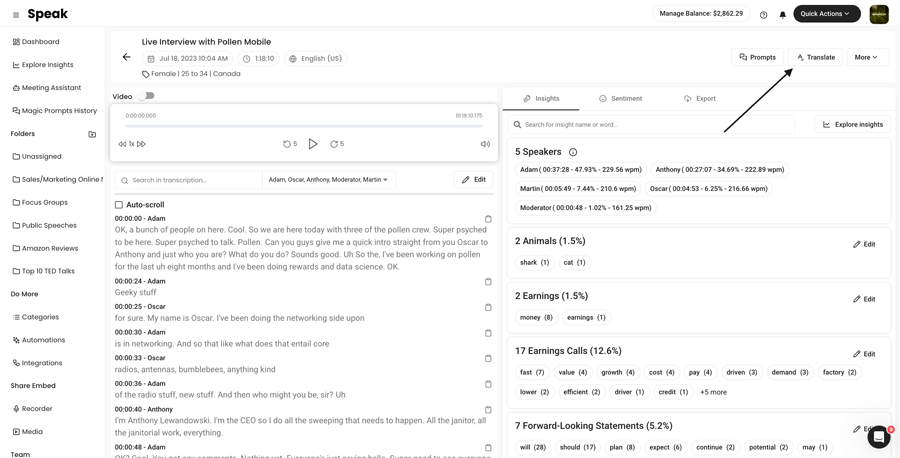
Step 3: Translate Your English file(s) to Hausa
ファイルをアップロードしたら、ファイルにアクセスして「翻訳」を選択するだけです。
音声ファイルやビデオファイルの場合、Speakは翻訳に話者名とタイムスタンプを残すかどうかを尋ねます。
一度に多くのファイルを翻訳したいですか?問題ありません!
You can view the files you want to automatically translate from English to Hausa from the folder level and instantly translate as many files as you need with our artificial intelligence translation in just a few clicks.
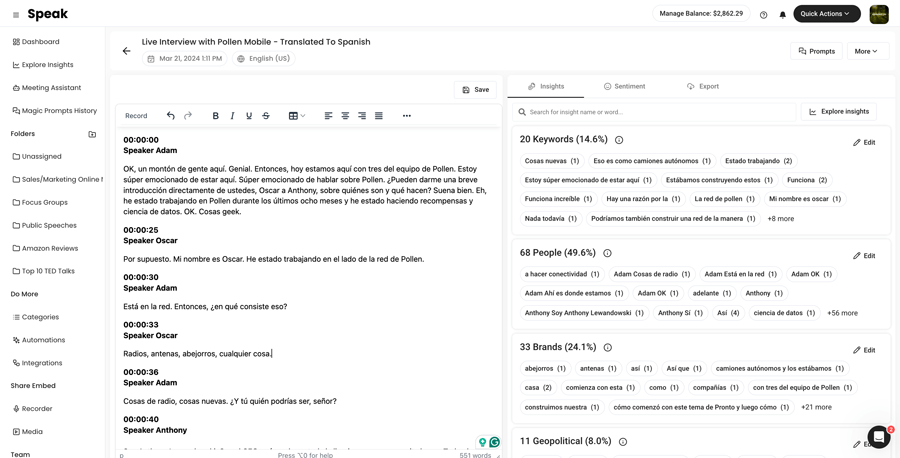
Step 4: That’s It! View, Analyze, Modify & Export Your New Hausa file(s)
翻訳が完了すると、アラートが表示され、元のファイルと同じフォルダに新しいドキュメントが表示されます。
ファイル名は同じになるが、翻訳版であることを示すダッシュが付く。
Need support with your English translation?
私たちはいつでもここにいて、喜んでスピークのお手伝いをさせていただきます!
右下のライブチャットでメッセージをお送りください。
Interested in translating English or other languages to different languages? View our entire list of supported translation 言語はこちら.
Automatic, accurate, instant AI translation from English to Hausa is here for you.
以下の方法でスピークに登録する。 このリンク and begin translating English to Hausa today.
Unlocking New Frontiers: The Power of English to Hausa Translation
In today’s fast-paced, globally connected world, the ability to communicate across linguistic boundaries is more valuable than ever. Translating English to Hausa opens up vast opportunities for businesses, researchers, and individuals alike. With the advent of AI-driven technologies, like those developed by Speak AI, this process has become not only more efficient but also richer in possibilities. Let’s explore the significance of English to Hausa translation, its applications, and how automatic translation technology is shaping the future of cross-cultural communication.
The Strategic Advantage of English to Hausa Translation
Understanding the context and advantages of translating content from English to Hausa requires a deep dive into the relevance of both languages in the modern world.
Global Reach and Cultural Integration
English, with its status as a global lingua franca, and Hausa, as one of Africa’s most spoken languages, create a bridge between diverse cultures and economies. This linguistic connection fosters international relations, trade, and cultural exchange, benefiting businesses and researchers looking to engage with West African markets and communities.
Enhanced Accessibility and Inclusion
Automatic translation helps break down language barriers, making information accessible to millions of Hausa speakers. This inclusivity not only expands the audience for content creators but also ensures that knowledge and resources are more equitably distributed.
Cost and Time Efficiency
The traditional translation process can be tedious and expensive. AI-driven tools like Speak AI’s translation services streamline this process, providing quick, accurate translations that save significant time and resources.
Speak AI: Bridging Languages with Cutting-Edge Technology
Speak AI’s innovative approach to translation leverages NLP, large language models, and generative AI to offer seamless English to Hausa translations. Our solutions cater to a wide range of applications, from transforming business documents to making educational resources universally accessible.
AI Meeting Assistant for Real-Time Translations
Imagine joining a virtual meeting with participants who speak different languages. Speak AI’s AI Meeting Assistant integrates with platforms like Microsoft Teams and Zoom, offering real-time translation that ensures effective communication and collaboration across language divides.
Automatic Analysis for Deeper Insights
Beyond translation, Speak AI’s tools analyze text, audio, and video content, providing valuable insights into sentiment, trends, and more. This capability is invaluable for researchers and businesses aiming to understand market needs and cultural nuances.
Exploring the Unique Landscape of English and Hausa
To fully appreciate the significance of English to Hausa translation, it’s important to explore the characteristics, use cases, and intricacies of both languages.
Geography and Influence
English is spoken by over a billion people worldwide, serving as the primary or secondary language in countries across every continent. Hausa, predominantly spoken in West Africa, boasts over 50 million native speakers, with significant populations in Nigeria, Niger, and diaspora communities globally.
Fascinating Linguistic Facts
- English is renowned for its vast vocabulary and complex spelling system.
- Hausa is written in both a modified Arabic script (Ajami) and Roman alphabet (Boko).
- Both languages have absorbed loanwords from other languages due to historical trade and colonization.
Empowering Global Communication through Translation
As Speak AI continues to innovate at the intersection of language and technology, the potential of English to Hausa translation is limitless. Whether for business expansion, research, or fostering cultural connections, our tools are designed to empower users with efficient, accurate, and accessible translation solutions.
Embracing AI-driven translation is not just about overcoming language barriers; it’s about unlocking opportunities for collaboration, understanding, and growth in a diverse world. Experience the future of communication with Speak AI’s English to Hausa translation services.
FAQs: The Complexities and Curiosities of English and Hausa
What locations are English and Hausa popular?
English enjoys widespread use globally, serving as an official language in countries like the United States, United Kingdom, and Australia. Hausa holds sway in West Africa, particularly in Nigeria and Niger, where it serves as a lingua franca among diverse ethnic groups.
What are some fun facts about English and Hausa?
English’s unpredictable spelling results from its history of borrowing from numerous languages. Hausa, contrastingly, has a phonetic spelling system, where words are written as they are pronounced. Both languages have evolved to include loanwords, making their vocabularies rich and diverse.
What are the differences and similarities between English and Hausa?
While English and Hausa belong to different language families (Indo-European and Afro-Asiatic, respectively), they share similarities in syntax, such as subject-verb-object (SVO) order. Differences lie in phonology, grammar, and writing systems, highlighting the intricate nature of translating between them.
By harnessing the power of AI and automatic translation, Speak AI ensures that these linguistic nuances are navigated with precision, opening up a world of possibilities for English and Hausa speakers alike.
Translate English To These Other Supported Languages:
- Translate English-to-Albanian
- Translate English-to-Amharic
- Translate English-to-Arabic (Egypt)
- Translate English-to-Arabic (Iraq)
- Translate English-to-Arabic (Israel)
- Translate English-to-Arabic (Jordan)
- Translate English-to-Arabic (Kuwait)
- Translate English-to-Arabic (Lebanon)
- Translate English-to-Arabic (Oman)
- Translate English-to-Arabic (Palestinian Authority)
- Translate English-to-Arabic (Qatar)
- Translate English-to-Arabic (Saudi Arabia)
- Translate English-to-Arabic (Syrian Arab Republic)
- Translate English-to-Arabic (United Arab Emirates)
- Translate English-to-Arabic Modern Standard (Bahrain)
- Translate English-to-Armenian
- Translate English-to-Azerbaijani
- Translate English-to-Bengali
- Translate English-to-Bosnian
- Translate English-to-Bulgarian
- Translate English-to-Catalan
- Translate English-to-Chinese (Cantonese, Traditional)
- Translate English-to-Chinese (Simplified)
- Translate English-to-Chinese (Traditional)
- Translate English-to-Croatian
- Translate English-to-Czech
- Translate English-to-Danish
- Translate English-to-Dari
- Translate English-to-Dutch
- Translate English-to-English
- Translate English-to-English (Australia)
- Translate English-to-English (India)
- Translate English-to-English (Ireland)
- Translate English-to-English (New Zealand)
- Translate English-to-English (Scottish)
- Translate English-to-English (South African)
- Translate English-to-English (United Kingdom)
- Translate English-to-English (United States)
- Translate English-to-Estonian
- Translate English-to-Farsi (Persian)
- Translate English-to-Finnish
- Translate English-to-French
- Translate English-to-French (Canada)
- Translate English-to-Georgian
- Translate English-to-German
- Translate English-to-German (Swiss)
- Translate English-to-Greek
- Translate English-to-Gujarati
- Translate English-to-Haitian Creole
- Translate English-to-Hausa
- Translate English-to-Hebrew
- Translate English-to-Hindi
- Translate English-to-Hungarian
- Translate English-to-Icelandic
- Translate English-to-Indonesian
- Translate English-to-Irish
- Translate English-to-Italian
- Translate English-to-Japanese
- Translate English-to-Kannada
- Translate English-to-Kazakh
- Translate English-to-Korean
- Translate English-to-Latvian
- Translate English-to-Lithuanian
- Translate English-to-Macedonian
- Translate English-to-Malay
- Translate English-to-Malayalam
- Translate English-to-Maltese
- Translate English-to-Marathi
- Translate English-to-Mongolian
- Translate English-to-Norwegian
- Translate English-to-Pashto
- Translate English-to-Persian
- Translate English-to-Polish
- Translate English-to-Portuguese
- Translate English-to-Portuguese (Brazilian)
- Translate English-to-Portuguese (Portugal)
- Translate English-to-Punjabi
- Translate English-to-Romanian
- Translate English-to-Russian
- Translate English-to-Serbian
- Translate English-to-Sinhala
- Translate English-to-Slovak
- Translate English-to-Slovenian
- Translate English-to-Somali
- Translate English-to-Spanish
- Translate English-to-Spanish (Mexico)
- Translate English-to-Swahili
- Translate English-to-Swedish
- Translate English-to-Tamil
- Translate English-to-Telugu
- Translate English-to-Thai
- Translate English-to-Turkish
- Translate English-to-Ukrainian
- Translate English-to-Urdu
- Translate English-to-Uzbek
- Translate English-to-Vietnamese
- Translate English-to-Welsh
 English
 Español
 Français
 Italiano
 العربية
 Português do Brasil
 Nederlands
 Deutsch
 עִבְרִית
 Русский
 日本語
 Polski
 Čeština
 Українська
 Slovenščina
 Svenska
 Ελληνικά
 Norsk bokmål
 简体中文
 Türkçe
 Català
 Magyar
 한국어
 Slovenčina
 Suomi